




 Whitman Expo
Weekly World Mint Coinage: September 24, 2026
New coins from Austria, Germany, and Switzerland.
by Michael Alexander |
Published on September 24, 2026

Download the Greysheet app for access to pricing, news, events and your subscriptions.
Subscribe to RQ: Red Book Quarterly for the industry's most respected pricing and to read more articles just like this.
Austria - Mint of Austria
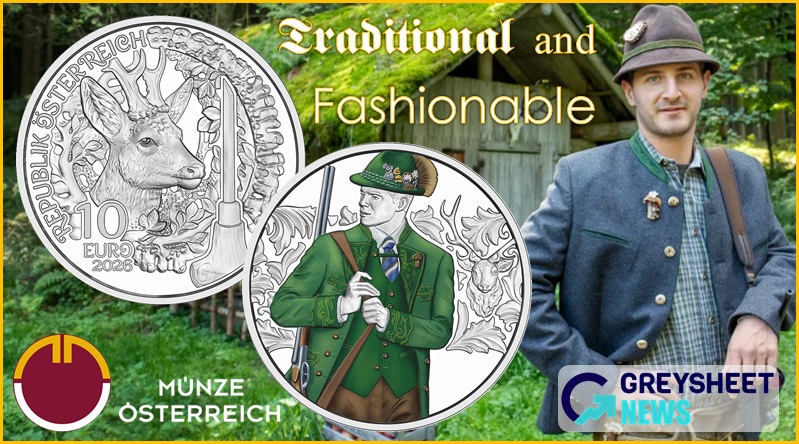
Final Silver Proof Coins in Traditional and Fashionable Series
The final coin in a series focusing on traditional Austrian costume highlights the unique buttons fashioned from stag’s horn used in attire. These accessories are one of the most primal raw materials, symbolising the close bond between humanity, nature, and craftsmanship.
Derived from natural raw materials, the horn is transformed, thanks to the skill of artisans into refined ornaments that give folk costumes a unique character. Elk horn is a material that has held a special place in Austrian traditional costume for centuries. It is far more than just an ordinary material, but a living expression of tradition that draws on regional resources and cultural practises that brings the natural world into traditional dress. It is a material that bridges past and present while keeping alive an appreciation of sustainable and centuries old craftsmanship.
Designed by Anna Schlindner and Elena Dolgova, the obverse depicts an Austrian man wearing traditional costume along with a rifle slung over his right shoulder. His appearance is enhanced by beautifully crafted horn buttons on his deep green jacket and waistcoat, an expression of a centuries-old craft. The Proof coins highlight the jacket with deep green colour. In the background, an ornamental design inspired by traditional horn carving frames the motif. The reverse features the head of a majestic stag off-centre to the left – a symbol of Alpine wildlife and an inspiration for many traditional costume motifs. To the right are images of a tool used to carve the buttons and a pattern of the design often found on horn accessories. Along the right rim is the stylised text REPUBLIK OSTERREICH with the denomination and year of issue, 10 EURO 2026 placed just to the lower left.
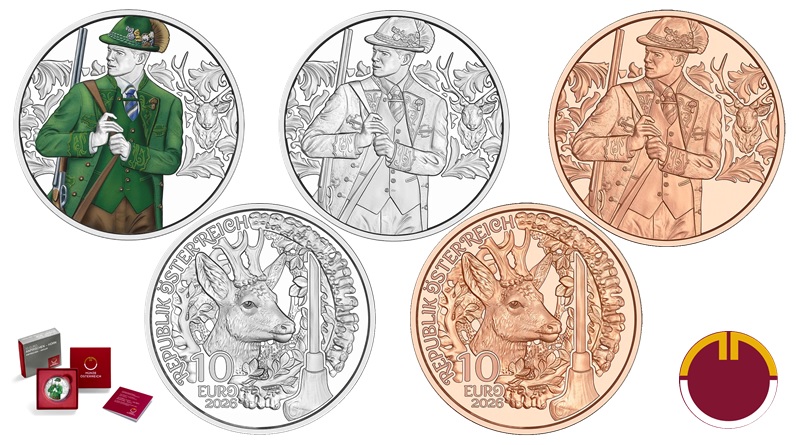
| Denomination | Metal | Weight | Diameter | Quality | Mintage limit |
| 10 Euro | copper | 15 g. | 32 mm. | UNC | 130,000 |
| 10 Euro | .925 Silver | 16.8 g. | 32 mm. | BU | 30,000 |
| 10 Euro | .925 Silver | 16.8 g | 32 mm. | Proof & Colour | 30,000 |
Each Proof coin is encapsulated and presented in a heavy gauge card case accompanied by a numbered certificate of authenticity and protective slipcase. The Special Uncirculated coins are presented in a blister pack folder with illustrations and informative text. The UNC copper coins are sold at commercial banks and the retail shop of the Austrian Mint for their face value. For additional information, visit the e-webshop of the Austrian Mint.
Germany – Staatliche Münze Berlin
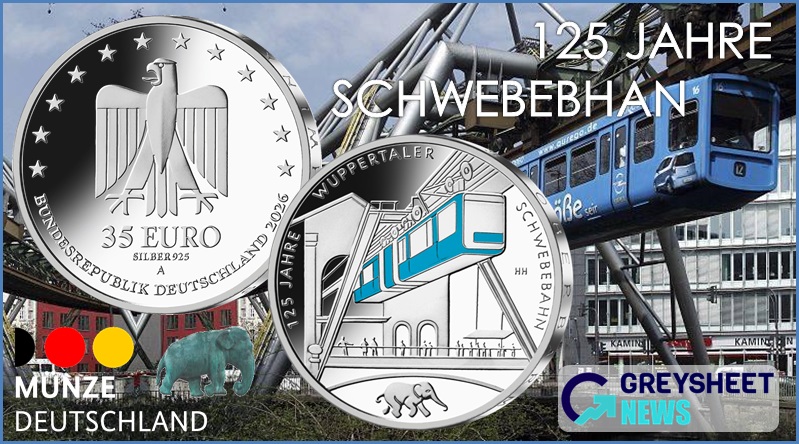
Silver and Colour Coins Mark 125th Anniversary of First Suspension Railway
New coins pay tribute to the Wuppertal Suspension Railway, considered the oldest monorail suspended railway in continuous operation worldwide. Originally built to connect the industrial towns of Barmen, Elberfeld and Vohwinkel, the system proved so vital that it indelibly bound these communities together, leading to their formal merger into the city of Wuppertal in 1929. The world's oldest electric elevated railway with hanging cars began operation on the 1st March1901.
The 1901official opening inaugurated the first commercial stretch opened to the public, followed by completion of the full 13.3 kilometres route in 1903. The structure is built on a steel framework, with the cars suspended from an upper track and electrically powered. During the Second World War, the Wuppertal Suspension Railway sustained significant damage in 1945 from Allied air raids, pausing service until it was rebuilt a year later.
Today, the Schwebebahn operates as a completely modern rapid transit line as well as a very popular tourist attraction. Its current fleet of sky-blue articulated carriages safely reaches speeds of up to 60 kilometres or 35 miles per hour gliding up to 12 meters or almost 40 feet above the traffic and river. The Wuppertal Suspension Railway remains the backbone of the city's public transport network, reliably moving over 80,000 passengers every day.
Designed by Heinz Hoyer, the obverse depicts a train departing from the Hauptbahnhof main station. The station building is positioned parallel to the background and the departing train is highlighted with the use of blue colour on the body of the carriage. Steel scaffolding in the background supports a triangular composition. In the lower segment of the coin, separated by the curved arch of a bridge is a replicated image of Tuffi the young elephant’s tributary sculpture referencing the dramatic story of the circus elephant's fall in the 1940s. Along the left, upper and right rim is the commemorative text 125 JAHRE WUPPERTALER SCHWEBEBAHN. The reverse depicts a stylised eagle, centred with the coins’ denomination 35 EURO shown below. Just under the denomination is the coin’s fineness SILBER 500 (unc) or SILBER 925 (proof) and the mintmark A denoting the Staatliche Münze in Berlin. The text BUNDESREPUBLIK DEUTSCHLAND 2026 is placed below the face value and along the lower rim and along the upper rim are twelve five-pointed stars representing the European Union. The coins include an incused inscription on the edge which reads VOHWINKEL BIS OBERBARMEN BIS (Vohwinkel to Oberbarmen to)
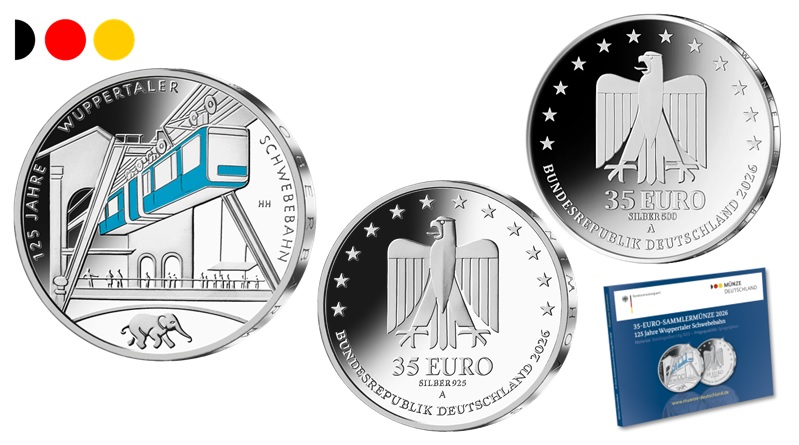
| Denomination | Metal | Weight | Diameter | Quality | Mintage Limit |
| 35 Euro | .500 Silver | 17 g. | 32.5 mm. | UNC | n/a |
| 35 Euro | .925 Silver | 18 g. | 32.5 mm. | Proof | 63,000 |
The Brilliant Uncirculated pieces are available for their face value at leading commercial banks and post office counters. The Proof-quality collector’s edition is encapsulated and presented in a folder available by visiting the e-webshop of Munze Deutschland.
Switzerland – Swissmint
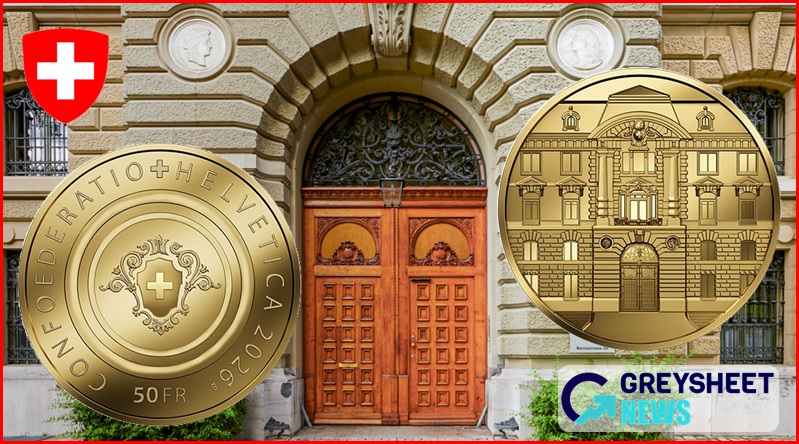
Proof Gold Coins Highlight the Swissmint’s Landmark Headquarters
The year 2026 marks the 120th anniversary since the classic federal building that houses the Swissmint building was officially commissioned and which has embodied a fusion of history, craftsmanship and Swiss coinage. Located in the Kirchenfeld district of Bern, the building was a typical example of a prestigious industrial building from the early 20th century.
Constructed between 1903 and 1906 according to approved plans by the Bernese architect Theodor Gohl (1844 – 1901), its Neo-Renaissance design was considered an exceptional addition to the city. With its light red brick structure, cornices and decorative elements in natural stone, its architecture combines the functional requirements of a purpose-built mint along with the official and imposing appearance of a classic and typical Swiss federal building.
There are many architectural highlights, including two massive coin images carved into the Saint-Triphon marble flanking the main entrance portal. These monumental relief medallions were designed by renowned Swiss sculptor Giuseppe Chiattone. His relief displays the obverse side of the historic five-franc piece featuring the allegorical head of Helvetia on the left side of the entrance. In this custom architectural adaptation, her gaze is turned to the right so she looks directly inward toward the entrance. To the right of the entryway is the relief featuring the iconic Gold Vreneli coin design.
The interior is also exceptional in design as it features a grand and richly decorated staircase winding up the curved back wall. In the centre of the staircase is a lantern with a post which is decorated with a cast-iron dragon. On the ceiling above the stairwell, Lucerne artist Emil Kniep painted a fresco depicting Helvetia, the symbolic allegorical embodiment of Switzerland, showering gold coins on a mother and a beggar. A Swiss cross adorns the mosaic floor at the foot of the cellar stairs. In the foyer, there is also a niche-shaped fountain created by Anselmo Laurenti (1845 – 1913). The arch of the curved back wall is shaped like a shell, and the water spout is in the form of an incongruous mask. The pedestal under the water basin is in the shape of three dolphins.
In May 1906, the new mint opened its doors to begin coin production. Later that same year, the entire Federal Council visited the building and thus officially took possession of it. From this time, every Swiss coin placed into circulation and specially commissioned collector coins have all been minted in this historic venue. The Swissmint facility is listed as a “Heritage Site of National Significance” by the Swiss Inventory of Cultural Property of National and Regional Significance.
The obverse of the new coins features the façade of the Swissmint in miniature and in all its architectural splendour. In the centre, the imposing entrance portal, the half-columns and pilasters of the central front section, as well as the segmental arch crowning the heraldic cartouche adorned with the Swiss cross are intricately depicted. To the left and right of the main entrance, the two renowned relief medallions by the sculptor Giuseppe Chiattone can be seen. Various matte finishes are used to suggest the different building materials of the façade. The reverse focuses on the building’s interior with the inclusion of an architectural element highlighting a coat of arms bearing the Swiss cross in its centre, the design of which is inspired by the mosaic floor at the foot of the main staircase. Around the rim of the coin is the inscription CONFOEDERATIO HELVETICA the minting year 2026 along with the mint mark B denoting the Bern Mint. The face value 50 FR is placed just under the crest.
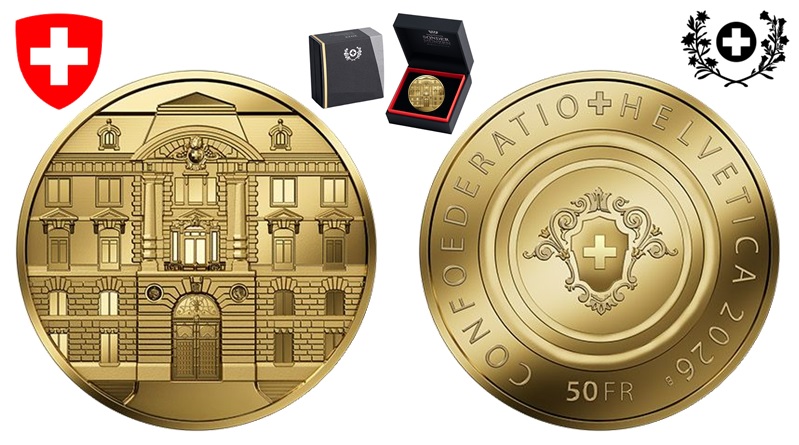
| Denomination | Metal | Weight | Diameter | Quality | Maximum Mintage |
| 50 Francs | .900 Gold | 11.29 g. | 25 mm. | Proof | 4,000 |
The Proof quality coins are encapsulated and presented in an easel-style custom case accompanied with a certificate of authenticity. For additional information, visit the e-webshop of the Swissmint’s Special Coins section.
Related Stories (powered by Greysheet News)
View all news



New coins from China, Kazakhstan, and Kirghizstan.
Please sign in or register to leave a comment.
Your identity will be restricted to first name/last initial, or a user ID you create.
Comment
Comments