




 Whitman Expo
Weekly World Mint Coinage: September 17, 2026
New coins from Australia and New Zealand.
by Michael Alexander |
Published on September 17, 2026

Download the Greysheet app for access to pricing, news, events and your subscriptions.
Subscribe to RQ: Red Book Quarterly for the industry's most respected pricing and to read more articles just like this.
Australia - Royal Australian Mint
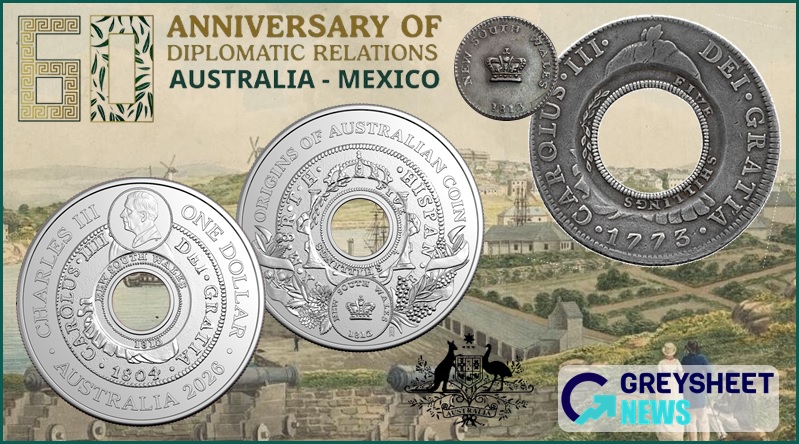
Commemorative Coins Mark Significant Diplomatic Anniversary
This year, Australia and Mexico celebrate 60 years of diplomatic relations - a partnership built on cooperation, culture and shared outlooks. However, a unique numismatic connection between these two nations began much earlier, more than 150 years ago. Spanish silver eight reales struck in colonial Mexican mints travelled vast ocean trade routes to the fledgling colony of New South Wales. Faced with a critical shortage of currency, Governor Lachlan Macquarie authorised these coins being re-purposed into Australia’s first distinctive coins – referred to as the Holey Dollar and Dump. By punching out their centres, these global coins were ingeniously recycled to serve a new economy.
The Holey Dollar became the country's first official distinct minted currency, created in 1813 which came about to solve a severe cash shortage in the colony of New South Wales. In one of history's great ironies, the man punished for counterfeiting coins became the craftsman entrusted with producing Australia's first legal tender. Working from a modest Sydney government workshop, convicted forger William Henshall spent more than a year developing the tools and techniques needed to transform thousands of Spanish silver dollars into Australian coinage at the request of the government. This clever process also produced two separate pieces from each Spanish silver dollar, namely the Holey Dollar and the Dump.
The coins officially entered circulation in 1814 but authorities began replacing them with standard British sterling coinage in 1822, and the remaining stock was melted down by 1829. Today, these rare historical numismatic artefacts are extremely valuable to collectors, with only about 300 Holey Dollars and roughly 1,000 Dumps known to still survive. This remarkable story of adaptation and exchange also highlights an enduring link between Australia and Mexico - one forged not only through diplomacy, but through shared history, resourcefulness and the enduring legacy of Australia’s coin origins.
It was in March 1966 that official diplomatic relations were inaugurated between the two countries. Prior to this date, diplomatic relations between Mexico and Australia were conducted via London as Australia was part of the British Empire.
For 2026, Australia focuses on the historic ‘Holey Dollar’ design that celebrates a little-known link between the origins of Australia’s iconic Holey Dollar and Dump coins and a significant contemporary diplomatic anniversary between two countries in the new world. Designed by Elyssa Waterford, the coin’s concept replicates elements of the 1804/1813 Holey Dollar currently held in the National Coin Collection. On the reverse side is a stylised bouquet of ribbons, flowers and leaves that frame the Holey Dollar and feature the coin’s original decorative elements. The flowers depicted are national flowers - dahlias for Mexico and wattle for Australia. Below the centred hole and superimposed over the lower part of the wreath is the obverse side image of a replicated dump coin which includes a crown and the legend NEW SOUTH WALES and the year 1813. Above the primary design along the upper rim is the text ORIGINS OF AUSTRALIAN COIN. The obverse depicts a portion of the obverse of the Spanish eight reales coin along with a modern dump punch-out with the Commonwealth effigy of HM King Charles III created by Dan Thorne placed above the centred hole. Above the primary design along the upper rim is the legend CHARLES III ONE DOLLAR with the additional text AUSTRALIA 2026 placed along the lower rim.
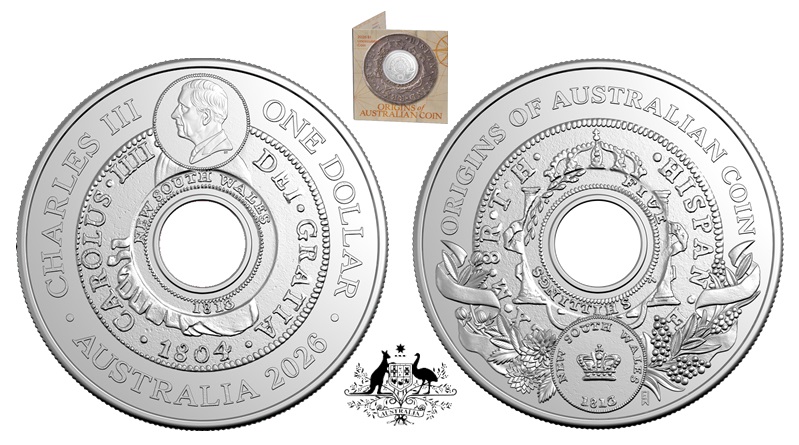
| Denomination | Metal | Weight | Diameter | Quality | Maximum Mintage |
| 1 Dollar | Copper-nickel | 12.58 g. | 30 mm. | BU | 35,000 |
Each BU coin is encapsulated and included in a presentation folder with illustrations and text detailing the history of the Holey Dollar and Dump coin. For additional information, visit the e-webshop of the Royal Australian Mint.
New Zealand - New Zealand Post
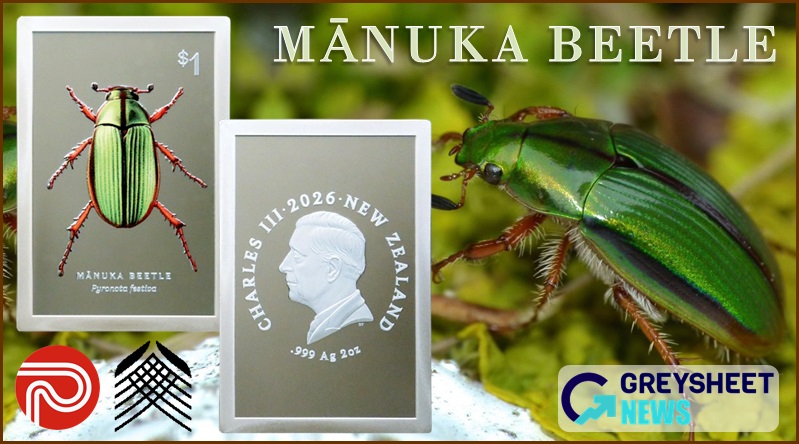
Final Coin Offered by New Zealand Post Features Indigenous Beetle Species
The story ends here - the final coin issue offered from New Zealand Post. As the last new coin design, this milestone piece represents the conclusion of NZ Post's long-standing role as the official distributor of New Zealand commemorative coins.
For the last 25 years, New Zealand Post, on behalf of the Reserve Bank of New Zealand helped to celebrate the country’s stories, culture, history and heritage. This exceptional rectangular coin celebrates a special example of New Zealand's unique native fauna, which has been a fixture of the coin programme.
New Zealand is known to be home to more than 5,000 beetle species. The mānuka beetle (Pyronota festiva), known by the Māori people as kerewai, is an endemic scarab beetle and closely related to other beetles in the Scarabaeidae family found in other parts of the world. Common and widespread across New Zealand, there is no compelling evidence to suggest they found elsewhere in the world.
The Māori once used these insects in traditional medicines to reduce fevers and stomach aches. The mānuka beetle came to the attention of the Victorians who were instantly attached to their bright metallic and iridescent green colour which they included in various pieces of jewellery. Curiously, these beetles were first seen in London from the middle of the 19th century as they were found in raw sheep's wool imported from New Zealand.
The rectangular silver Proof and colour coins are produced by the BH Mayer’s Kunstprägeanstalt (Mint) GmbH at their facilities in Baden-Württemberg on behalf of the Reserve Bank. Designed by the Fuller Design Firm of Wellington, New Zealand, the reverse features the image of a high-relief mānuka beetle finished with iridescent colour applied to the surface. The mirrored proof background complements the realistic, life-size rendering of the beetle. The coin’s denomination $1 is shown near the upper right corner. Below the primary design is the text MĀNUKA BEETLE along with its scientific name Pyronota Festiva. The obverse depicts the Commonwealth effigy of King Charles III created by engraver Dan Thorne along with the legend CHARLES III · 2026 · NEW ZEALAND. Below the King’s likeness are the coin’s specifications .999 Ag 2 oz.
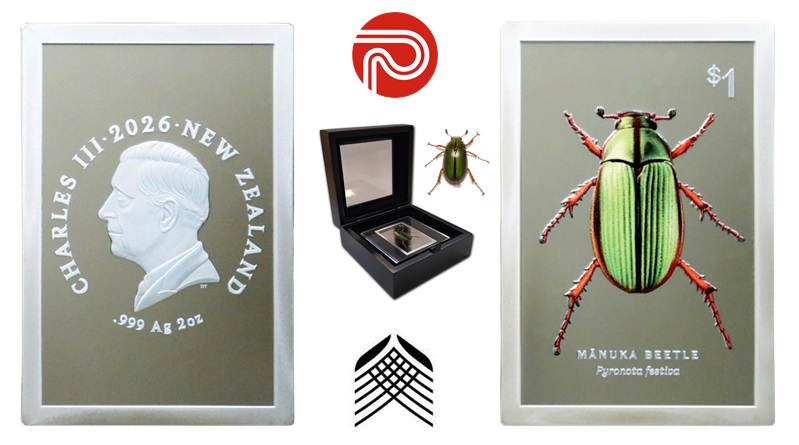
| Denomination | Metal | Weight | Dimensions | Quality | Maximum Mintage |
| 1 Dollar | .999 Silver | 62.2 g. | 38 / 55 mm. | Proof & Colour | 400 |
Each Proof coin is specially encapsulated to accommodate its rectangular shape and presented in a custom case with transparent top cover to allow display and viewing while the case is closed. The coin is also accompanied by a certificate of authenticity. For additional information, visit the e-webshop of New Zealand Post* – official distributors.
*Please Note – New Zealand Post announced earlier this year their numismatic department will be closing and will no longer retail collector coins issued by the Reserve Bank. The numismatic department will continue to fulfil orders, process final 2026 coin programmes and clear remaining stock through to November 2026.
Australia – Perth Mint
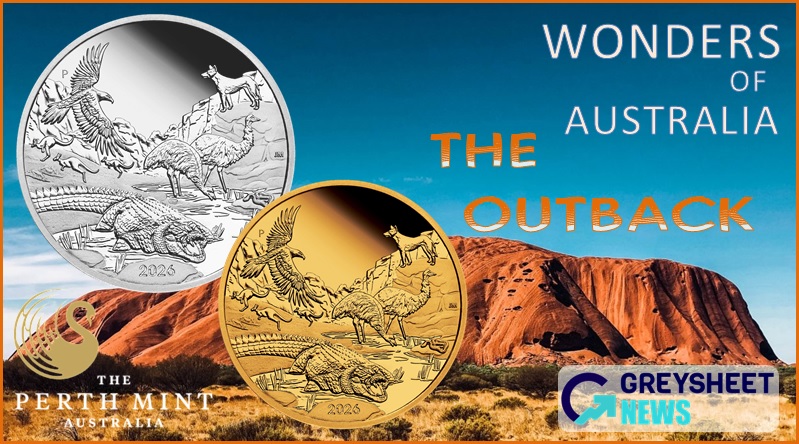
Gold and Silver Bullion Coins Launch Wonders of Australia Series
The inaugural release in a highly anticipated new bullion series focuses on a fascinating regional area in the Land Down Under. Australia's vast and rugged Outback is a land of awe-inspiring natural beauty, steeped in rich history and cultural significance. Australia is home to between 600,000 and 700,000 species of wildlife, many of which are found only in Australia, making the Australian outback one of the world's most precious natural treasures.
One fascinating feature of the Outback is the world’s longest continuous fence constructed to protect sheep flocks in southern Australia from wild dingoes. Construction began on an enormous pest-exclusion fence in the late 1880’s and now stretches over 5,614 kilometres or, 3,488 miles in length. This fence is longer than the entire border between the United States and Mexico, and parts of it require daily maintenance patrols to repair damage from wild camels and kangaroos.
If the heat in the outback gets too much during the summer, there is an underground town which offers the very best in subterranean living. The town of Coober Pedy is located in the harsh South Australian desert, and is known as the "opal capital of the world." With summer temperatures regularly soaring past 45°C or, 113°F, more than half of the town's population live underground in caves bored into the hillsides. These "dugouts" maintain a comfortable year-round temperature of 23°C or 76°F. The town even features underground churches, hotels, and a subterranean bookstore.
Australian wildlife design is showcased that features a dynamic scene from the Outback. Designed by Jennifer McKenna, the reverse depicts clockwise from the right - a dingo standing on a rocky perch and two emus positioned in the riverbed, one pausing to drink at the water’s edge. A frilled lizard, famous for the large, colourful skin fold around its neck, is taking the sun on a nearby rock, while a crocodile emerges from the water. Three kangaroos are depicted bounding across the terrain and a wedge-tailed eagle soars in flight above. The background features a rugged mountainous landscape extending across the horizon. The design includes the Perth Mint’s P mintmark seen near the upper left rim and the year of issue, 2026 is just under the primary design. The obverse includes the Commonwealth effigy of King Charles III created by Dan Thorne. Above the portrait is the legend CHARLES III AUSTRALIA while the coin’s specifications 1 oz 9999 Au 100 DOLLARS (gold) or 1 oz 9999 Ag 1 Dollar (silver) is placed below. The primary design is surrounded with illustrations of native Australian flora.
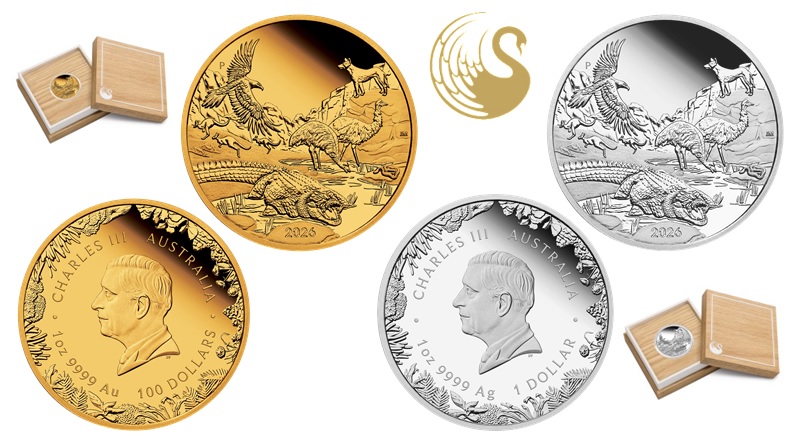
| Denomination | Metal | Weight | Diameter | Quality | Maximum Mintage |
| 1 Dollar | 99.99 Silver | 31.1 g. | 40.9 mm. | Proof | 5,000 |
| 100 Dollars | 99.99 Gold | 31.1 g. | 32.6 mm. | Proof | 200 |
Each gold and silver bullion Proof quality coin is encapsulated and presented in a FSC-accredited timber veneer custom crafted display case and illustrated outer protective box accompanied by a numbered certificate of authenticity. For additional information, visit the e-webshop of the Perth Mint – Australia.
Related Stories (powered by Greysheet News)
View all news

New coins from China, Kazakhstan, and Kirghizstan.
New coins from the Netherlands, South Africa, and Vatican City.
Please sign in or register to leave a comment.
Your identity will be restricted to first name/last initial, or a user ID you create.
Comment
Comments