




 Whitman Expo
Weekly World Mint Coinage: October 1, 2026
New coins from Poland, Romania, and Ukraine.
by Michael Alexander |
Published on October 1, 2026

Download the Greysheet app for access to pricing, news, events and your subscriptions.
Subscribe to RQ: Red Book Quarterly for the industry's most respected pricing and to read more articles just like this.
Poland – Mint of Poland
Silver Proof Coins Honour National Heroine and Sports Legend Halina Konopacka
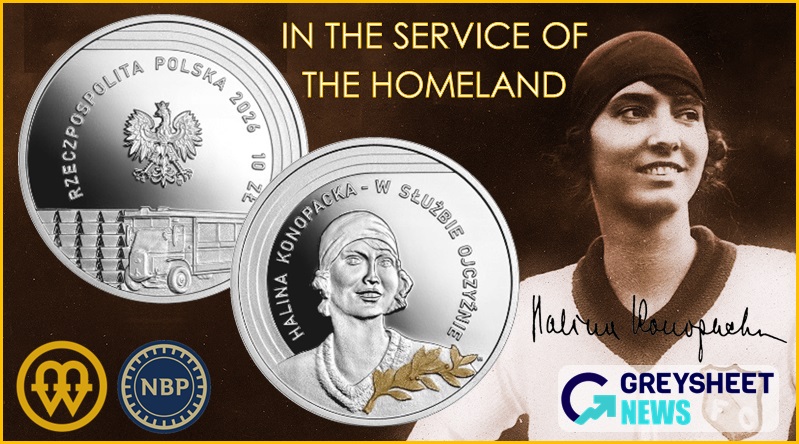
Halina Konopacka exemplifies the heroism of women, serving as a reminder that courage is an inseparable part in both sport and life’s most defining moments. During her lifetime, her sporting achievements and patriotism made her one of the most recognisable figures in Polish sport in the 20th century. Konopacka became the first Polish Olympic champion, winning the gold medal in the discus throw at the 1928 Amsterdam Olympics. She is also well remembered for her part in heroically protecting Polish gold reserves during the Second World War.
Her nickname of ‘double golden woman’ came from her Olympic achievement and her heroic action at the start of World War II. Shortly after her return from the Summer Olympiad, she married Ignacy Matuszewski, a rising politician who was also the Minister of the Treasury in Prime Minister Piłsudski's government from 1929 to 1931.
Their lives changed considerably following Poland’s invasion by the Third Reich in September 1939. Matuszewski, together with the Polish parliamentary deputy planned the removal of the reserves out of the country. Konopacka accompanied her husband in transporting the gold driving one of the trucks in this valuable convoy. Unfortunately, one of Konopacka’s most treasured personal items and invaluable memento – her gold Olympic medal was forever lost in the commotion that accompanied the couple’s own evacuation.
Halina Konopacka and her husband survived the war, and in 1941 they both took up permanent residence in the United States. Sadly, Ignacy Matuszewski died suddenly in New York City on the 3rd August 1946, at the age of 54. Konopacka would eventually remarry and moved to Florida, passing away in January 1989 at the age of 88.
The silver Proof coins are produced by the Mint of Poland at their facilities in Warsaw on behalf of the National Bank and designed Dominika Karpińska-Kopiec. The obverse of the coin features an image of Halina Konopacka off-centre to the left and which is replicated from a photograph taken during her attendance at the Olympic Games. To the lower right superimposed over the portrait is a golden laurel branch which is selectively plated in gold symbolising her sporting victory and along the left and top rim is a fragment of an Olympic stadium track. Surrounding Konopacka’s portrait is the inscription HALINA KONOPACKA – W SŁUŻBIE OJCZYŹNIE (Halina Konopacka – In the Service of the Homeland). The reverse depicts relevant reference to the evacuation of the gold in September 1939 with images of bars of gold and a public transport bus from the period placed near the lower half. Centred is the image of the crowned eagle established as the state emblem of the Republic of Poland. Below the Eagle on the right is the MW mintmark denoting the Mint of Poland. Surrounding the Eagle is the inscription RZECZPOSPOLITA POLSKA 2026 10 ZŁ. Along the right and top rim is a fragment of an Olympic stadium track which is in opposite direction from the obverse side.
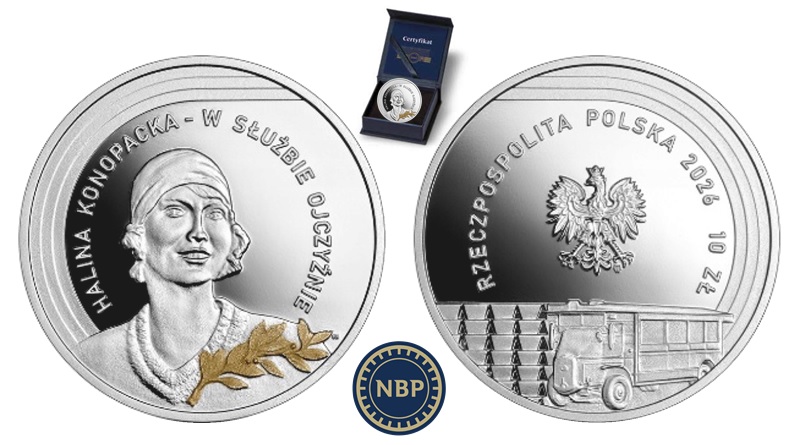
| Denomination | Metal | Weight | Diameter | Quality | Mintage Limit |
| 10 Zlotych | .999 Silver | 14.1 g. | 32 mm. | Proof | 8,000 |
Each silver Proof quality coin is encapsulated and presented in a heavy-gauge lined card case, accompanied with a certificate of authenticity. For additional information, visit the e-webshop of the National Bank of Poland.
Romania – Romanian State Mint
Rectangular Silver Proof and Colour Coin LaunchesRomanian Painters Series
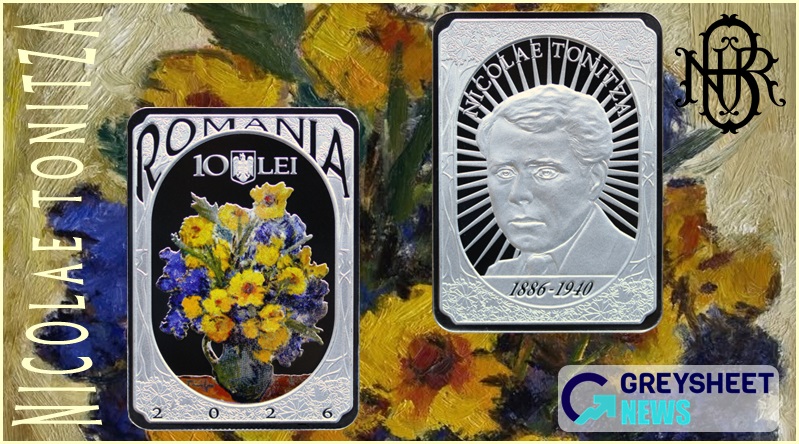
The National Bank of Romania immortalises the historic artwork Yellow Flowers and the artist Nicolae Tonitza (1886 – 1940) with the release of their first-ever rectangular, silver Proof and colour coin. Tonitza was a pioneering Romanian painter, engraver, lithographer, journalist and art critic who played a monumental role in introducing European modernist guidelines to local art.
Born in 1886 in Bârlad, Romania, he studied at the Iași National School of Fine Arts in Iași and the Royal Academy of Fine Arts in Munich. After his return to his homeland, Tonitza applied his talents to painting frescos in several churches in Moldavia and worked as an art teacher as well as an editor of Iașul newspaper. In 1916, Tonitza was drafted into the Army and fought with the 84th Infantry Regiment at the Battle of Turtucaia. Wounded, he fell prisoner to the Bulgarians and was sent to an internment camp in Kardzhali. Haunted by poverty, illness, and his own experiences of the devastation of the First World War, Tonitza used his art and journalistic illustrations to reflect on social issues and human fragility. His work Yellow Flowers was a prominent fixture of the National Bank of Romania's private art collection before becoming part of the National History Museum of Romania, located in the historic centre of Bucharest.
The silver Proof and colour coins are produced by the Monetăria Statului, Romanian State Mint at their facilities in Bucharest on behalf of the National Bank. The obverse includes a tribute to the artist himself with an engraved three-quarter facing portrait of Nicolae Tonitza set within a rounded rectangle and with the depiction of sunburst rays in the background. The portrait is replicated from a black and white photograph of a young Tonitza capturing his distinct hair part, formal collar, tie and deep, intense gaze. The photo was taken during his formative student years between 1902 and 1910. Along the inner border of the rounded rectangle and above the portrait is the text NICOLA TONITZA along with the years 1886 - 1940 placed below Tonitza’s likeness. The reverse beautifully reproduces a vivid colour image of Yellow Flowers painted around 1920 and set within a rounded rectangle. The original work measures 40 / 50 centremetres (15 / 20 inches) on cardboard and depicts a dense bouquet of glowing yellow flowers arranged in a dark container, juxtaposed against a heavily textured, dark background that accentuates the pure luminosity of the petals. The edge of the coin is styled specifically to replicate an intricately carved wood frame. Above the primary design is the stylised art-deco text ROMANIA with the denomination 10 LEI along with the Romanian crest.
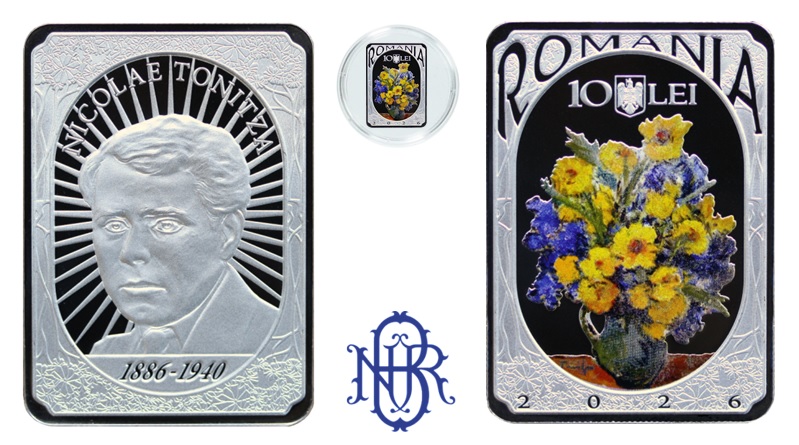
| Denomination | Metal | Weight | Dimensions | Quality | Mintage Limit |
| 10 Lei | .999 Silver | 31.1 g. | 43 / 31 mm. | Proof & Colour | 500 |
Each coin is specially encapsulated to accommodate its rectangular shape and is accompanied by a certificate of authenticity containing the signatures of the NBR governor and the central cashier. They are available directly through regional branches of the National Bank of Romania. For additional information, visit the numismatic section of the National Bank’s website.
Ukraine – Mint of Ukraine
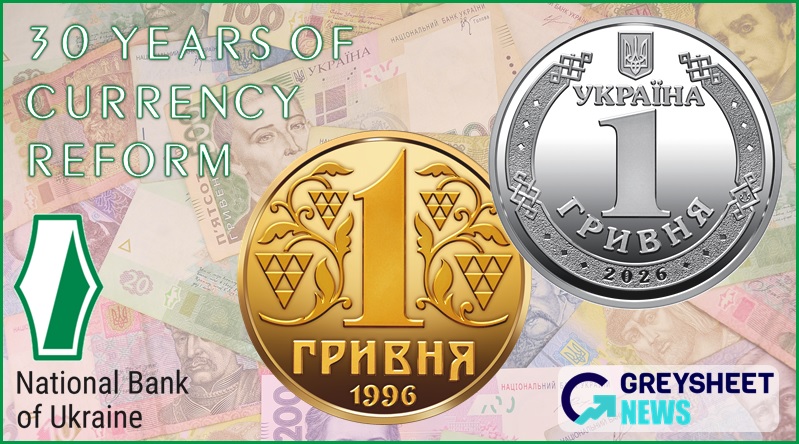
Silver and Gold-Plated Coins Mark 30 Years of National Currency Reform
Following Ukraine’s status as an independent state in 1991, nation building was paramount for Europe’s second-largest country in terms of landmass. However, its economic and financial situation was dire and in need of significant reform.
The establishment of the National Bank of Ukraine in 1991 was carried over from the Ukrainian branch of the Soviet Gosbank where they took on central banking functions. An economic collapse in 1993 was driven by a destructive mix of a dependent central bank, massive state subsidies still in place, and the chaotic breakdown of the Soviet-model economic climate. On the 25th August 1996, President Kuchma signed the decree ‘On Monetary Reform in Ukraine’, which formally established the new hryvnia, subdivided it into 100 kopiyok as sole legal tender. The reforms were indeed successful in restoring confidence in the Ukrainian economy and reducing inflationary pressures with the rate dropping to 40% by the end of 1996 and further to 10% by 1997. Despite the damage to Ukraine's economy as an effect of the 1998 Russian financial crisis, declines in real GDP decreased year on year going into 1999.
The collector coins are produced by the Mint of Ukraine at their facilities in Kyiv on behalf of the National Bank and designed by Volodymyr Demyanenko (reverse) and Vasyl Lopata (obverse). The obverse recreates the design of the 2018 1 gryvnia circulation coin originally created by Vasyl Lopata and featuring the numeral 1 centred and decorated on each side with a pattern of stylised branches and geometric shapes. The text ГРИВНЯ (Gryvnia) is placed just under the numeral and below is the year 1996, that of Ukraine’s monetary reform. The obverse is gold-plated to enhance the brass colour of the original coins. The reverse replicates the 1 Grivnia coin introduced into circulation in 2018 featuring the numeral 1 surrounded with a Slavic-style ornament and the national crest placed above the numeral. The text УКРАЇНА (Ukraine) is shown just below the crest and the additional text ГРИВНЯ (Grivnia) is placed below the numeral along with the year of issue, 2026.
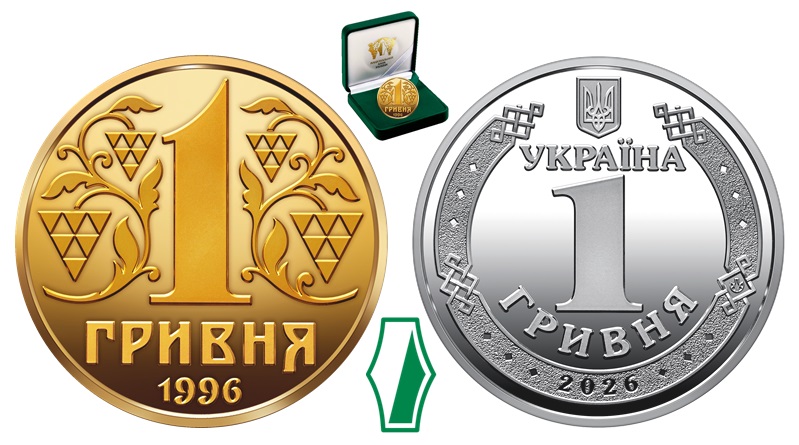
| Denomination | Metal | Weight | Diameter | Quality | Mintage Limit |
| 1 Grivnia | .925 Silver | 31.1 g. | 38.6 mm. | Proof & Plating | 5,000 |
Each silver Proof quality coin is encapsulated and presented in a custom case, accompanied by a certificate of authenticity. For additional information, please visit the e-webshop of the National Bank of Ukraine.
Related Stories (powered by Greysheet News)
View all news
New coins from Austria, Germany, and Switzerland.


Please sign in or register to leave a comment.
Your identity will be restricted to first name/last initial, or a user ID you create.
Comment
Comments