



 Whitman Expo


His free weekly newsletter offers insights on the coin and metals markets, and consumer education.
Image Coming Soon
We're working on adding images for this item.
Thank you to our sponsors!
Go check them out!










This prototype is one of the rarest of all silver dollars struck since 1794, and it has been poetically described as the "birth certificate of America's last silver dollar". Only three prototypes in total are known since being struck 50 years ago. Two of the three originate from this prototype's die pair, with a third struck from a different obverse prototype die. It is also one of the three earliest-known of all Eisenhower dollars, and bears a prototype design featuring an unfinished moon.
The three known prototypes are lacking from the Smithsonian's National Numismatic Collection, the United States Mint collection, all of the Federal Reserve museum collections, and the collections of the American Numismatic Association and American Numismatic Society.
Pattern vs. Prototype
For centuries, no working prototype of any American coin destined for circulation in its actual metal of issue was known in private hands. That all changed when the three Eisenhower dollar prototypes first appeared via this discovery coin in 2008, followed by the second in 2010, and a final example in 2013. Unfortunately, the terms "pattern" and "prototype" are often used interchangeably and inappropriately. What, then, is a "pattern" coin, and how does it differ from a "prototype"?
A pattern coin is generally thought to be a concept coin, struck to evaluate a purely conceptual design never officially approved for circulation. Likewise, many pattern coins were struck in unrelated metals to that of any approved and issued coin series. Often they are nothing more than fantasy pieces, deliberately struck for sale or trade to collectors by mint officials. A vast number of pattern coins remain in collector hands, and many were actually traded by the Mint to collectors in exchange for items that it wanted. A famous example of this would be the fabulous 1877 Half Union gold patterns, traded by William Woodin to the Mint for, ironically, vast quantities of pattern coins. Pattern coins are specifically identified as patterns by their Judd catalog numbers, drawn from the Judd pattern reference. An excellent website we often recommend for studying pattern coins is uspatterns.com.
Prototypes, by contrast, are coins produced within the Mint for the chief engraver's actual day-to-day working use (hence, our term "working prototype"). They are a tool to perfect an officially approved coin design for circulation. There is nothing fanciful with a prototype as with most patterns; rather, prototypes are among the tools required to evolve a circulating coin from inception to production. One would also expect a true working prototype to be struck in its proper metal of issue. As, in turn, are the three known 1971-S Eisenhower dollar prototypes on their 40% silver planchets.
Lee C. Lydston Discovers the First Prototype
On February 15, 2008, Eisenhower dollar expert collector Lee C. Lydston and his wife attended the "Long Beach" coin show. While there, Lee's wife called his attention to a dealer's table with tubes of Eisenhower dollars, of which one particular tube was found by Lee to contain a single 40% silver 1971-S Eisenhower dollar bearing an unusual appearance. Remarkably, it had hybrid characteristics of both the silver uncirculated and the silver proof Eisenhower dollars sold to collectors by the United States mint in 1971. The coin also exhibited the usual surface hazing imparted to Blue Pack uncirculated silver Eisenhower dollars, due to their long-term exposure to the mint's pliofilm packaging. Lydston then chose to submit his discovery to the Eisenhower dollar experts at the respected Ike Group for their analysis.
The Ike Group was founded by noted Eisenhower dollar expert and researcher Rob Ezerman, and its evaluation included comparison of an original 1970 Galvano at the Eisenhower Museum. The Ike Group, in turn, was responsible for its discovery there.
Obverse Description
Same as regular 1971 Eisenhower dollar.
Reverse Description
Same as regular 1971 Eisenhower dollar. A flying eagle, clutching olive branches, appears to be landing on the cratered moon, with the earth seen in the background. 13 stars surround the design with the words UNITED STATES OF AMERICA and ONE DOLLAR framing the periphery.
Source: Heritage Auctions
Catalog Information
GSID:
395650
Designer:
Frank Gasparo
Obverse Designer:
Frank Gasparro
Obverse Lettering:
IN GOD WE TRUST, LIBERTY, 1971, S
Reverse Designer:
Frank Gasparo
Reverse Lettering:
UNITED STATES OF AMERICA, ONE DOLLAR, E PLURIBUS UNUM
Fineness:
0.4
Weight (gr):
24.59 gr
Weight (oz):
0.8674 oz
Precious Metal Weight:
0.3161 oz
Strike Type:
Special Strike
Diameter:
38.1
Coin Shape:
Round
Edge:
Reeded
Variety:
Eisenhower
Variety 2:
J-2151
Coin Date:
1971-S
Denomination:
$1
Designation:
SP
Mint Location:
San Francisco
Mint Mark:
S
Mintage:
3 known
Coinage Type:
Prototype
Coinage Years:
1971
Composition:
40% Silver, 60% Copper
Rarity:
H7
Send Catalog Feedback
To: editor@greysheet.com
Subject: I would like to contribute catalog info to CDN for 1971-S $1 Eisenhower, J-2151 SP
Body: Referring page: http://livetest.greysheet.com/prices/item/1971-s-judd-2147-prototype-eisenhower-dollar-silver/gsid/395650 GSID: 395650 Title: 1971-S $1 Eisenhower, J-2151 SP
Subscribe to View
View more data, info, and visualizations. Get access to retail and wholesale pricing as well as auction data.
Pricing Data Not Yet Available
We are constantly adding to our pricing database and prioritize user requests. Click below to request pricing for this item.
Request PricingGreysheet News
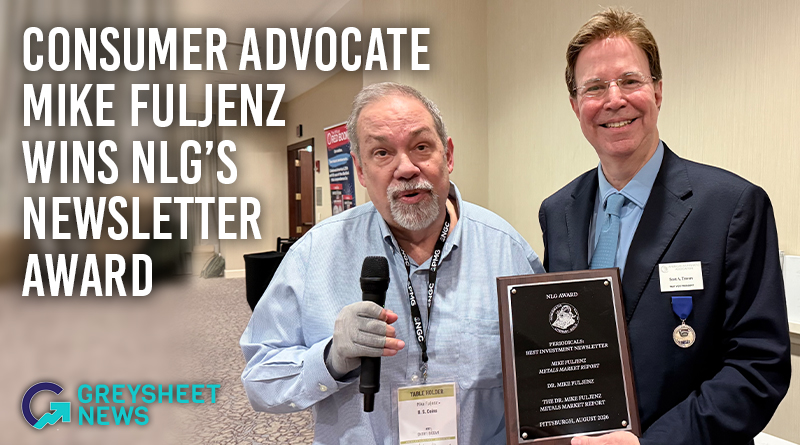
Consumer Advocate Mike Fuljenz Wins NLG's Newsletter Award
9/15/2026
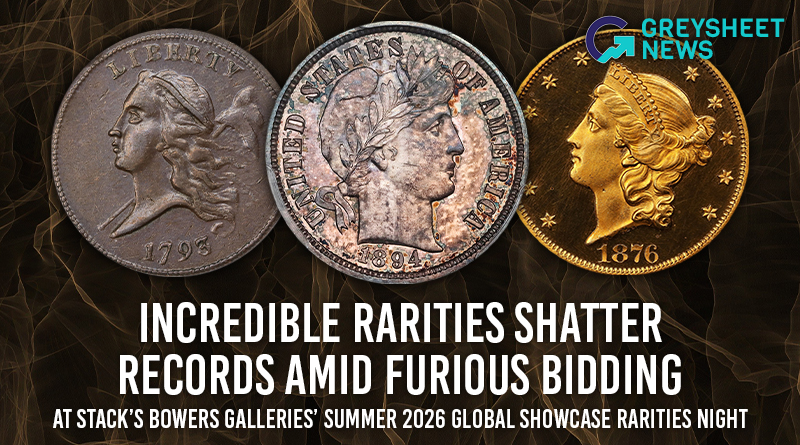
Incredible Rarities Shatter Records Amid Furious Bidding at Stack's Bowers Galleries' Summer 2026 Global Showcase Rarities Night Session
Stack's Bowers Galleries, one of the world's largest and most prestigious rare coin auction houses, is proud to announce record breaking results from the Rarities Night session of its annual Summer Global Showcase Auction.
9/15/2026

Five U.S. Coins Bring 7 Figures in $67 Million+ Heritage ANA Auctions
Scandinavian gold rarities also command exceptional results.
9/11/2026
Events
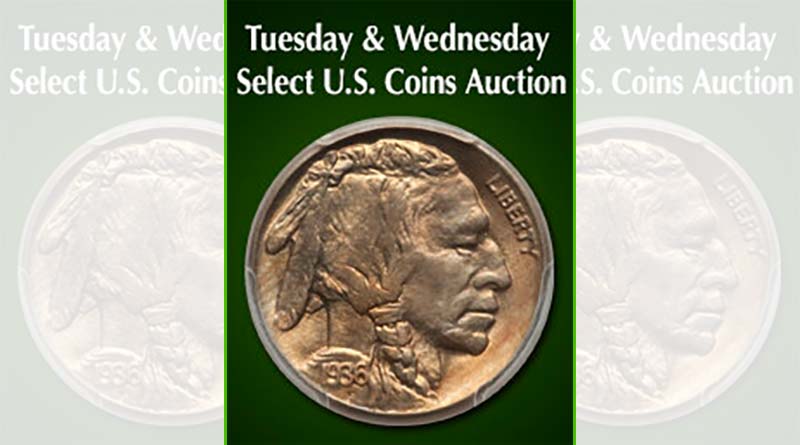
Heritage Auctions: US Coins Tuesday & Wednesday Select Auction
Location: Heritage Auctions
Wednesday, July 1, 2026
Heritage Auctions: World & Ancient Coins Wednesday & Thursday Select Auction
Location: Heritage Auctions
Thursday, July 2, 2026