




 Whitman Expo
Weekly World Mint Coinage: August 6, 2026
New coins from France, Germany, and Italy.
by Michael Alexander |
Published on August 6, 2026


Download the Greysheet app for access to pricing, news, events and your subscriptions.
Subscribe to RQ: Red Book Quarterly for the industry's most respected pricing and to read more articles just like this.
France - Monnaie de Paris
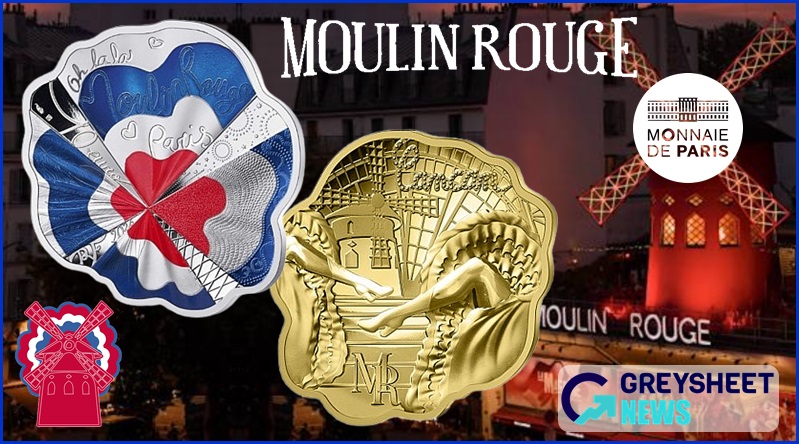
Uniquely Shaped Gold and Silver Coins Features Moulin Rouge
The Monnaie de Paris has created an extraordinary tribute to the Moulin Rouge, one of the most famous cabarets in the world. Located in Paris at the foot of Montmartre, it is recognisable by its iconic red windmill. Founded in 1889 by Joseph Oller and Charles Zidler during the Paris Universal Exposition, it quickly became a cornerstone of Parisian nightlife, blending revelry, music, dance and entertainment from its very opening. It is best known for popularizing the French Can-can, an energetic and daring dance that became a symbol of the freedom and festive spirit of the Belle Époque era.
From the early evening, the backstage area of the Moulin Rouge comes alive as the artists prepare for the show. The dancers, after numerous rehearsals, bring to life on stage a unique style combining discipline, energy and the Moulin Rouge tradition. Within the Moulin Rouge Creation Workshop, the seamstresses and tailors design new, richly embellished costumes for each show, combining original fabrics, pearls and rhinestones. In collaboration with the other workshops, they guarantee high-quality costumes that are truly spectacular, eye-appealing and comfortable for the performers. Since 1957, their unique expertise has enhanced the costumes of the Moulin Rouge dancers, combining elegance, delicacy and durability. Shoes are taken very seriously. Founded in 1945, the Maison Clairvoy is a shoemaking workshop specialising in the performing arts, creating bespoke shoes for artists. The artisans handcraft shoes that combine quality, durability and comfort - notably for the famous French Can-can boot used by dancers at the Moulin Rouge, they are designed to protect dancers and add showmanship during their performances.
Today, the cabaret is sold out every night, with two shows presented daily, every day of the year. A visit to Paris must include a visit to the Moulin Rouge, the world’s greatest and most unforgettable Cabaret Revue.
Designed by senior Monnaie de Paris engraver Joaquin Jimenez, the collection features both uniquely shaped gold and silver coins inspired by the skirts of the French Can-can, and traditional round pieces. The obverse features two French Can-can dancers captured in dynamic motion. In the background is the legendary Moulin Rouge with its recognisable windmill, as well as the backdrop of the French Can-can tableau depicting part of the Eiffel Tower. The initials stylised and intertwined initials MR for the Moulin Rouge are placed near the lower rim. The reverse features four portions of design in recognition of the famous four wings of the Moulin Rouge’s iconic landmark windmill. Each section of the design references a different craft of costume, feather-work, embroidery, shoemaking, and dance. The stylised lettering Oh la la and Moulin Rouge Paris is superimposed over the top half of the coin. In a diagonal direction between the feathered quarter and silk fabric is the denomination 200 or 20 euro (gold) and 20 or 10 euro (silver) In another diagonal direction between the feathered quarter and lower silk quarter are the initials RF referencing Republique Francaise along with the year of issue, 2026. The €10 silver proof includes vivid blue and red colouring in reference to both the French flag and the French Can-can skirt.
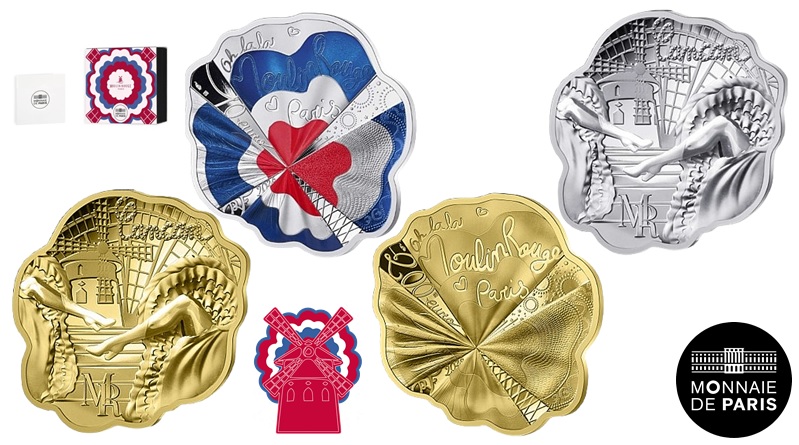
| Denomination | Metal | Weight | Diameter | Quality | Mintage Limit |
| 20 Euro | .999 Silver | 31.1 gr. | 37 mm. | HR Proof | 5,000 |
| 20 Euro | .999 Gold | 3.11 g. | 15 mm. | Proof | 1,000 |
| Denomination | Metal | Weight | Dimensions | Quality | Mintage Limit |
| 10 Euro | .999 Silver | 3.11 g. | 38 / 36.73 mm. | Proof & Colour | 5,000 |
| 200 Euro | .999 Gold | 31.1 g. | 38 / 36.73 mm. | Proof | 250 |
Each coin in the Moulin Rouge collector range is encapsulated to accommodate its unique shape and presented in a custom case accompanied with a certificate of authenticity. For additional information, visit the e-webshop of the Monnaie de Paris.
Germany – Bavarian State Mint
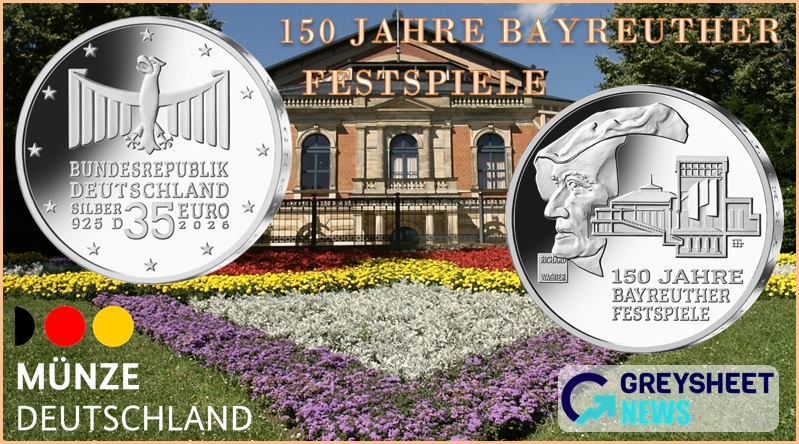
The Renowned Bayreuth Festival Shown on New €35 Silver Coins
The Federal Ministry of Finance and Munze Deutschland offer new coins in tribute to a renowned music theatre festival and its great significance to the world of classical music and opera. Since its inaugural opening in 1876, the Bayreuth Festival has been a central component of German and international cultural history.
Following the steep increase of silver bullion towards the end of last year, the Federal Ministry of Finance made the decision to raise the face value of these commemorative coins from €20 to €35 and also reduce the fineness of the uncirculated quality silver coins from .925 to .500. The Proof versions remain at .925 as they are sold to collectors at a premium above their face value. The new Bayreuth Festival silver coins are the first to be produced and released with these new standards.
Held since 1876 on the Green Hill in the purpose-built Festspielhaus or, Festival Hall, the idea was conceived by Richard Wagner as a venue for a unique artistic tradition where music, drama and stage design. The composer pursued the vision of a dedicated festival venue where his music dramas could be performed under ideal conditions – free from the constraints of the grand opera houses of his time. Financing this project proved to be initially difficult and it was only with the support of King Ludwig II of Bavaria was Wagner’s vision finally completed.
After Wagner's death in 1883, Cosima Wagner took over the directorship and under her leadership, Bayreuth developed into a focal point for Wagnerian musical influence and scholarship. The festival has remained a culturally significant to many Germans for 150 years that still attracts an international audience, retaining the title as one of the most prestigious operatic events in the world.
Designed by Ulrich Böhme of Stuttgart, the obverse depicts as the central image a portrait of Richard Wagner facing to the left in a slight three-quarter view off-centre and wearing a velvet beret, combined with a cross-section of the Festspielhaus on the Green Hill in Bayreuth. The design of the Festspielhaus includes a high level of detail that concentrates on the architectural cross-section of the entire building, including the auditorium, stage tower, orchestra pit, and backstage area. The text placed to the lower right reads 150 JAHRE BAYREUTHER FESTSPIELE.The reverse depicts a stylised eagle which is centred and positioned towards the top half. Below, the text BUNDESREPUBLIK DEUTSCHLAND along with the denomination 35 with the additional text SILBER 925 D (Proof) or, SILBER 500 D (unc) the mintmark denoting the Bavarian State Mint in Munich. To the right of the numeric denomination is the text EURO and the year of issue, 2026. Both versions of the coin include an incused lettering inscription along the smooth edge which reads WAGNER BEGINNT, WENN BAYREUTH SPIELT ♪ (Wagner begins when Bayreuth plays)
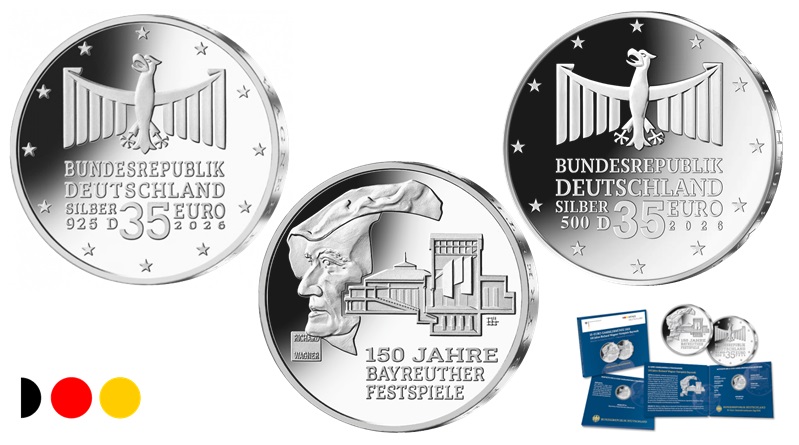
| Denomination | Metal | Weight | Diameter | Quality | Mintage Limit |
| 35 Euro | .500 Silver | 17 g. | 32.5 mm. | UNC | 600,000 |
| 35 Euro | .925 Silver | 18 g. | 32.5 mm. | Proof | 63,000 |
The Uncirculated coins are available for their face value. The proof-quality collector’s edition is encapsulated and included in a standard presentation folder. For additional information, please visit the e-webshop of Munze Deutschland, official distributors.
Italy - IPZS
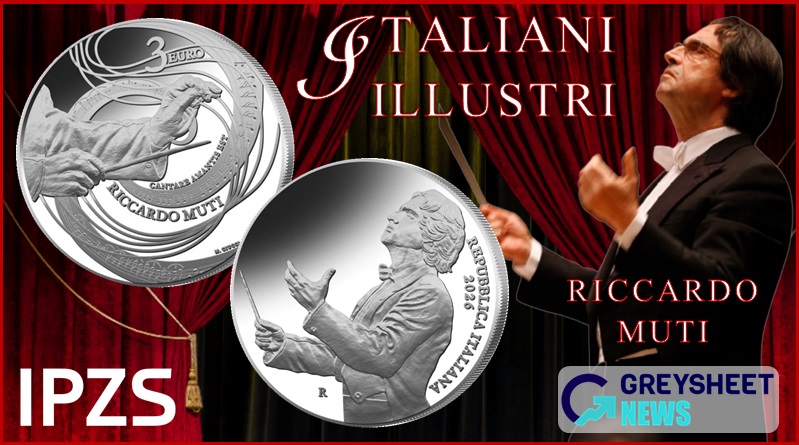
Latest Silver Coins in ‘Illustrious Italians’ Series Features Renowned Conductor Riccardo Muti
The IPZS begins a new collector series highlighting extraordinary careers and contributions of some of the most important interpreters of Italian music on the international scene. The first coin features one of Italy’s more renowned Maestros and classical music conductors, Riccardo Muti, who currently conducts the Luigi Cherubini Youth Orchestra, which he founded in 2004 in Piacenza and his home town of Ravenna. He has been music director of the Chicago Symphony Orchestra since 2010 and remains in this prestigious position.
Born in Naples, Italy, he is the son of physician Domenico Muti and his mother Gilda Peli Sellitto who was a professional singer. It had been hoped in the family that Young Riccardo would follow in his father’s footsteps and become a doctor himself, but he had already shown extraordinary talent for music at a very young age. He studied piano at the San Pietro a Majella Conservatory while also studying medicine for a time, but it was music that beckoned Muti who was awarded a diploma in Composition and Conducting by the Conservatory by conductor Antonino Votto.
In 1962, Muti was offered the position to study composition with Bruno Bettinelli and conducting along with his former teacher Antonino Votto. His debut as a conductor was in 1967 at the Teatro Coccia in Novara, Piedmont where he won the Cantelli Prize for young conductors, violinists, and flautists.
The prize for any conductor would be to become director for one of the world’s most famous and prestigious opera houses in the world, the Teatro alla Scala located in Milan, Italy. Muti was appointed its principal conductor from 1986 to 2005.
These days, Muti divides his time between his American home in Chicago and that of his home in Ravenna, Italy he shares along with his wife Cristina, who founded and directs the Ravenna Festival in Italy, their three grown children and their families.
The silver Proof coins are designed by Monica Ciucci who features an image of the maestro Riccardo Muti dressed in white tie and tails off-centre and to the right. The design is inspired by a series of images taken by photographer Silvia Lelli. Along the lower right rim is the text REPUBBLICA ITALIANA along with the year of issue, 2026. The R mintmark indicating the Rome Mint is shown just to the lower left alongside Muti. The reverse features the maestro's hands emerging from the left side of the coin, also captured in an image taken by photographer Todd Rosenberg. The sound waves, depicted in ascending motion and wrapped around a spiral of staves, musical notes, and fragments of three famous pieces by Giuseppe Verdi, notably - Amami, Alfredo from La Traviata, Ave Maria from Otello, and Tutto nel mondo è burla from Falstaff. Above the primary design is the denomination 3 EURO with the additional inscription CANTARE AMANTIS EST (singing belongs to one who loves) shown just below Muti’s left sleeve. His name RICCARDO MUTI is seen along the lower stave of the musical composition.
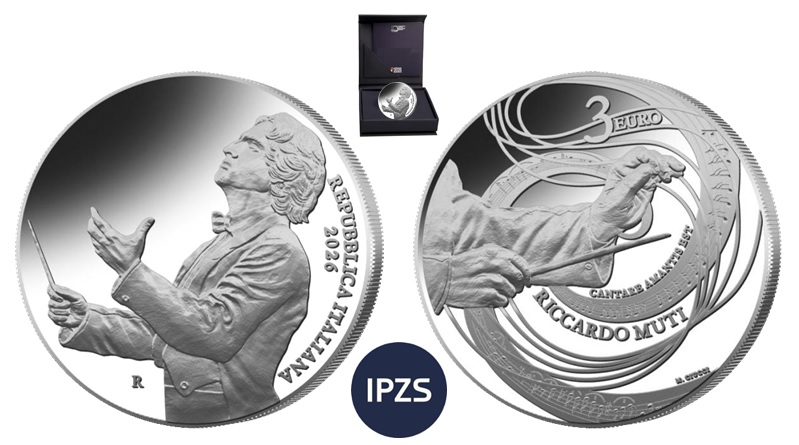
| Denomination | Metal | Weight | Diameter | Quality | Maximum Mintage |
| 3 Euro | .925 Silver | 18 g. | 32 mm. | Proof | 10,000 |
Each Proof coin is encapsulated and presented in a custom case accompanied with a certificate of authenticity. For additional information, visit the e-webshop of the Istituto Poligrafico e Zecca dello Stato – IPZS.
Related Stories (powered by Greysheet News)
View all news
New coins from the Netherlands, South Africa, and Vatican City.



Please sign in or register to leave a comment.
Your identity will be restricted to first name/last initial, or a user ID you create.
Comment
Comments