




 Whitman Expo
Tracing the Nation's History Through Commemorative Coins
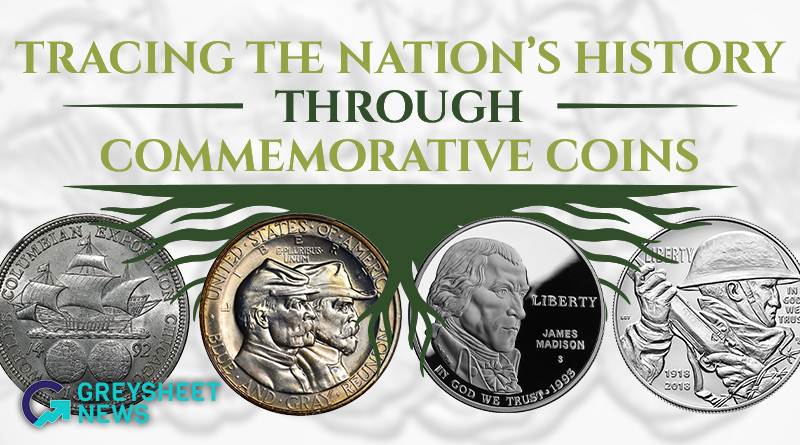
The commemorative has proven to be a suitable means of promoting historic persons, places and events and the variety of commemorative coins seen in the course of American history offers strong evidence of that.
by Larry Jewett |
Published on July 10, 2026

Download the Greysheet app for access to pricing, news, events and your subscriptions.
Subscribe to Greysheet for the industry's most respected pricing and to read more articles just like this.
From the very beginning, one of the main purposes of the United States commemorative coin program was rooted in making a nod to the nation’s history. It’s what separates the special issues from the circulating coinage that serve their purposes for commerce.
Many commemorative coins were created long before the United States seized the idea in earnest in the 1890s. Walter Breen’s Complete Encyclopedia of U.S. and Colonial Coins traces the use of special issues to ancient Greeks and Romans. Over time, there came a need to better differentiate, which Breen explained, "the greatest difference is that commemoratives are increasingly often NCLT’s (noncirculating legal tender coins) sold at a premium to coin collectors or the general public, though theoretically able to circulate."
The commemorative has proven to be a suitable means of promoting historic persons, places and events and the variety of commemorative coins seen in the course of American history offers strong evidence of that.
Author Anthony Swiatek, writing in his 1993 work Commemorative Coins of the United States, opined "I like to think of commems as ‘remembrance preservers,’ for they serve to remind us of elements from our heritage—to focus our attention, in the case of our own commems, on vignettes from America’s past. In a sense, they might be viewed as snapshots from our national photo album."
Indeed, each served a purpose, but not all had wide appeal as many commemoratives were issued to support local events. There are many, though, that would have impact beyond geographic or personal interest to transcend any obstacle preventing them from presenting a solid message of unilateral interest.
A list of the most impactful commemoratives that represent the nation’s 250 years of growth and development is subject to debate and certainly could be more inclusive. We have selected a representative sample from the classic and modern commemoratives that have been brought forth, through approval of the legislative bodies and executive branch approval into the nation’s conscience. Your own list may be different and that’s OK, for the nation was built on differences.
A Nation’s Beginning
The principles of the nation’s founding were put forth by its leaders and chief among them was Benjamin Franklin, who was honored on a commemorative coin program in 2006 to mark the 300th anniversary of his birth.
Introduced as H.R. 3204 by Delaware Representative Michael Castle, the measure stated that Franklin "was the only Founding Father to sign all of our Nation’s organization documents."
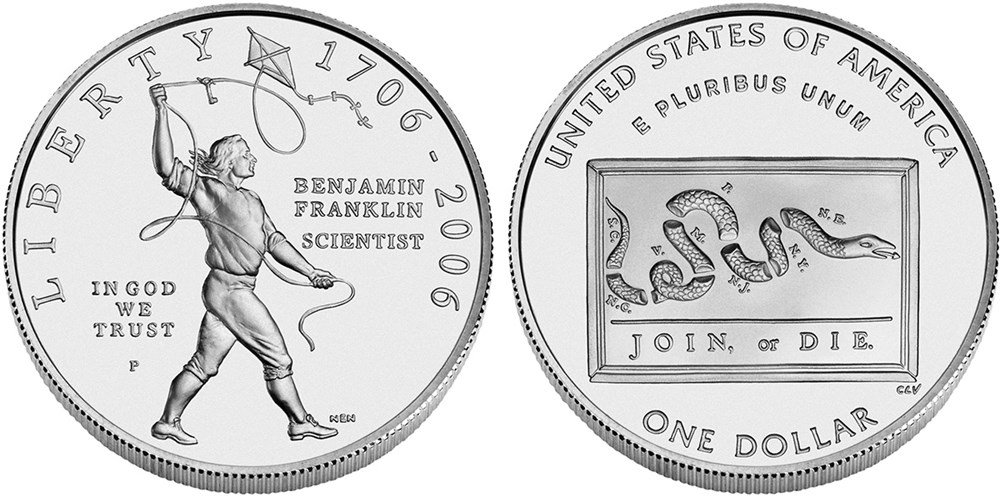
The program called for two different silver dollars with one intended for recognizing Franklin’s scientific achievements and a second coin to honor his patriotic work. In a fitting nod to Franklin’s history, all coins were to be minted in Philadelphia.
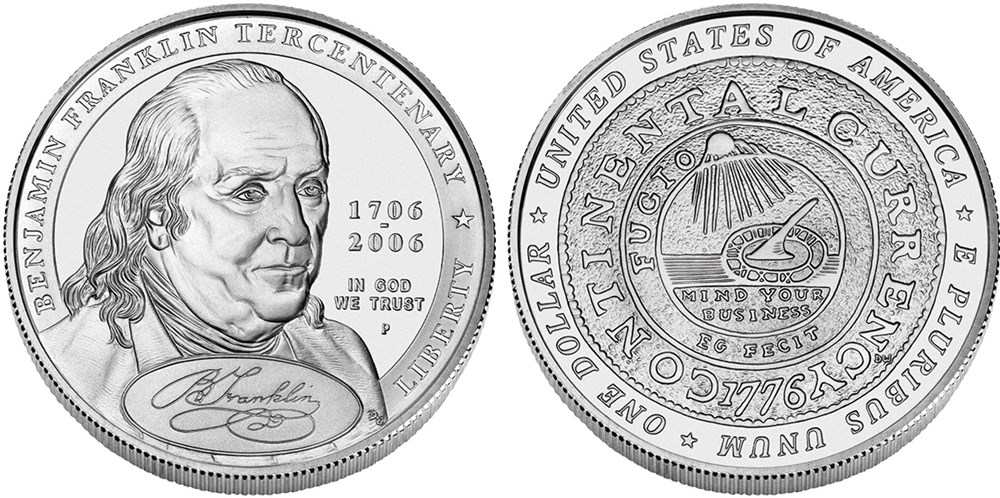
The obverse of the 2006 Founding Father silver dollar was designed by Don Everhart and features a head and shoulders portrait of an elder Franklin as required by the legislation. The law called for the reverse to "bear an image related to Benjamin Franklin’s role in developing the early coins and currency of the new country." Designer Donna Weaver implemented a copy of a 1776 Continental dollar into the heart of the design, surrounded by modern lettering and mottoes required by current law.
Other Founding Fathers have been pictured on commemorative coins, often in recognition for their accomplishments. The first gold dollar in the classic commemorative series, issued for the 100th anniversary of the United States’ purchase of the Louisiana Territory from France, offered a left-facing portrait of Thomas Jefferson in recognition of his role in the transaction. George Washington shared the obverse with sitting president Calvin Coolidge on the obverse of the Sesquicentennial of American Independence half dollar in 1926. Both Jefferson and Washington would later appear on commemorative coins as individual honors.
Founding Fathers can even be found on modern commemoratives. Long after the nation gained its independence, there was still work to be done to guide the path of the fledgling country. Drawing inspiration from historic documents such as the Magna Carta and the state of Virginia’s Declaration of Rights, James Madison sought to create the Bill of Rights, which would limit government power and protect individual liberties through the Constitution. The Bill of Rights is more commonly known as the first ten amendments and received first approval in 1791.
The Bill of Rights commemorative coins were actually a portion of Public Law 102-281, which also called for commemorative coins honoring the White House and coins honoring the quincentenary of Christopher Columbus’s first voyage to the New World. In the section labelled "Title V – James Madison Coins", the law called for issuance of $5 gold, $1 silver and 50-cent silver coins. This 1993 issue marked the first time since 1982 that the half dollar would be minted in silver.
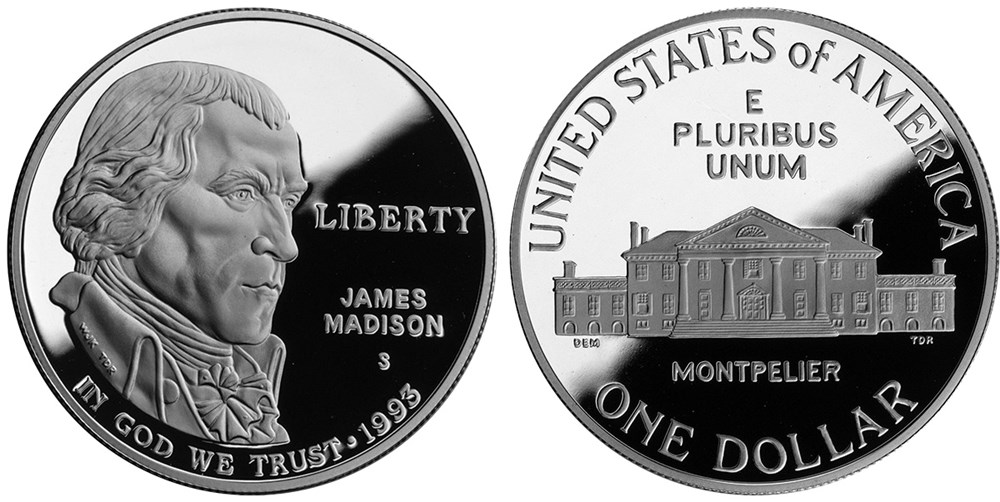
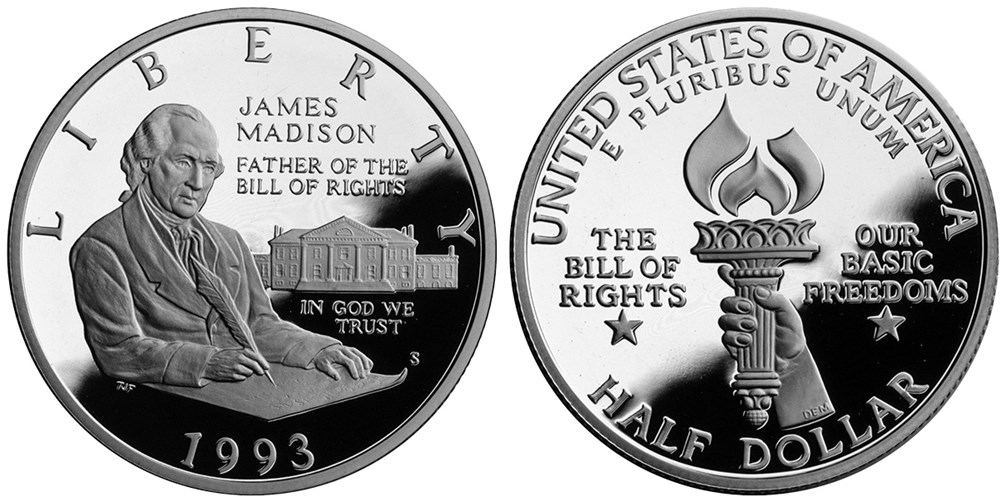
Each coin had specific design criteria, but all shared the directive for procuring the design. Under the law, "The Director of the United States Mint shall sponsor a nationwide open competition for the design of the coin beginning not later than 3 months after the date of the enactment of this Act. The Director of the United States Mint shall convene the Design Panel established under subsection (e) which shall select ten designs to be submitted to the Secretary who shall select the final design." There were more than 800 submissions received.
The Design Panel included the chairperson of the Fine Arts Commission, the executive director of the National Numismatic Collection, the Smithsonian Institution and a representative of the American Numismatic Association. This measure pre-dated today’s Citizens Coinage Advisory Committee, established in 2003.
Prior to the Bill of Rights commemoratives, a Constitution Bicentennial silver dollar and gold $5 was issued in 1987. Each was available in Uncirculated or Proof finish. The coins were also available in a two-coin and four-coin sets
Conflicts Shape the Nation
For a nation born from revolution, conflict is naturally interwoven throughout the 250 years of history. One of the first commemorative coins to recognize the fact pre-dates independence as the 1925 Lexington-Concord Sesquicentennial half dollar paid tribute to the fighting between patriotic insurgents and ruling British armies in 1775. It would be many years before a commemorative program honored those who fought in the American Revolution, and it was another case directed to an event before the nation’s founding. The Black Revolutionary War Patriots silver dollar honored the 275th anniversary of the birth of Crispus Attucks, considered to be the first patriot killed during the Boston Massacre. Low distribution figures (37,210) made the Uncirculated examples highly desirable.
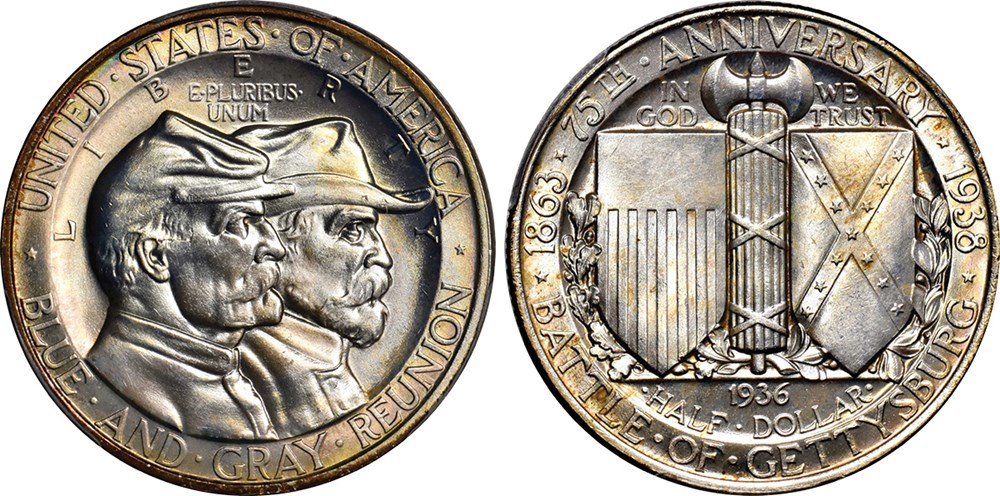
Battles fought during the Civil War were remembered as part of the classic commemorative program. The Battle of Gettysburg Anniversary half dollar was one of more than a dozen programs of 1936 and actually pre-dated the 75th anniversary of the 1863 conflict. The following year saw the Battle of Antietam Anniversary half dollar to remember the 75th anniversary of the bloodiest battle in the War Between the States. Records showed more than 23,000 men killed, wounded or missing and that number is unfortunately greater than the distribution of the silver half dollar. Only 18,028 coins at a price of $1.65 were sold.
An all-encompassing commemorative program brought attention to all battles during the conflict. To raise funds for the preservation of Civil War battlefields, a suite of three coins that included clad half dollar, a silver dollar and a gold $5 coin were approved quickly in Congress. It took fewer than five months for the proposal to go from introduction to enactment in 1992 with the coins targeted for release in 1995. Each coin offered a unique design and each was struck in Uncirculated and Proof finishes.
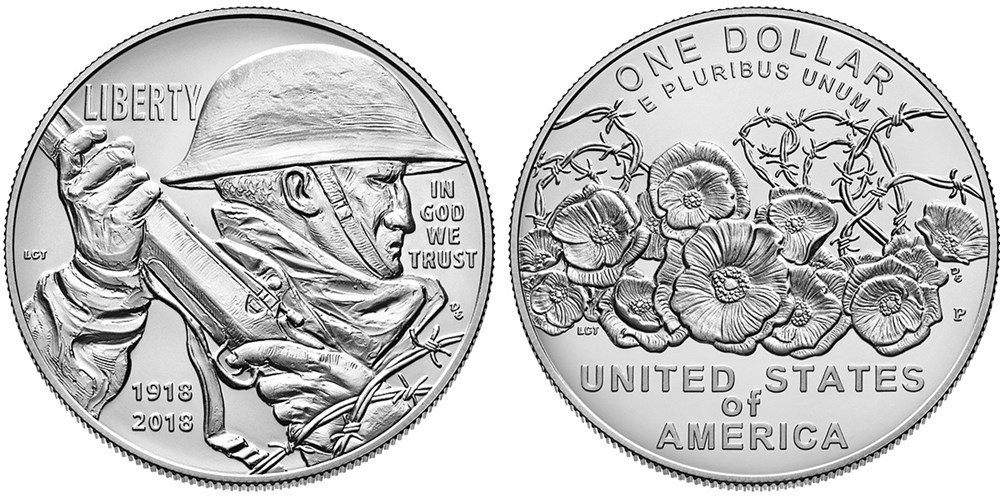
Global conflicts such as the world wars of the 20th century served as great opportunities for the commemorative coin program to continue the remembrance of the historic importance to the nation’s heritage. The 50th anniversary of World War II led to the development of dual dated clad, silver and gold commemoratives in 1993. To mark the centennial of World War I, a silver dollar was issued in 2018. In support of the singular coin, the Mint created companion silver medals for each of the five branches of the U.S. armed forces in action during that time. Those who fought were honored on numerous occasions with commemoratives directed to branches of the military to mark special anniversaries. Examples include the United States Marine Corps, which was honored in 2005 and 2025 and leaders like the 5-Star Generals in a three-coin program in 2013.
A Continuing Role
To date, one of the pivotal events in the nation’s history has yet to be remembered through a commemorative coin, but that could change soon. On May 20, 2026, the House of Representatives passed H.R. 1993, a commemorative coin program marking the 25th anniversary of the September 11, 2001 terrorist attacks on the United States. The unanimous vote to advance the measure serves as a harbinger of hope that swift action will push the measure through to a future signing. If passed, the gold $5 coins and silver dollars would be sold during 2027.
Coins have been considered as "history in your pocket" and though commemoratives are never intended for circulation, their role can solidify the importance of recognizing how the nation was built. For 2026, circulating coinage in honor of the nation’s 250 years will emphasis the importance of history, but it’s the commemorative that will carry out the duty long after the one-year anniversary programs of 2026 fade into time.

Related Stories (powered by Greysheet News)
View all news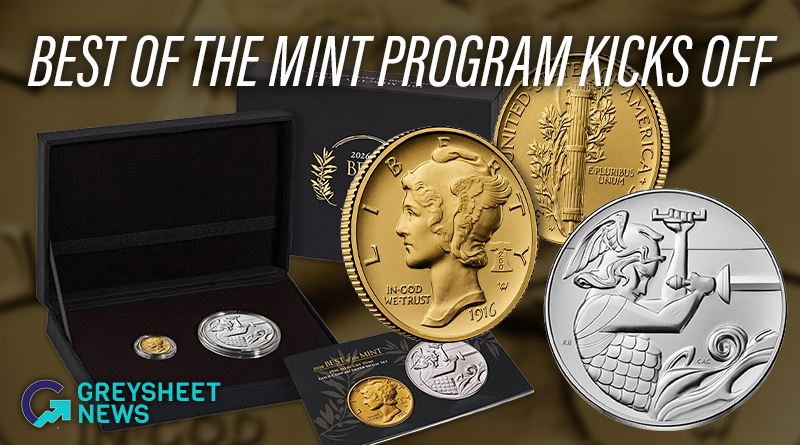
In continuing celebration of the nation's 250th anniversary in 2026, the United States Mint will embark on a "Best of the Mint" program.

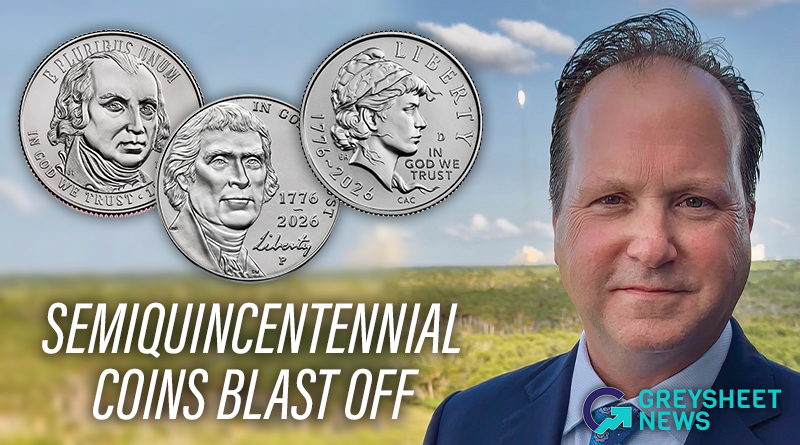
Circulation plans for the dual dated 1776–2026 coins celebrating the Semiquincentennial of the United States reached new heights in the early evening of May 15.
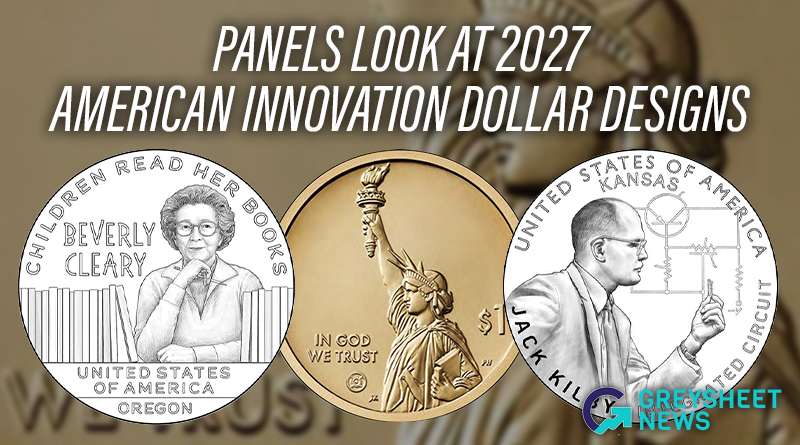
In April, the Commission of Fine Arts and the Citizens Coinage Advisory Committee considered design proposals for the 2027 American Innovation dollars.
Please sign in or register to leave a comment.
Your identity will be restricted to first name/last initial, or a user ID you create.
Comment
Comments