




 Whitman Expo
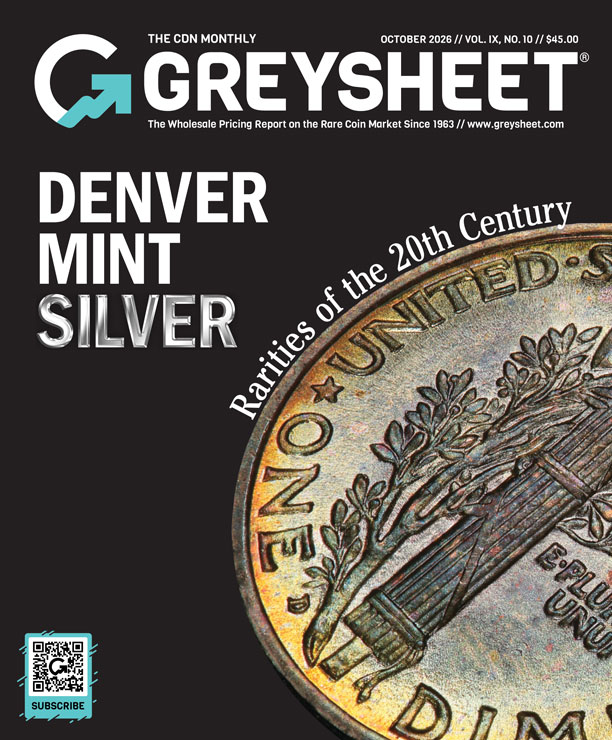
The Business of Numismatics: October 2026 Greysheet Editor's Letter
While reviewing the initial results in various categories of recent auctions, my initial take is that the sales were moderate to strong.
by Patrick Ian Perez |
Published on October 6, 2026

Download the Greysheet app for access to pricing, news, events and your subscriptions.
Subscribe to Greysheet for the industry's most respected pricing and to read more articles just like this.
I write this month’s column at the end of the week following the World’s Fair of Money®, which is a week of nonstop auction activity. While the immense Stack’s Bowers Global Showcase still has a number of online-only sessions yet to be conducted, many thousands of lots of United States and world coins have found new homes. The Heritage Signature Auction has concluded, and just U.S coins did a hair short of $40 million, while world coins added another $26.4 million. There were five seven-figure lots at the top, all gold coins. The Stack's Bowers sessions had a single seven-figure U.S. coin, the highly anticipated 1894-S Barber dime.
While reviewing the initial results in various categories and using different filters, my initial take is that the sales were moderate to strong. In my analysis, I like to look at prior sales of the same coin/grade, and how the sale price compares to both the Greysheet bid (wholesale) and CDN-CPG® (retail) prices. It is very informative for us as pricing editors to look at comparisons to both wholesale and retail to get an idea of trendlines and the strength of the overall market at a point in time. It is also a methodical way to evaluate the appetite at the investor level—generally $10,000 and up. Many of the top 500 lots, ranked by price, sold in between their respective wholesale-retail levels. As has been commonplace over the past six years, records were set, but not as many as in prior sales of this magnitude.
A highlight at Stack’s Bowers was the Mack C. Chase Collection of Walking Liberty half dollars. Any time a very high-end collection of this popular series is offered it is newsworthy simply for how popular the series is. The headline coin, a PCGS/CAC MS66 1921-D sold for $183,000, besting the previous high water mark of $168,000. A PCGS MS67 1917-S (Reverse) had never before been sold publicly, and this initial appearance set the bar at $122,000. The Chase 1921-S that brought $109,800 was the highest non-CAC PCGS MS65 ever sold. We plan additional in-depth coverage of this collection in a future issue. It is also interesting to note that another very high-quality collection of Walkers is on the market for private sale that was on view at the World’s Fair of Money®.
A few other coins that jumped out include Heritage lot 3772, a PCGS/CAC MS67 1897-S double eagle. Housed in a very early PCGS holder, this is the Eliasberg specimen, and remarkably had not sold publicly since the original Eliasberg gold coin sale in 1982. More impressive still is that said sale was prior to the creation and widespread adoption of third-party grading, and yet not another 1897-S $20 has been found in the intervening years to match this piece. One other PCGS MS67 without CAC endorsement sold back in 2005, but this example realized a record $390,400. For comparison, MS65 1897-S $20s bring prices in the range of $10,000 to $14,000 on average. So many of the original Eliasberg coins have resurfaced on the market since 1982, and it would be a fascinating, yet time consuming, study to try and figure out how many remain that have not. Heritage lot 3401 was a 1968-S Washington quarter, certified PCGS PR70DCAM. As the one and only coin at this certification level, it sold for a whopping $36,600. This result proves both registry and high-end modern coin collecting is still alive and well. PCGS has certified 53 coins at the PR69DCAM level of this date, and the most recent sale was at $732 in May, giving the PR70 coin a 4,900% premium.
Sincerely,
Patrick Ian Perez, patrickp@whitmanbrands.com

Related Stories (powered by Greysheet News)
View all news
Outside of the direct trading of coins, our industry has seen some shake up recently on the data and information front.

This issue of Red Book Quarterly comes amidst the thick of a rare coin bull market.
With the month of July and all the celebrations of Independence Day behind us, the rare coin market looks with anticipation to August.
Please sign in or register to leave a comment.
Your identity will be restricted to first name/last initial, or a user ID you create.
Comment
Comments