




 Whitman Expo
Right for its Time: The Short Life of the 2 Cent Coin
The United States utilized a two-cent coin for just ten years, from 1864 to 1873.
by Larry Jewett |
Published on August 19, 2026

Download the Greysheet app for access to pricing, news, events and your subscriptions.
Subscribe to RQ: Red Book Quarterly for the industry's most respected pricing and to read more articles just like this.
Many of the denominations used by consumers throughout history have had a long run that helped develop familiarity over time. There is one denomination that existed only briefly in circulation and it has an interesting story that has captured the attention of numismatists but has escaped any attention of the general public. Enter the two-cent coin.
The United States utilized a two-cent coin from 1864 to 1873, beginning at a time when the attention of the nation was distracted by internal conflict and the effects that war can bring to a nation’s daily existence. The two-cent coin was created through the Mint Act of April 22, 1864, but it was not the primary objective of the measure. At that time in history, there was a need to address the coinage composition of small denomination coins. Prior to the passage of the Act, the one-cent coin was composed of 88 percent copper and 12 percent nickel. The cent would now be minted with a greater percentage of copper (95%) with the balance to be a mixture of zinc and tin, heretofore known as the "bronze cent". The change was necessitated by dwindling supplies of nickel and the new composition would eliminate the need for nickel in any amount.
As part of the Mint Act of April 22, 1864, a new two-cent coin would be created using the same composition but double the weight of the one-cent coin. The two-cent coin would make its first appearance in circulation later that year, but it was far from the first time that the idea had been touted.
Previous Attempts
In 1806, Senator Uriah Tracy offered the ideal of a billon two-cent coin composed of 79% copper and 21% silver that Tracy supported as "convenient for the marketplace." Tracy’s idea passed the Senate but drew the attention of Mint Director Robert Patterson who opposed the idea. Patterson felt the coin would be hard to produce and found support in the House of Representatives, successfully derailing the effort. Tracy tried again, getting Senate passage, but his measure found the same fate in the other chamber.
In 1816, Representative Erastus Root offered an idea of a two-cent coin, but once again, those responsible for production were able to keep the idea on the drawing board. It took another 20 years before the idea came back to government attention, but this time, it originated outside the halls of Congress.
In 1836, Treasury Secretary Levi Woodbury resurrected an idea similar to the proposal of Senator Tracy 30 years previous. The amount of silver would be reduced to about 10 percent. Woodbury took it to Congress, but a familiar nemesis reappeared when the Mint raised objections. This time, it was Mint Director Robert Maskell Patterson, the son of the previous Mint Director who dismissed the idea in 1806. The younger Patterson took the same course, expressing that the coins would be easy to counterfeit and that was enough to prevent the idea from moving forward.
Making History
One of the provisions of the Mint Act of April 22, 1864 allowed for "the shape, mottoes, and devices of said coins shall be fixed by the director of the mint, with the approval of the Secretary of the Treasury." While nothing is specifically addressed, the timing came on the heels of a letter that had been written to government officials a few years previous. In his work, In God We Trust the American Civil War, Money, Banking and Religion, author William Bierly provides the text of an 1861 letter to Secretary of the Treasury Salmon P. Chase from Reverend Mark Watkinson, who told Chase, "One fact touching our currency has hitherto been seriously overlooked. I mean the recognition of the Almighty God in some form on our coins."
Bierly points out that communication between Mint Director James Pollock and Chase shortly after the bill passage addressed the motto. Pollock, in a letter on May 2, 1864, recommended changing the motto of "God Our Trust" to "In God We Trust". Chase had previously suggested the change.
While "God Our Trust" had been the more common phrase throughout the early discussions, Bierly noted Pollock preferred "God Our Trust" due in part to its brevity. Under the terms, though, it would be the Secretary of the Treasury with the final call.
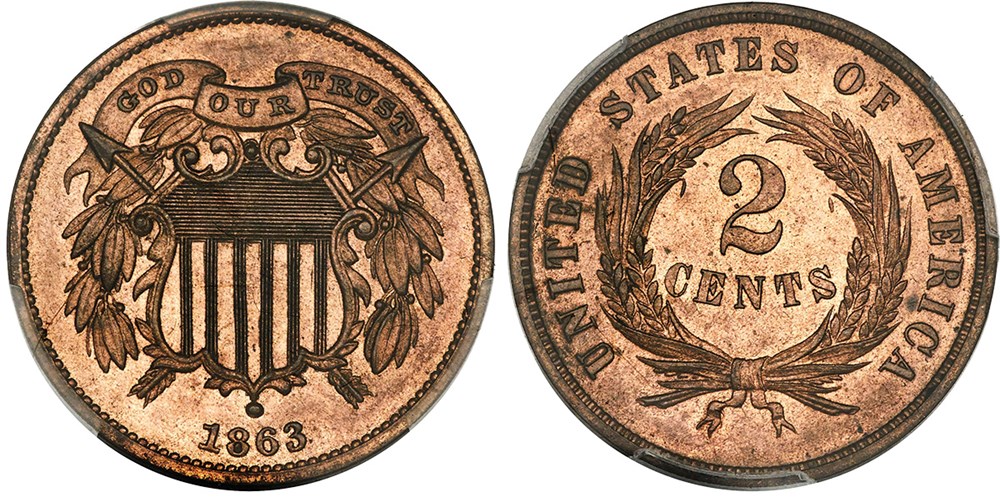
One of the theories about the reason Chase favored "In God We Trust" was proposed by Walter Breen, who said in Walter Breen’s Encyclopedia of U.S. and Colonial Coins, "The wording was evidently influenced by the motto of Chase’s alma mater, Brown University." History shows there is no connection between Chase, who graduated from Cornell, and the Rhode Island institution.
First Year
In his cover story in the December 2009 The Numismatist, researcher Robert W. Julian noted, "Coinage of the first 2-cent piece began at the end of May with a delivery of 25,000 coins."
Julian adds that the U.S. Mint entered into an agreement with the firm of Holmes, Booth and Hayden of Waterbury, Connecticut for the blanks for production and the first were delivered from the firm later that summer.
History shows that there are two different types that were produced in 1864. According to Julian, "The earliest 2-cent pieces struck for circulation accidentally used a pattern die on which the motto IN GOD WE TRUST was rendered in small letters. These ‘Small Motto’ coins are in strong demand."
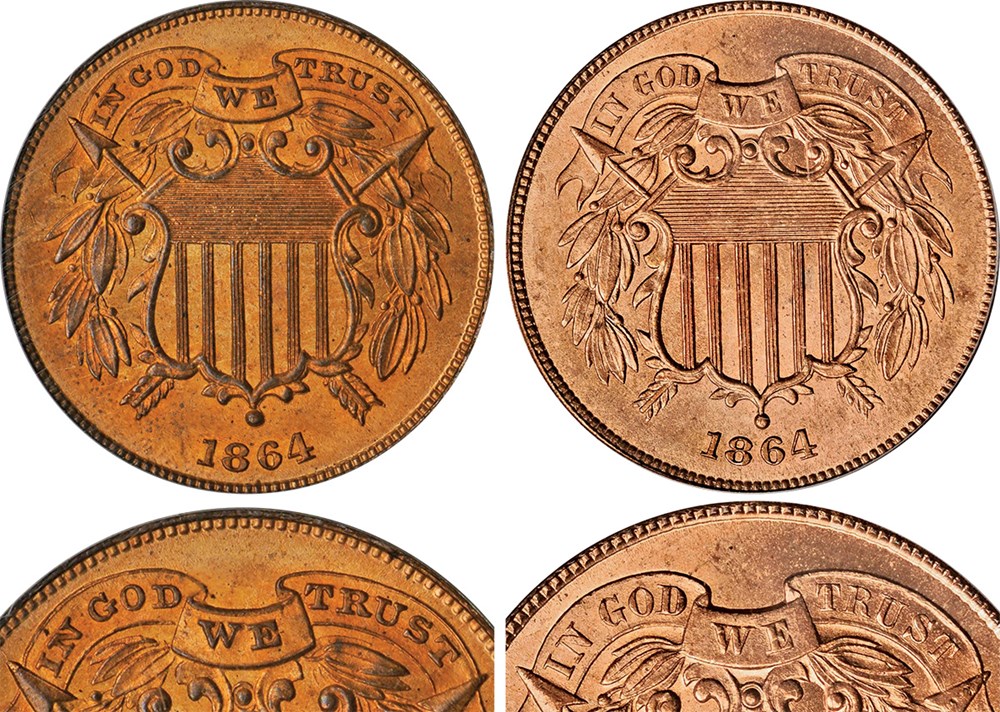
Left: 1864 Small Motto. Right: 1864 Large Motto.
The first year mintage was, by far, the greatest as the new coins began to make their way into circulation and the hands of the general public. The nation was still divided by the Civil War, but a provision within the Mint Act of April 22, 1864 essentially made the private tokens issued at the time unwanted. "A fine of up to $1,000 and imprisonment of up to five years was included for even passing them, let alone producing them," noted Bierly. "Unlike the July 1862 legislation banning the tokens, which was largely ignored, this 1864 legislation was taken seriously."
Threat for an Old Foe
The two-cent coin’s time in the spotlight was short-lived due to renewed efforts of interests in the nickel industry. While the nation had a three-cent silver coin to round out denominations, these were commonly hoarded and not circulated. Led by industrialist Joseph Wharton, legislation was offered to create a copper-nickel three-cent coin intended for the nation’s commerce. The coin would debut the following year and nearly equal the mintage of the 1865 2-cent coin. By 1866, the U.S. Mint in Philadelphia was making more three-cent coins than the two-cent coins. The writing was on the wall for the lesser denomination.
Julian noted, "During the late 1860s, when silver fell in value because too much was mined, the Treasury undertook a thorough review of the coinage. In due course, Congress passed a comprehensive act that resulted in numerous changes." The measure, known as the Coinage Act of 1873, wiped out the two-cent coin and also eliminated the silver three-cent coin and the half dime among the fractional denominations.
The final year saw two-cent coins only offered in Proof format, including two varieties in 1873. The "Open 3" and "Closed 3" provide an additional challenge for collectors seeking to complete a set.
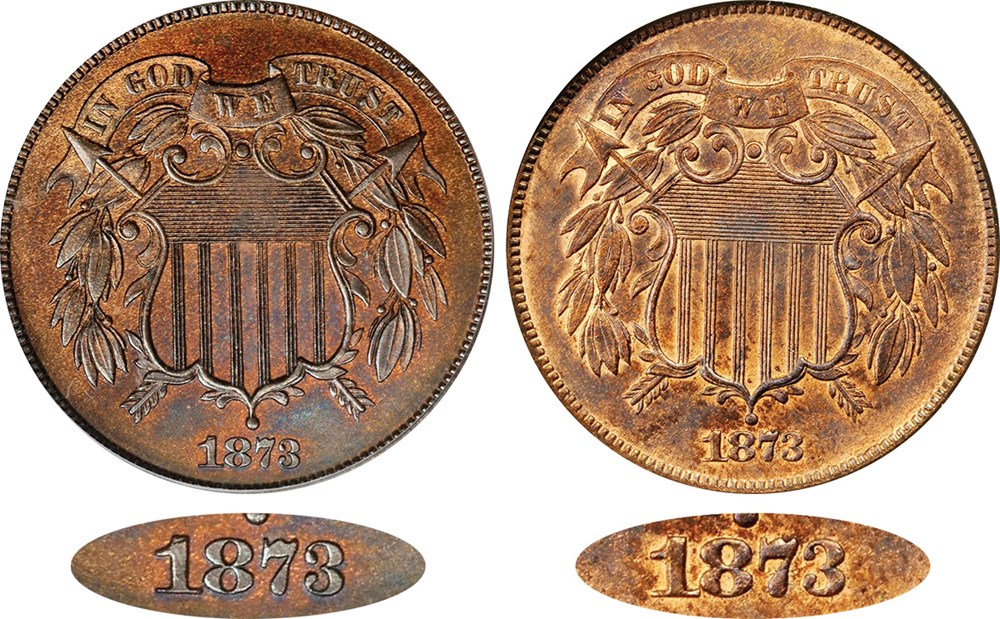
Left: Closed Three. Right: Open Three.
Collecting Today
With such a short life, the two-cent offers an enticing attraction to seeking out a full set. In the Red Book Series United States Type Coins, Fourth Edition, Q. David Bowers notes, "Examples are readily available in nearly all grades. The first several years of the series can be purchased in such grades as VF, EF and AU. Most have light brown surfaces and are quite attractive."
Known only to history and numismatists, the two-cent coin provides a fascinating look into life at a time when the nation needed small denominations, an attitude long gone in today’s world.
Images courtesy of Heritage Auctions, HA.com

Related Stories (powered by Greysheet News)
View all news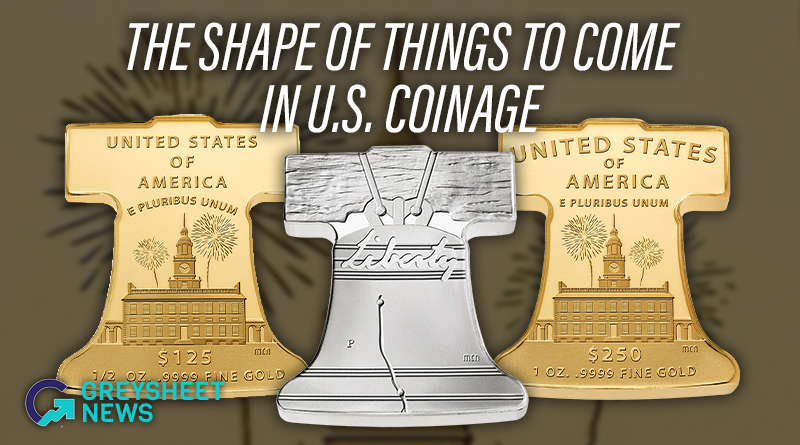
The U.S. Mint is planning to release the first U.S. coinage and medal of a shape other than round.


Numismaster.com ceased operations on July 31, leaving paid digital subscribers scrambling to pursue other options for their numismatic information.
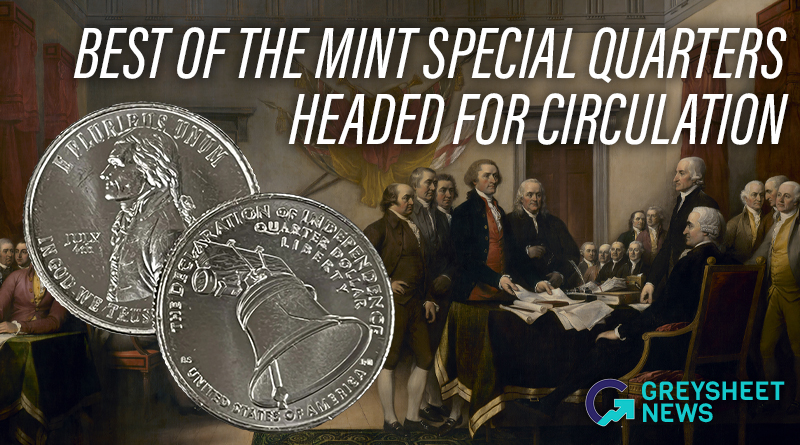
The search is on for special quarter dollars that will be placed in circulation by the United States Mint as part of the nation's Semiquincentennial celebration.
Please sign in or register to leave a comment.
Your identity will be restricted to first name/last initial, or a user ID you create.
Comment
Comments