




 Whitman Expo
Hungary. Latest Silver Proof Coins Remembers Sporting Legend Olympian Boxer László Papp
The National Bank of Hungary release coins marking the centenary anniversary of birth of a national hero.
by Michael Alexander |
Published on March 30, 2026

Download the Greysheet app for access to pricing, news, events and your subscriptions.
Subscribe to RQ Red Book Quarterly for the industry's most respected pricing and to read more articles just like this.
Advertisement
Laszlo Papp (1926 – 2003) is fondly remembered for having won Olympic gold medals in London 1948, Helsinki 1952 and Melbourne 1956. He was the first boxer to ever win gold at three consecutive Olympic Games competing in the middleweight and light-middleweight divisions. With a left-handed stance, unusual for a boxer in his weight class and a height of 1.65 meters or, 5 feet 4 inches, Papp was the pride of Hungary, and after his extraordinary Olympic gold medal success, he received special government permission to turn professional in 1957. At the age of 31, he had become the first boxer from a communist country to do so and, became the European middleweight champion in 1962, a title he retained six times. In 1965, Papp solidified his place as a premier boxer in his class when he signed a contract to challenge American Joey Giardello in New York at Madison Square Garden. He was to defend for the second time the WBA-WBC 160-pound (72.574 kg) title he won in December 1963 by a 15-point decision against Nigerian Dick Tiger at the Convention Hall in Atlantic City.
However, that same year while training in Vienna, Papp was immediately called back to his country for what was supposedly a consultation of his contributions to the sport. In reality, the government under the advice of its then-Prime Minister revoked his passport which restricted his ability to travel abroad and compete. The decision was arrived at due to the international attention Papp received as an athlete from the Eastern-Bloc competing for a cash reward while in the West. The government declared boxing as a professional for monetary gain was counter-productive to socialist principles. At the age of 39, many fans and those in the managerial side of boxing still firmly believed he was still in his prime.
Papp’s last professional fight was in October 1964 against Irishman Mick Leahy —he retained his title for the sixth time against his challenger, the only opponent who lasted all 15 rounds against the European middleweight champion. Papp retired undefeated with a record of 27 wins, 2 draws, and 0 losses. Thus, the promising career of László Papp, Olympic champion and undefeated in 29 professional fights, had come to an ignominious and premature end.
Later in his life, Papp was asked about the fateful decision by the government which ended his sporting dreams of attaining world title status. He pointed out the government minister who specifically his career was out and there were no agreements in writing. Though he believed he was one step away from the world middleweight title, which meant he had to travel to the US and the government was against that. Papp also pointed out that he had already earned more money at the time than most of ministers would see in a lifetime and their decision to restrict him may have been due to sheer jealousy. He rightly pointed out that he had never been defeated by an opponent, but only by the bureaucrats of his own country.
After retirement, Papp began working as a coach which proved very successful. From 1971, he was the coach of the Hungarian national boxing team and returned once again to the Olympic Games in 1972 at Munich. He led its only Olympic champion György Gedó, who won gold in the light flyweight division by defeating his North Korean opponent. He remained in this position until 1992 and the next year in recognition of his impeccable sportsmanship, which he always demonstrated throughout his career, Papp was awarded the UNESCO Fair Play Prize in Paris. Despite an early and forced retirement, his efforts and excellence in the boxing ring weren’t forgotten. in 1999 after a vote by sports journalists from different countries, he was chosen as one of the 25 best athletes of all time. Papp died in October 2003 in Budapest at the age of 77 and was buried in the city’s Farkasréti cemetery.
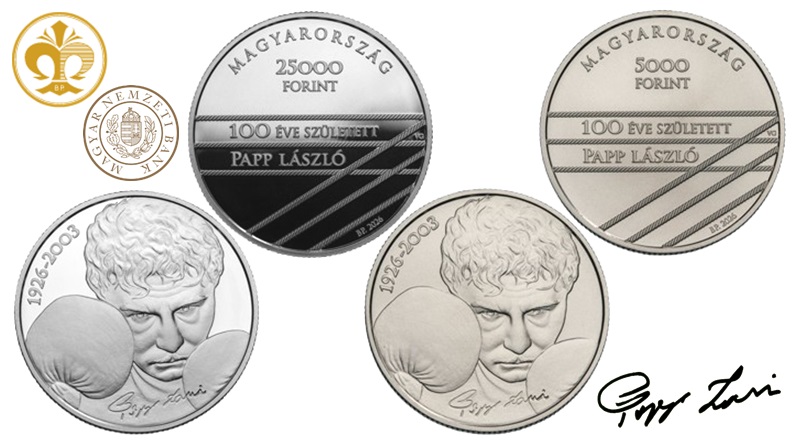
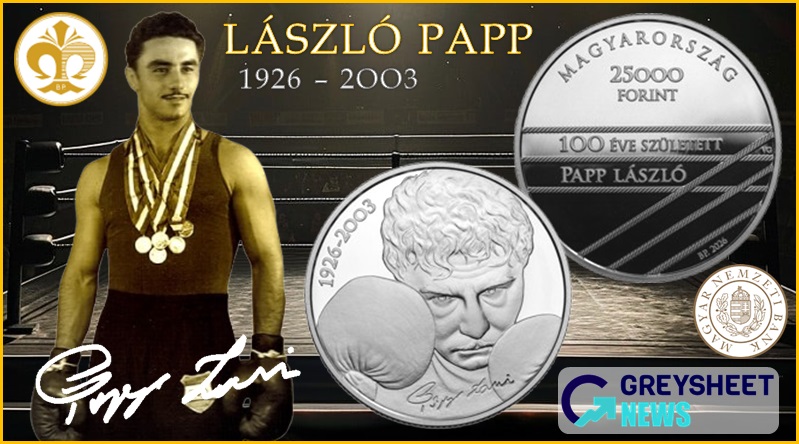
The proof and BU coins are produced by the Hungarian Mint at their facilities in Budapest on behalf of the National Bank and are designed by Gábor Veres. The obverse side depicts an action image of László Papp as he is best remembered, in the stance of a fighting champion complete with boxing gloves. Just below his face is Papp’s autograph superimposed. Along the upper left rim are the years of Papp’s birth and death, 1926 – 2003. The reverse side replicates the corner of a boxing ring with the depiction of three ropes across the coin’s field from left to right and in a sharp diagonal direction to the right side. Between the ropes centred is the commemorative text 100 ÉVE SZÜLETÉTT PAPP LÁSZLÓ (Birth of Laslo Papp 100 years ago). Along the upper rim is the text MAGYARORSZÁG (Hungary) and just below, the denomination 25000 FORINT (silver) or, 5000 FORINT (cupro-nickel). Along the lower right rim is the year of issue, 2026 and the mintmark BP denoting the Budapest Mint.
| Denomination | Metal | Weight | Diameter | Quality | Mintage Limit |
| 5000 Forint | Cupro-Nickel | 30.8 g. | 38.6 mm. | BU | 5000 |
| 25,000 Forint | .925 Silver | 31.4 g. | 38.6 mm. | Proof | 4000 |
Available from the 25th March, each BU and proof coin is encapsulated and is accompanied with a certificate of authenticity. A presentation case to house the coin is available as a separate purchase. For additional information, please visit the e-webshop of the Hungarian Mint.
Related Stories (powered by Greysheet News)
View all news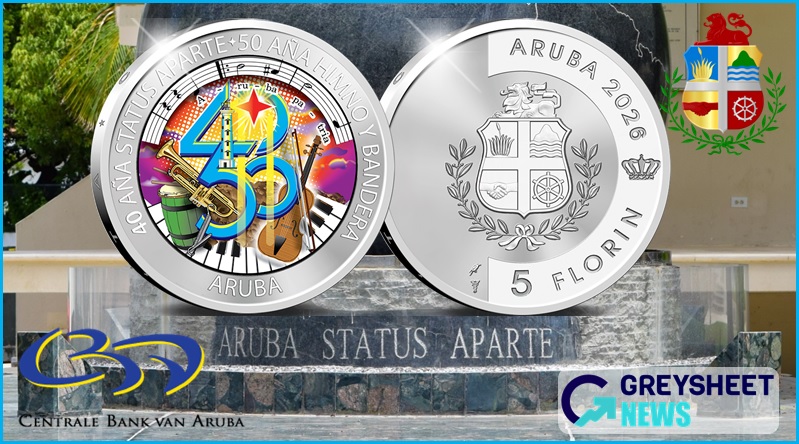
The Central Bank of Aruba Release new festive silver coins marking a special national anniversary.

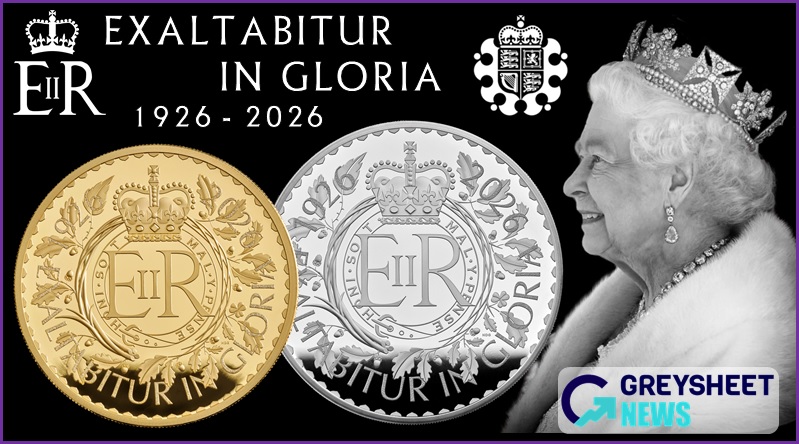
The Royal Mint release new collector coins marking the Late Queen's 100th anniversary of birth.

The Central Bank of the United Arab Emirates release silver collector coins highlighting Children's Day.
Please sign in or register to leave a comment.
Your identity will be restricted to first name/last initial, or a user ID you create.
Comment
Comments