




 Whitman Expo
Can You Borrow Against Your Coins?
Yes, but it’s complicated!
by Armen Vartian |
Published on October 23, 2025


Download the Greysheet app for access to pricing, news, events and your subscriptions.
Subscribe to The Greysheet for the industry's most respected pricing and to read more articles just like this.
Advertisement
Economists say Americans carry too much debt. Accountants like to divide types of debt into two categories, unsecured and secured. An unsecured debt is based upon the borrower’s creditworthiness, with no collateral being pledged to the lender. The major unsecured debt many of us carry every day arises from our use of credit cards. Secured debt, on the other hand, involves the borrower pledging title to some of his or her property—collateral—to guarantee payment. A borrower who defaults on a secured debt will quickly find the pledged property turned over to the creditor for sale, without the same lengthy proceedings as are required in the case of unsecured debt. Good examples of secured debts are home mortgages and car loans. If quicker access to the property wasn’t enough reason for creditors to prefer secured debt, another reason is that a secured creditor has priority over unsecured creditors if the borrower files for bankruptcy, and will often get paid in full even if the unsecured creditors only get pennies on the dollar.
Ok, so can coins be collateral on secured loans? They serve that function every day. Dealers carry credit lines with major banking institutions for tens of millions of dollars, secured by their inventories. Auction houses provide advances to their consignors, sometimes quite substantial, which are secured by the coins and the expected proceeds of their sale. And individual collectors and investors can borrow from certain specialized lenders against their holdings.
Is there a problem with any of this? I didn’t think so, until a lender told one of my clients that it wouldn’t accept coins or currency as collateral for a loan because they were not "goods" under the Uniform Commercial Code (UCC). Article 9 of the UCC governs secured loans in 49 states, and under the UCC the only possible collateral category for coins and currency would be "goods." If coins aren’t "goods," they couldn’t legally be collateral. From the lender’s standpoint, that would mean that the loan would basically be unsecured, and this particular lender had no intentions of making an unsecured loan to my client. But the lender was wrong and the loan went through. Here’s why.
Article 9’s definition of "goods" appears in section 9-102(a)(44), which begins by defining "goods" as "all things that are movable when a security interest attaches," which certainly would cover coins and currency. However, the section goes on to specifically exclude "money" from the definition. Neither the section itself nor the Official Comment defines "money," but a definition elsewhere in the UCC (section 1-201) states that money is "a medium of exchange authorized or adopted by a domestic or foreign government …." The lender, of course, said that rare coins and currency fell within that definition. My response was that the UCC’s drafters specifically stated that their definitions would apply "unless the context otherwise requires," and there were two pretty good reasons for thinking this was one of the situations where the drafters did not intend to exclude numismatic items from the definition of "goods" available for collateral purposes.
First, another section of the UCC (2-105) defines "goods" as "all things … which are movable at the time of identification to the contract other than the money in which the price is to be paid…." However, unlike in Article 9, the drafters provided an Official Comment to this section which is designed to clarify their intent. It states: "The definition of goods is based on the concept of movability….Goods is intended to cover the sale of money when money is being treated as a commodity but not to include it when money is the medium of payment." Courts have applied the UCC to rare coins generally based upon this provision. There is no question that coins and currency in a dealer’s inventory are treated as commodities and are the subject matter of transactions, not the medium of payment. There’s no rational reason why the UCC’s drafters would have included money treated as commodities in the definition of "goods" under one section while excluding it from a substantially similar definition contained in the other, especially given the obvious intent of both sections to be as inclusive as possible with respect to "movable" items.
Second, the lender’s argument would yield absurd results when one considers the fact that many U.S. and foreign rare coins—including many of the most celebrated and valuable ones—were never "authorized or adopted" by their governments as legal tender. Pattern coins come to mind, not to mention 1894-S Barber Dimes, 1913 Liberty Nickels and a host of other U.S. and foreign coins. Would those coins be acceptable collateral because they aren’t "money?" Sometimes, even among lawyers, common sense prevails—but not without a lot of arguing!

Related Stories (powered by Greysheet News)
View all news
In the absence of any specific contractual provisions addressing the point, buyers' rights of rejection are governed by the Uniform Commercial Code as enacted in the relevant state.

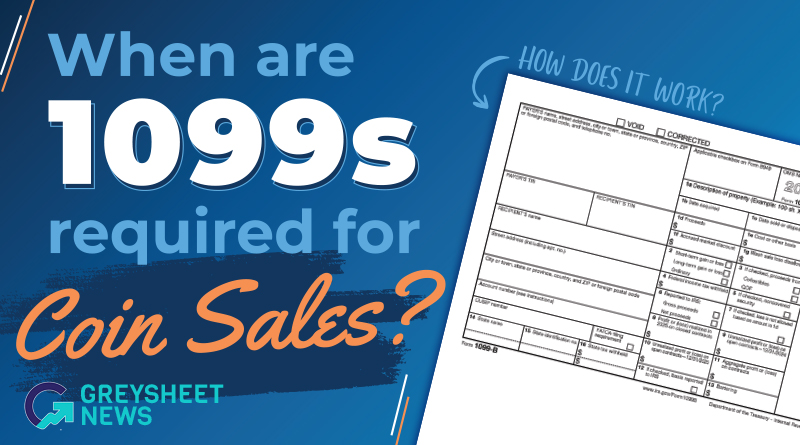
A 1099-B form requires reporting the seller's full name, address and Social Security number.
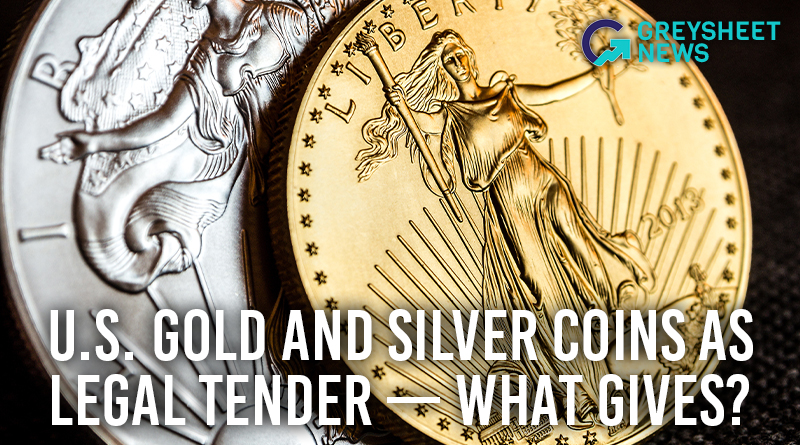
Aren't most U.S. gold and silver coins legal tender already?
Please sign in or register to leave a comment.
Your identity will be restricted to first name/last initial, or a user ID you create.
Comment
Comments