



 Whitman Expo
Weekly World Mint Coinage: April 30, 2026
New coins from Israel, Greece, and Estonia.
by Michael Alexander |
Published on April 30, 2026

Download the Greysheet app for access to pricing, news, events and your subscriptions.
Subscribe to RQ Red Book Quarterly for the industry's most respected pricing and to read more articles just like this.
Advertisement
Israel - Holy Land Mint
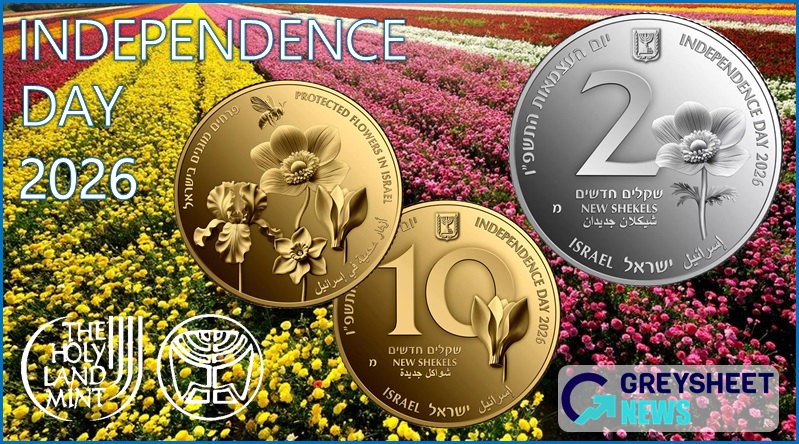
New Gold and Silver Proof Coins Mark Israeli Independence Anniversary
The Bank of Israel has released a new range of collector coins marking the 78th anniversary of independence by recognizing the beauty and delicacy of the nation’s protected wildflowers. They are also a reminder of the importance to protect them as part of Israel’s landscape and natural heritage for future generations.
Protection of the country’s wildflowers began in the mid-20th century, on the understanding that uncontrolled uprooting of flowers was liable to lead to their extinction. During the 1950s and 1960s, nature lovers, educators and environmental organisations, specifically the Society for the Protection of Nature in Israel led an extensive nationwide campaign to promote wildflower protection.
Legislation concerning scores of protected plant species resulted in which the picking or uprooting these many species and variations were forbidden by law. Since then, wildflower protection has become ingrained in the conscience of the Israeli public, a symbol of love of the land and environmental responsibility. It is noteworthy to mention the Israeli flower industry has grown to become a major exporter of decorative flowers, even to far more green and fertile countries which are located in Europe, North & South America and as far as Australia.
The gold and silver Proof and prooflike coins are produced by the Holy Land Mint at their facilities in Nesher, Haifa on behalf of the Bank of Israel and designed by Igal Gabay. The common obverse design features four particular protected flowers in Israel - the Poppy Anemones, Iris, Narcissus and Cyclamen centred. Above them is a honeybee, whose important job is to pollinate all of these flowers. Along the rim is the inscription PROTECTED FLOWERS IN ISRAEL shown in three languages, Hebrew along the upper left, English along the upper right and Arabic along the lower right. The reverse side of each denomination features one of the protected flowers of Israel. Shown to the right of the bold numeral denoting the face value is a cyclamen (10 Shekel) a Poppy Anemone (2 Shekel) and an Iris (1 Shekel). Above the primary design is a small image of the Israeli State Emblem. Along the right rim is the inscription INDEPENDENCE DAY 2026 in English. The same is shown in Hebrew along the left rim. Along the lower rim is the text ISRAEL shown in English, Hebrew and Arabic. The denomination NEW SHEKELS is placed just under the numeral and also shown in Hebrew and Arabic. The mintmark "מ" placed to the lower left of the denomination indicates a proof strike while a Star of David indicates a BU specimen.
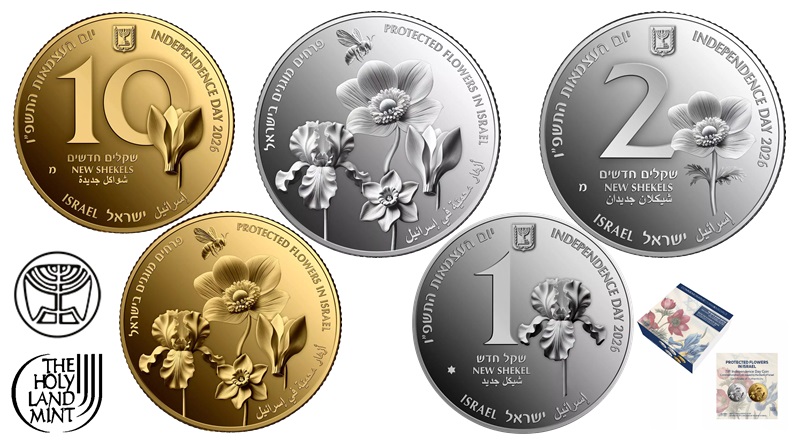
| Denomination | Metal | Weight | Diameter | Quality | Mintage limit |
| 1 Shekel | .925 Silver | 14.4 g. | 30 mm. | Proof-like | 1800 |
| 2 Shekels | .999 Silver | 28.8 g. | 38.7 mm. | Proof | 2800 |
| 10 Shekels | .917 Gold | 16.96 g. | 30 mm. | Proof | 555 |
Each coin is encapsulated and presented in a custom-branded Holy Land Mint case accompanied by a certificate of authenticity. All coins in the 78th Independence anniversary range are available to purchase as a separate item. For additional information on these and other coins issued by the Bank of Israel, please visit the e-webshop of the Holyland Mint.
Greece - Hellenic Mint
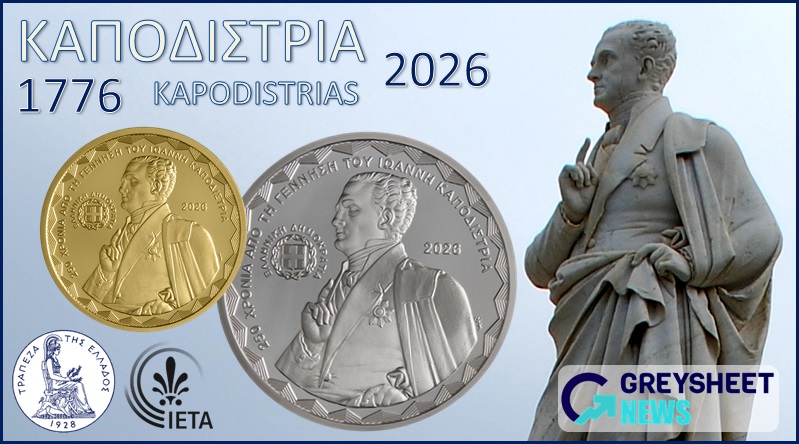
New Proof Gold and Silver Collector Coins Honours Esteemed Statesman.
This year, Greece celebrates the 250th anniversary of the birth of Ioannis Antoniou Kapodistrias (1776 – 1831) one of the most distinguished politicians and diplomats of 19th-century Europe and remembered as the Father of the Greek Nation.
The well-educated Kapodistrias studied medicine, philosophy and law in Italy. When he returned to Corfu in 1805, he founded the National Medical Association in Corfu and accepted the title of Secretary of State, Inspector of Education. It was in 1808 that Kapodistrias was offered the position of Minister of Foreign Affairs of Russia, as an envoy of Czar Alexander I which he accepted. He used this position to influence European powers to side with Greek independence and as Russian foreign minister he had invaluable contact with the continent’s main powers.
As Greece declared its independence from Ottoman rule in March 1821, Kapodistrias left Corfu and moved to Geneva where he organised funds and military equipment. While still in Geneva, Kapodistrias learned the newly formed Greek National Assembly elected him as the first head of state with the title of Governor for a seven-year term. He used his diplomatic prowess to secure Greece’s recognition as an independent state and obtained further territorial gains. He established Greece’s first administrative, economic and military structures while continuing to promote education, agriculture and industry. Kapodistrias also organised the phoenix as the first currency of the Greek State, and whose name appears on these coins.
In 1831, Kapodistrias ordered the imprisonment of Petrobey Mavromichalis, who had been the leader of the successful uprising against the Turks. The two younger brothers of Petro Mavromichalis took matters in their own hands and plotted to assassinate Kapodistrias in retaliation. Tragically they carried out their plan on the 27th September 1831 while Kapodistrias was entering church. As a result of the chaos ensuing, the Great Powers who guaranteed Greek independence, Great Britain, France and Russia changed the course of Greece by imposing a new form of government.
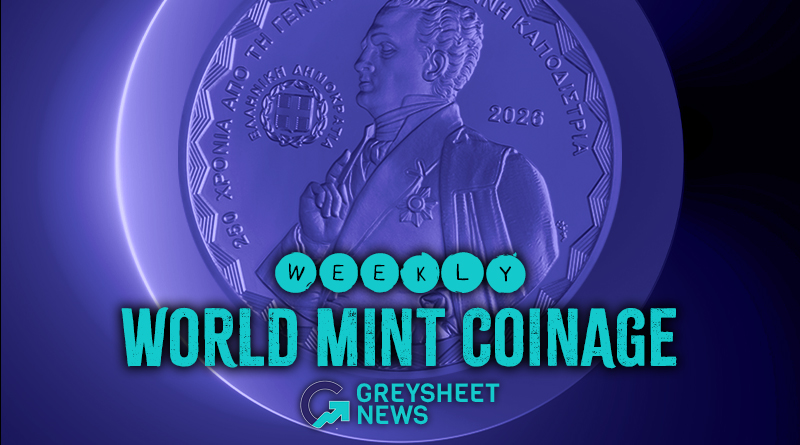
The coins are produced by the Hellenic Mint at their facilities in Athens on behalf of the Bank of Greece and designed by senior engraver George Stamatopoulos. The obverse side, shared by both gold and silver examples, depicts an image of Kapodistrias which is based on the statue honouring the country’s first head of state located directly across from the historic Ionian Academy building in Corfu. The primary design is surrounded by a stylised border and within this is the commemorative inscription 250 ΧΡΟΝΙΑ ΑΠΟ ΤΗ ΓΕΝΝΗΣΗ ΤΟΥ ΙΩΑΝΝΗ ΚΑΠΟΔΙΣΤΡΙΑ (250 years since the birth of Joannis Kapodistrias) To the left is a small crest of the Hellenic Republic and to the right, the year of issue, 2026. As a security feature, the gold coins include a micro-text engraving which shows the characters 917 IETA referencing the gold’s fineness and Greek Mint and is found near the lower right sleeve near the border. The reverse features an image of the original Greek flag adopted in 1822, that of a white cross on a blue background. The cross represents the Orthodox Christian faith and its crucial role in the Greek War of Independence against the Ottoman Empire. In the background are olive leaf branches, symbolic of peace and just under the flag is the denomination 200 ΕΥΡΩ (gold) or 10 ΕΥΡΩ (silver). The primary design is surrounded with the same ornamental stylised border.
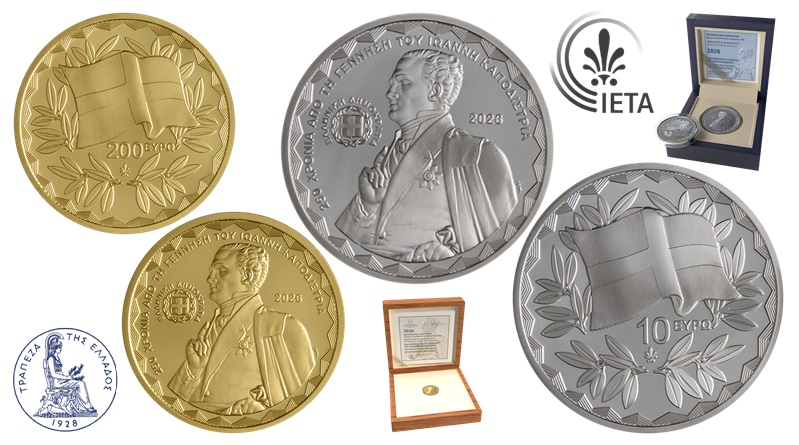
| Denomination | Metal | Weight | Diameter | Quality | Maximum Mintage |
| 10 Euro | .925 Silver | 34.1 g. | 40 mm. | Proof | 1500 |
| 200 Euro | .917 Gold | 7.98 g. | 22.1 mm. | Proof | 1000 |
Each proof quality coin is presented in a custom Bank of Greece-branded polished wood case accompanied with a certificate of authenticity. For additional information, please visit the numismatic webpage of the Bank of Greece.
Estonia - Mint of Lithuania
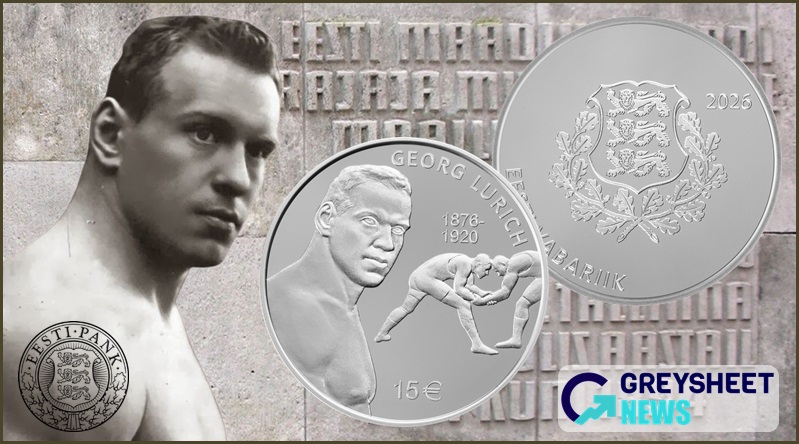
Latest Silver Proof Coins Honour Outstanding World-Famous Athlete
Georg Lurich (1876–1920) was one of the most famous Estonian wrestlers whose achievements brought him international success and fame during his own lifetime. The multi-talented strongman would become a cultural ambassador for Estonia – before even achieving independence in 1920 and promoted a healthy lifestyle, becoming an inspiration for many. This year, Lurich and his legacy are remembered in a numismatic tribute on the occasion of the 150th anniversary of his birth by the Bank of Estonia.
For many sports enthusiasts, Georg Lurich is one of the most outstanding, unique and versatile personalities not only in the modern history of Estonia, but also that of physical education and body-building which still stands as an example of excellence.
Originally born as Georg Luri, his family later altered their surname to Lurich after changing religious congregations. Despite the change to the family’s surname, Georg was often a target of physical harassment from his mostly Baltic German fellow schoolmates, which became the impetus for his decision to focus on sporting activities. After graduating in 1894, he travelled to St. Petersburg in Russia where he practised weightlifting and wrestling. Lurich began to compete with local wrestlers and took part in many various lifting demonstrations. He became the first Estonian to set world weightlifting records.
Lurich and fellow Estonian wrestler Aleksander Aberg travelled to the United States to take part in matches for American audiences, competing in freestyle wrestling matches between 1913 and 1917. After returning home in 1917, the approach of German troops drove the two athletes went to southern Russia, eventually to the town of Armavir. The town was infected with an epidemic of typhoid fever due to the war and medical aid was difficult to obtain. Lurich fell ill and died on the 20th January 1920. Aberg died on the 15th February 1920. The wrestler friends and fellow Estonians were buried in one grave in the Armavir German cemetery.
Because of his austere lifestyle and enormous willpower, perseverance and determination Lurich’s popularity and worldwide fame resulted in the emergence of weightlifting clubs and societies named after him in many parts of Europe, and later in America.
The silver proof quality coins are produced by the Mint of Lithuania at their facilities in Vilnius and on behalf of the Bank of Estonia. Designed by Riho Luuse, the obverse features a three-quarter facing portrait of Georg Lurich borrowed from an early 20th century collector card. The image is placed to the left side of the coin of the young fighter who is shown with the determined gaze, radiating energy and strength. To the right of the portrait are two wrestling figures in the background, Georg Lurich and Aleksander Aberg demonstrating wrestling also recreated from a postcard circa 1901. The text GEORG LURICH is placed along the right rim and the years 1876 – 1920 those of his birth and death are shown just above the wrestling pair. The denomination 15€ is placed near the lower half. The reverse features an image of the Estonian crest – centred together with the year of issue, 2026 placed just to the upper right. The text EESTI VABARIIK is shown along the lower left rim.
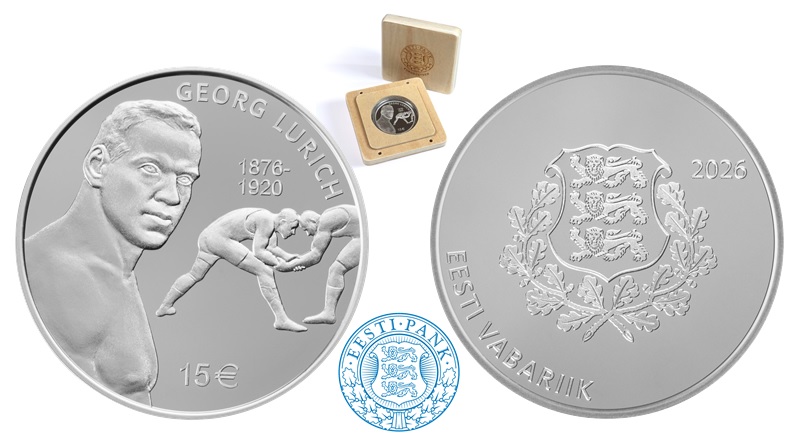
| Denomination | Metal | Weight | Diameter | Quality | Mintage limit |
| 15 Euro | .925 Silver | 28.2 g. | 38.6 mm. | Proof | 3000 |
Each coin is encapsulated and presented in a polished hardwood custom case accompanied by a certificate of authenticity. For additional information, visit the retail webpage of Omniva, official distributor.
Related Stories (powered by Greysheet News)
View all news

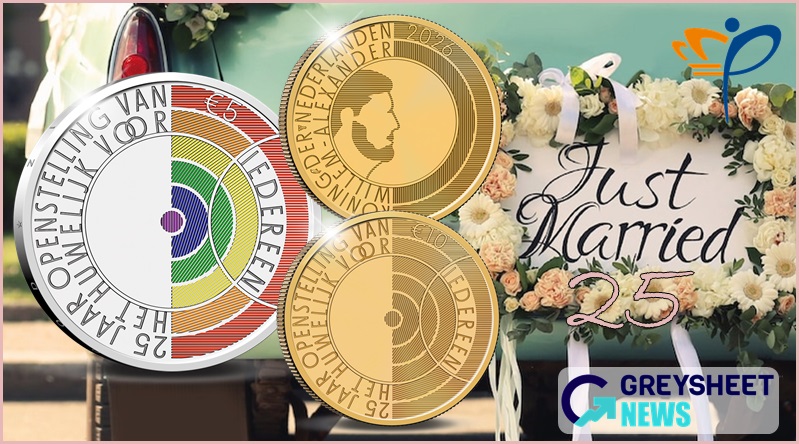
The Royal Dutch Mint release gold and silver coins honouring 25 years of marriage equality.
Please sign in or register to leave a comment.
Your identity will be restricted to first name/last initial, or a user ID you create.
Comment
Comments