

Portugal. New Silver Proof Coins Mark 50th Anniversary of the Return of National Elections
The Imprensa Nacional Casa da Moeda release new silver coins remembering an important step towards democracy.
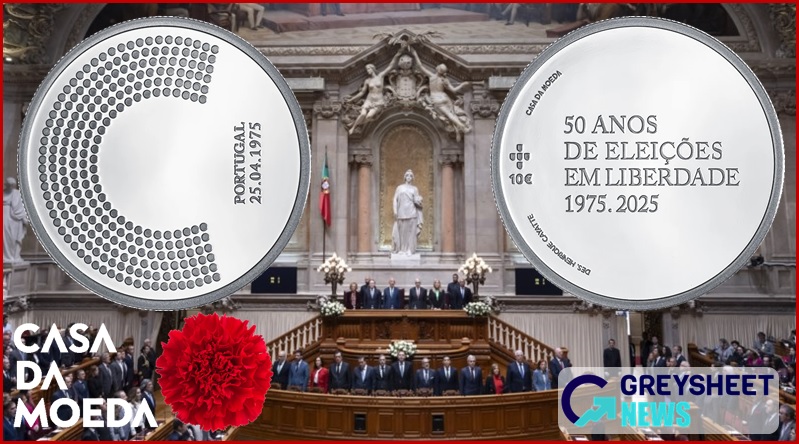
2025 marks the 50th anniversary of the return of democratic elections which were denied to the people of Portugal during the years known as the Estado Novo. Installed in 1933, the authoritarian political movement evolved from the Ditadura Nacional or, National Dictatorship which came about after the coup d'état of the 28th May 1926. This action overthrew Portugal’s first but unstable First Republic created as a result of the overthrow of the Monarchy in 1910. The Estado Novo was greatly inspired by autocratic ideologies similar to those seen in Spain headed by Francisco Franco since 1936 and headed by António de Oliveira Salazar. He became President of the Council of Ministers from 1932 until illness forced him out of office in 1968. The new constitution introduced by Salazar established an anti-parliamentarian and authoritarian government that would last until the spring of 1974 and fundamental change.
By then, Portuguese citizens had enough of the Estado Novo, the overseas conflicts and lack of basic freedoms. The impetus for change came at the instigation of Portugal’s military who were tired of the endless conflicts in overseas colonies and were intent on overthrowing the regime. A group of military officers formed the MFA (Armed Forces Movement) and their aim was to take control of the regime by force on the 25th April 1974. The results in Portugal were immediate and extended to the colonies as well who saw recognition of independence within months. Achievements at home included a new constitution, universal suffrage, the creation of political parties, equal rights for married women, freedom of association, advances in health, education, and labour rights. Constituent Assembly elections were carried out in Portugal on 25 April 1975, exactly one year after the Carnation Revolution. The election resulted in 250 members of parliament accredited to the new Portuguese Constituent Assembly. It was the first free election held in Portugal since 1925, and only the seventh free election in all of Portuguese history. It was also the first under universal suffrage since 1894 and with a turnout was a record 91.66 percent, which still remains the highest ever in any Portuguese democratic elections. This elected members of the Constituent Assembly drafted a new constitution which came into effect in 1976. Since then, Portugal has consolidated its democratic principles with regular elections and achievements such as joining the European Union and Euro-zone.
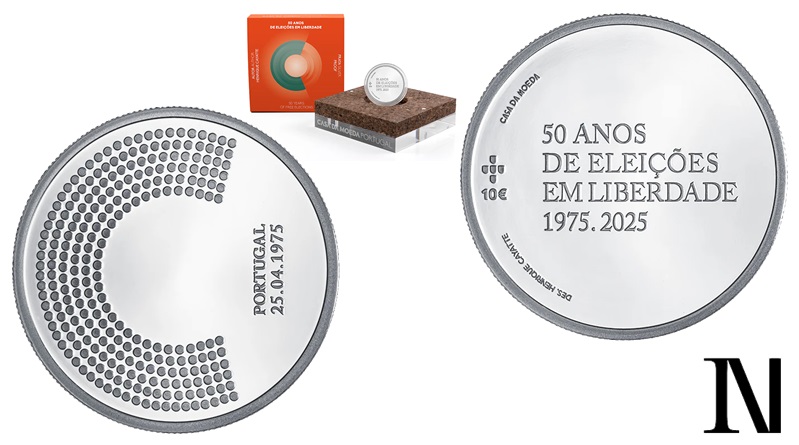
The design is the creation of artist Henrique Cayatte, and featuring the layout of the parliamentary formation on the obverse. The design also represents the democratic milestone of 1975 guaranteeing fundamental rights and consolidating the political participation of all citizens. The pattern of the parliamentary layout also forms the letter C which also represents the 1974 revolução dos cravos or, carnation revolution which brought about fundamental change. The reverse side features the inscription 50 ANOS DE ELEIÇÕES EM LIBERDADE 1975.2025 which is perfectly centred. Close to the left rim is both the Portuguese crest and denomination 10€. Above and below along the left rim is the name of the Mint CASA DO MOEDA and name of the artist HENRIQUE CAYATTE in small lettering.
| Denomination | Metal | Weight | Diameter | Quality | Mintage limit |
| 10 Euro | .925 Silver | 27 g. | 40 mm. | Proof | 4000 |
Available from the 25th April, each silver proof quality coins are encapsulated and presented in a custom case made of a natural Portuguese cork base and a Perspex cover accompanied with a certificate of authenticity. For additional information on these and other coins available from the INCM, please visit their online webshop.

Download the Greysheet app for access to pricing, news, events and your subscriptions.
Subscribe Now.
Subscribe to RQ Red Book Quarterly for the industry's most respected pricing and to read more articles just like this.
Visit these great CDN Sponsors
CDN Sponsors






Author: Michael Alexander
 Michael’s background in both numismatics and banknotes spans more than three decades and whose activities have varied from being a dedicated world coin collector to coin & medal design, marketing, theme concept and production. His additional interests include banknote research and in 1997, he founded the London Banknote and Monetary Research Centre to further these interests and activities. The company continues to offer monthly currency bulletins to both online and printed publications which includes information about the latest banknote news and releases from Central Banks and Monetary Authorities around the world. Michael has been a contributor to COIN NEWS magazine based in the UK since 1998 where many of his in-depth interviews, articles and bulletins have been published.

Please sign in or register to leave a comment.
Your identity will be restricted to first name/last initial, or a user ID you create.
Comment
Comments