

Netherlands. Iconic City Gate in Groningen Features on Latest Silver Proof Ducat Coins
The Royal Dutch Mint release the latest silver proof ducats featuring historic defence fortresses.
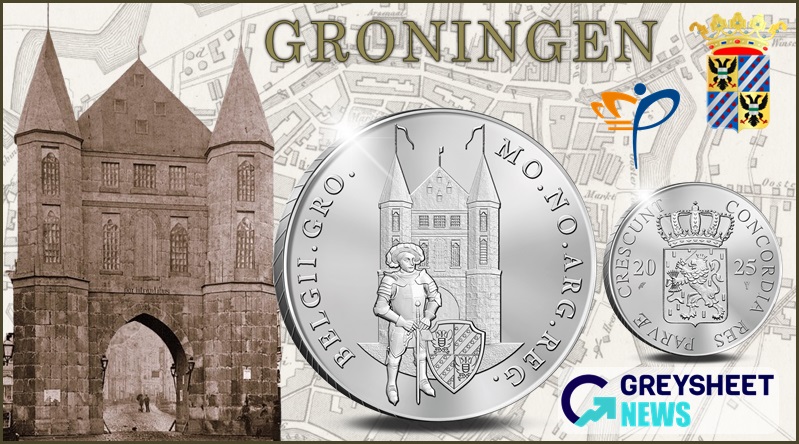
Launched in 2023, the latest coin Dutch City Gates series is the seventh release and highlights the demolished in 19th century Gate and Tower of Poelepoort. Built in the 13th century, the Poelepoort Gate was one of six city gates in Groningen. The original Poelepoort gate was most likely demolished around 1470 and moved a few meters where this new tower became the most impressive tower of the city, due to the design and construction of two towers. Foundations of this new Poelepoort tower have been found during excavations in 1929 and 1989.
In the early 17th century, as the city expanded, the gate lost its primary function as the main entrance, which was taken over by the Nieuwe Steentilpoort fortification. The upper floor of the Poelepoort was subsequently converted into a prison, housing various notable local figures over the years. While the structure served as a prison gate, the area behind it was used as a fortification where the city's army was stationed behind the gate and tower. The prison closed in 1826, and unfortunately, the Poelepoort gate can no longer be admired in person, as it was demolished in 1828 as the city's fortifications were removed to make way for urban expansion. The gate lives on in historical drawings and prints, such as those by Cornelis Pronk from 1756, held in the Groningen archives. In 1879, a replica edifice was built for the Groninger feesten (Groningen Relief celebration). Its foundations were most recently discovered in 1989 during renovations to sanitation works. Today, the square is colloquially known as Poeleplein and is a major entertainment venue in Groningen.
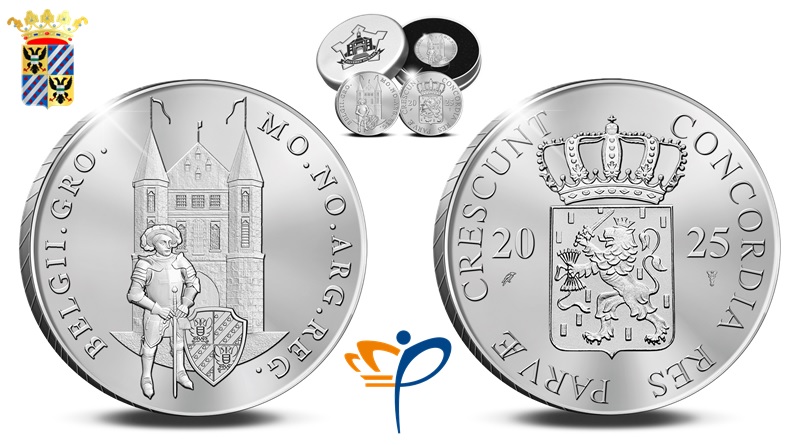
The obverse of the Poelepoort Gate silver ducat depicts Duke Karel van Egmond (1467 – 1538) in front of the famous building. The image is recreated from a photo of the replica gate which was re-built in 1879 showing the exterior view. The provincial crest of Groningen can be found on Duke Karel van Egmond’s shield. The inscription around the primary design reads MO.NO.ARG.REG.BELGII.GRO which is translated from Latin as Moneta Nova Argenta Regni Belgii (New Silver coin of the Kingdom of the Netherlands) GRO representing the province of Groningen. On the reverse of the Silver Ducat is the national crest of the Kingdom of the Netherlands with the Royal Crown placed between the two numerals of the year 2025. The inscription reads CONCORDIA RES PARVAE CRESCUNT, translated as Unity makes Strength which is placed around the crest along the rim. The mintmaster’s privy mark is placed just under the first two numerals of the year and the mintmark of the Royal Dutch Mint is shown just under the second two numerals.
| Denomination | Metal | Weight | Diameter | Quality | Mintage Limit |
| Ducat | .873 Silver | 28.2 g. | 40 mm. | Proof | 1500 |
Available from the 4th December, the coin is encapsulated and presented in a new reduced size metal round two-piece case accompanied with a certificate of authenticity. For additional information, please visit the e-webshop of the Royal Dutch Mint.

Download the Greysheet app for access to pricing, news, events and your subscriptions.
Subscribe Now.
Subscribe to RQ Red Book Quarterly for the industry's most respected pricing and to read more articles just like this.
Visit these great CDN Sponsors
CDN Sponsors




Author: Michael Alexander
 Michael’s background in both numismatics and banknotes spans more than three decades and whose activities have varied from being a dedicated world coin collector to coin & medal design, marketing, theme concept and production. His additional interests include banknote research and in 1997, he founded the London Banknote and Monetary Research Centre to further these interests and activities. The company continues to offer monthly currency bulletins to both online and printed publications which includes information about the latest banknote news and releases from Central Banks and Monetary Authorities around the world. Michael has been a contributor to COIN NEWS magazine based in the UK since 1998 where many of his in-depth interviews, articles and bulletins have been published.
Please sign in or register to leave a comment.
Your identity will be restricted to first name/last initial, or a user ID you create.
Comment
Comments