

Netherlands. New Gold and Silver Proof Restrikes Featuring Historic Golden Shield Design Released
The Royal Dutch Mint release a new restrikes featuring an exceptional historic coin design.
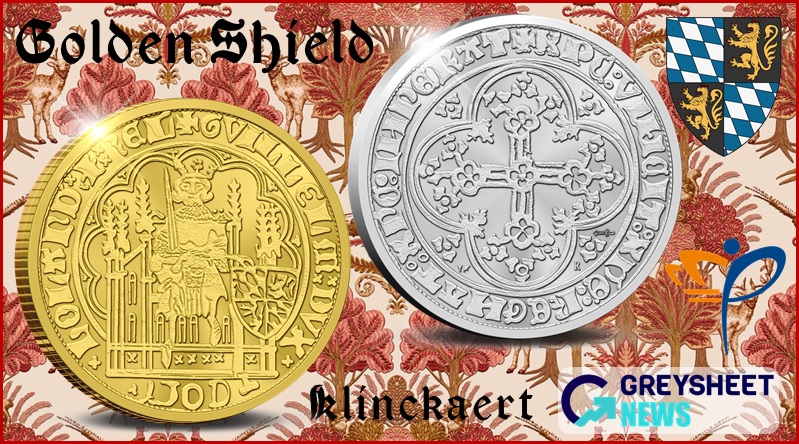
Golden Shields are the oldest gold coin minted in significant quantities in the Netherlands. Originally a coin with a weight of between 3.3 and 3.7 grams with a gold fineness of just over 70 percent and were mixed with other lesser metals to ensure durability in trade. Earlier Variations of the Golden shield coins were minted by the Duchy of Brabant in 1354, during the rule of Count Willem V of Holland who is credited with introducing the first gold coin of the County of Holland similar to the gold Ecu coins originating in France. Eventually, the coins were referred to as ‘Golden Shields’ in reference to the ornate and detailed crest. Depicted on the obverse, the shield of the Bavarian Royal House is shown next to the seated William I, Duke of Bavaria - who ruled in Holland as Count Willem V.
Under the rule of Albert of Bavaria which ended in 1404, the weight and gold content were reduced, after which the coins were colloquially dubbed as Klinckaert due to the distinct high ringing pitch the coins made when they hit counters or floors.
During the year 1411 in the Dutch city Dordrecht, the gold coins became widely used and sought after with a seated figure of Willem VI, son of Albert, Duke of Bavaria shown on the obverse. Count Willem’s Golden Shield coins were minted between 1411 and up to his death in 1417. Other notable Golden shield coins or, Klinckaerts were minted during the rule of Duke Philip of Bavaria from 1426 to 1427.
Ultimately, the Golden Shield coins were replaced with, or evolved into other gold coins of similar specifications when they were issued under successive rulers of Holland. Following the rule of the Wittelsbach dukes of Bavaria who ruled Holland, Hainaut, and Zeeland from 1346 to 1433, the House of Burgundy took control, followed by the House of Habsburg in 1482.
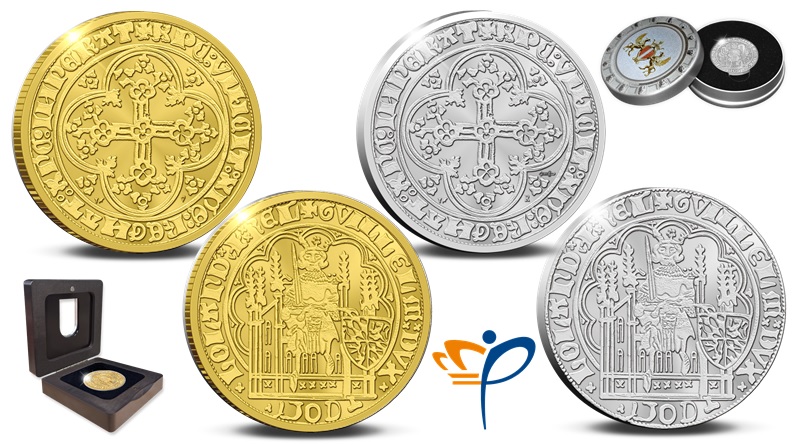
The Klinckaert coins are a tangible piece of Dutch numismatic history and, especially for the period in which it was minted they display a very impressive design. The restrike of the Klinckaert is based on the most famous variant of the Golden Shield, minted in 1411 during the rule of Count Willem VI. The impressive obverse depicts the Count seated on a Gothic throne with a sword in his right hand and with his left hand resting on a coat of arms of Holland-Bavaria. The Latin text GVILLELM DVX COM HOLAND Z ZEL (Willem, Duke and Count of Holland and Zeeland) encircles the coin. The reverse side depicts a cross surrounded by stylised floral elements and within a rounded cross shape. The abbreviated Latin inscription XPC VINCIT: XPC REGNAT: XPC IMPERAT: which translates as Christ conquers, Christ reigns, Christ commands) is shown along the rim surrounding the primary design.
| Denomination | Metal | Weight | Diameter | Quality | Maximum Mintage |
| Klinckaert | .999 Silver | 31.1 g. | 38.7 mm. | Proof | 200 |
| Klinckaert Piedfort | .999 Silver | 62.2 g. | 38.7 mm. | Proof | 100 |
| Klinckaert | .999 Gold | 31.1 g. | 38.7 mm. | Proof | 20 |
| Klinckaert Piedfort | .999 Gold | 62.2 g. | 38.7 mm. | Proof | 10 |
Available from the 19th February, the Klinckaerts are struck in gold and silver to proof quality in weights of one and two ounces. The gold restrikes are encapsulated and presented in a custom hardwood case accompanied with a numbered certificate of authenticity. The silver examples are encapsulated and presented in a two-piece pressed tin round case accompanied with a certificate of authenticity. For additional information, please visit the e-webshop of the Royal Dutch Mint.

Download the Greysheet app for access to pricing, news, events and your subscriptions.
Subscribe Now.
Subscribe to RQ Red Book Quarterly for the industry's most respected pricing and to read more articles just like this.
Visit these great CDN Sponsors
CDN Sponsors






Author: Michael Alexander
 Michael’s background in both numismatics and banknotes spans more than three decades and whose activities have varied from being a dedicated world coin collector to coin & medal design, marketing, theme concept and production. His additional interests include banknote research and in 1997, he founded the London Banknote and Monetary Research Centre to further these interests and activities. The company continues to offer monthly currency bulletins to both online and printed publications which includes information about the latest banknote news and releases from Central Banks and Monetary Authorities around the world. Michael has been a contributor to COIN NEWS magazine based in the UK since 1998 where many of his in-depth interviews, articles and bulletins have been published.

Please sign in or register to leave a comment.
Your identity will be restricted to first name/last initial, or a user ID you create.
Comment
Comments