

Lithuania. Unique Silver Proof Coins Highlight Europe-wide Emergency Access Number Service
The Bank of Lithuania release new innovative coins highlighting an important European Public service.
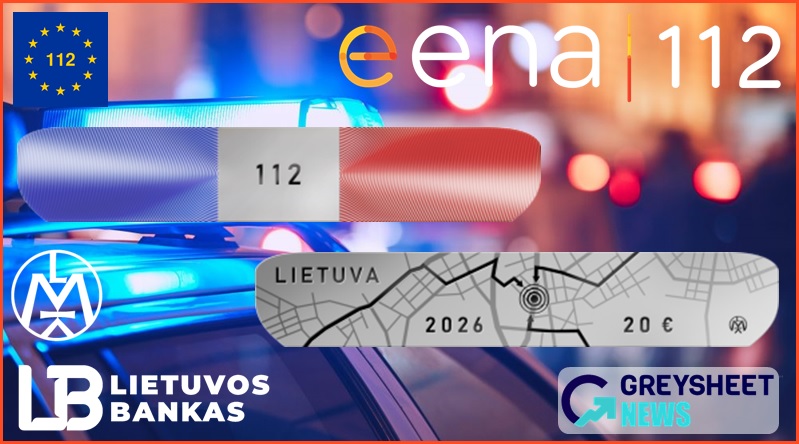
It was thirty five years ago in 1991 that by dialling 112 - the single European emergency number, the European Emergency Number Association - EENA ensured that Europeans can call the single European emergency number wherever they are in Europe, ensuring European citizens gain better access to all emergency services via new technologies. The concept of a Europe-wide emergency number was first initially adopted as a common European emergency number by the European Conference of Postal and Telecommunications CEPT in 1976, but gained traction when the Council of the EU established it as the EU’s common emergency number in 1991.
As part of the European-wide service, operators in many countries can answer calls not only in their home language but also in Standard English or French. If the caller does not know where they are, the operator will locate the person who made the call and will forward it to the emergency authorities so they can help immediately.
112 is accessible from both from landlines and cellular or mobile phones to contact any emergency service such as ambulance, the fire department or police. Specially trained operators will answer any 112 calls and handle the request directly or divert calls to the most appropriate emergency service depending on the national emergency services organisation. The emergency access number 112 functions alongside with existing national emergency numbers such as 999 in the United Kingdom. However countries such as Denmark, Estonia, Finland, Malta, the Netherlands, Portugal, Romania and Sweden have selected 112 as their only national emergency number. Since March 2022, all smartphones in the European single market can automatically access Global Navigation Satellite Systems along with the EU positioning system designed to enhance the 112-calls location resulting in faster response times.
From an early age, every European child and young person is taught what to do in the event of an accident or fire. Parents and educators teach children what number to call and what to do when something goes wrong to ensure they will know how to act in case an accident actually occurs. A symbol of a shared responsibility and solidarity, 112 has demonstrated itself as a continental-wide service of modern safety, reminding Europeans that in critical situations, the most important thing is a swift action and trust from those men and women trained to help.
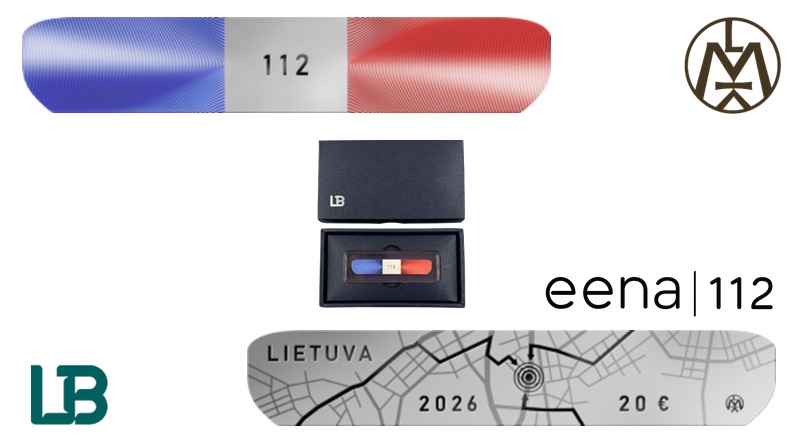
The proof and colour silver coins are minted by the Lithuanian Mint at their facilities in Vilnius on behalf of the Bank of Lithuania and designed by Tomas Dragūnas. The uniquely-shaped coin utilises an Isosceles trapezium with differently rounded corners. The obverse side of the coin features blue and red emergency response colours as a symbol of the joint mission and dynamic activities of the emergency services. The refraction of light texture behind the blue and red translucent colours utilising UV printing technology creates a subtle flickering effect. At the centre of the coin is the number 112. The reverse side features a composition depicting a fragment of a city map with a pulsating or focal point to which all three highlighted routes representing the ambulance, fire brigade and police lead to. The text LIETUVA (Lithuania) is shown near the upper left, the year of issue 2026 is seen just to the lower centre and the denomination €20 is placed near the lower right. The mintmark of the Lithuanian Mint can be seen near the lower right corner.
| Denomination | Metal | Weight | Dimensions | Quality | Mintage Limit |
| 20 Euro | .925 Silver | 28 g. | 70 mm. / 13 mm. | Proof & Colour | 2500 |
Available from the 19th February, each proof coin is specially encapsulated to accommodate its shape and presented in a heavy-gauge two-piece card case accompanied with a certificate of authenticity. For additional information, please visit the e-webshop of the Lithuanian Mint.
Download the Greysheet app for access to pricing, news, events and your subscriptions.
Subscribe Now.
Subscribe to RQ Red Book Quarterly for the industry's most respected pricing and to read more articles just like this.
Visit these great CDN Sponsors
CDN Sponsors



Author: Michael Alexander
 Michael’s background in both numismatics and banknotes spans more than three decades and whose activities have varied from being a dedicated world coin collector to coin & medal design, marketing, theme concept and production. His additional interests include banknote research and in 1997, he founded the London Banknote and Monetary Research Centre to further these interests and activities. The company continues to offer monthly currency bulletins to both online and printed publications which includes information about the latest banknote news and releases from Central Banks and Monetary Authorities around the world. Michael has been a contributor to COIN NEWS magazine based in the UK since 1998 where many of his in-depth interviews, articles and bulletins have been published.
Please sign in or register to leave a comment.
Your identity will be restricted to first name/last initial, or a user ID you create.
Comment
Comments