




 Whitman Expo
Ireland. New Silver Proof Coins Released in Tribute to Playwright Seán O’Casey
The Central Bank of Ireland release new silver proof coins marking an important literary anniversary.
by Michael Alexander |
Published on April 3, 2026

Download the Greysheet app for access to pricing, news, events and your subscriptions.
Subscribe to RQ Red Book Quarterly for the industry's most respected pricing and to read more articles just like this.
Advertisement
Irish playwright Sean O’Casey (1880 - 1964) is renowned for realistic dramas of the Dublin slums during war and revolution in which tragedy and comedy are juxtaposed in a way not previously experienced in the theatre of his time. This year marks the centenary anniversary of the production of The Plough and the Stars which triggered some of the most significant riots in Irish theatrical history.
Born into a lower middle-class Irish Protestant family, his father died when he was just six years old and thereafter the family became progressively poorer. With only three years of formal schooling, he started work at 14, mostly at manual labour, including several years with the Irish railways. He educated himself by reading at the same time O’Casey became interested in the cause of Irish nationalism. It was this time that he changed his first name from ‘John’ to its Irish form ‘Sean’ and learned Gaelic. His attitudes and eventually his writings were greatly influenced by the poverty and squalor he lived through and witnessed in Dublin’s slums and by the teachings of the Irish labour leader Jim Larkin.
At this time, O’Casey became active in the labour movement and also began to write articles for the Irish Worker newspaper. O’Casey also became a member of the Irish Citizen Army, a paramilitary arm of the Irish labour unions, but disillusioned with their political stance, he turned to writing drama and comedy stories with a message of societal irony.
Although several of his plays had been rejected, in 1923 the Abbey Theatre in Dublin agreed to produce The Shadow of a Gunman, set during the guerrilla strife between the Irish Republican Army and British forces. In 1924 the Abbey staged Juno and the Paycock, which would become his most popular play, with a backdrop set during the period of civil war over the terms of Irish independence. However, it was his work entitled The Plough and the Stars in 1926 with the 1916 Easter Rising as its background. Driven by public outrage over its un-heroic portrayal of the 1916 Easter Rising fighters and protestors, the play caused significant controversy and riots, as well as personal trauma for O'Casey. The aftermath saw intense public debate regarding artistic freedom. While the play caused significant controversy and riots, its opening run lasted for just seven nights. This incident solidified the belief that O’Casey’s plays had gained a reputation for eliciting an explosive effect on the audiences and which also inadvertently helped to broaden the Abbey theatre’s own appeal and standing.
That same year, O’Casey went to England in 1926, where he met the Irish actress Eileen Carey Reynolds and married her. O’Casey made England his permanent home, his decision to do so was largely motivated by the reaction of the audience to the production of The Plough and the Stars. In 1929, the Abbey rejected his latest play entitled The Silver Tassie and considered a departure from his previous style, and eventually staged in England. O’Casey is most remembered for his three indisputably great tragicomedy plays, The Shadow of a Gunman, Juno and the Paycock and The Plough and the Stars.
His later plays were given to fantasy and ritual and which were directed against the life-denying puritanism he thought had beset Ireland. His last full-length play was a satire on Dublin intellectuals entitled Behind the Green Curtains published 1961. O’Casey died in September 1964 at the age of 84, at his home in Torquay, Devon and was cremated at the Golders Green Crematorium. He was survived by his wife Eileen (1903 - 1995) and two of their three children, his son Breon and daughter Shivaun.
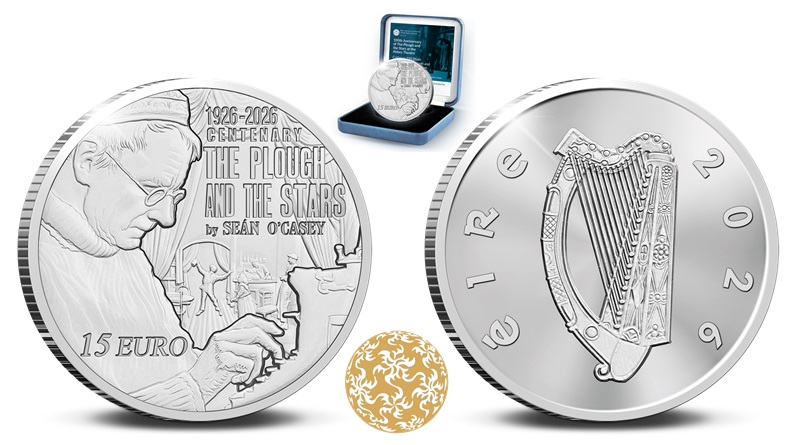
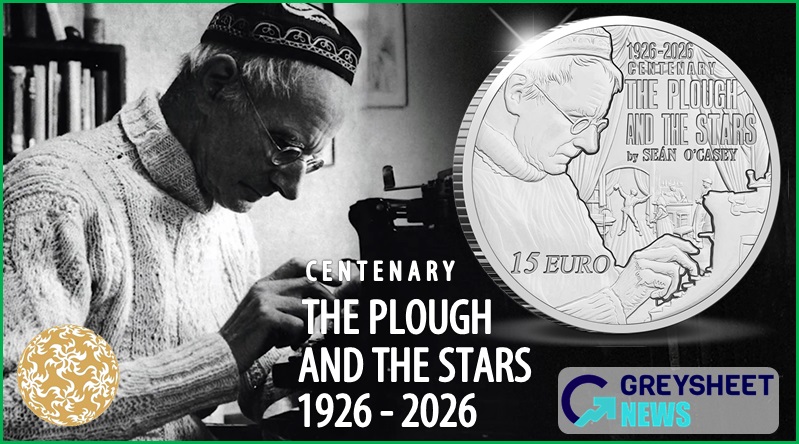
The silver proof coins are produced by the Royal Dutch Mint at their facilities in Houten, Netherlands on behalf of the Central Bank of Ireland. Designed by PJ Lynch, the obverse side features a portrait of Seán O'Casey based on a photograph by Wolfgang Suschitzky circa 1955. He is shown seated at his typewriter with spectacles and wearing a decorated skull cap. In the background field is an image of O’Casey’s play staged at the Abbey Theatre. Superimposed and to the right is the commemorative inscription 1926 – 2026 CENTENARY THE PLOUGH AND THE STARS by SEAN O’CASEY. Just under the portrait of O’Casey to the left is the denomination 15 EURO. The reverse side depicts the national insignia of Ireland, the cláirseach or Celtic harp which is centred. The text EIRE and 2026 are positioned on either side of the harp.
| Denomination | Metal | Weight | Diameter | Quality | Mintage Limit |
| 15 Euro | .925 Silver | 28.2 g. | 38.6 mm. | Proof | 3000 |
Available from the 30th March, each coin is encapsulated and presented in a Central Bank of Ireland branded custom case accompanied with a certificate of authenticity. For additional information on this and other coins available from the Central Bank, please visit their retail website.
Related Stories (powered by Greysheet News)
View all news
The Royal Mint of Belgium release a new bullion range of 'Belga' gold coins.

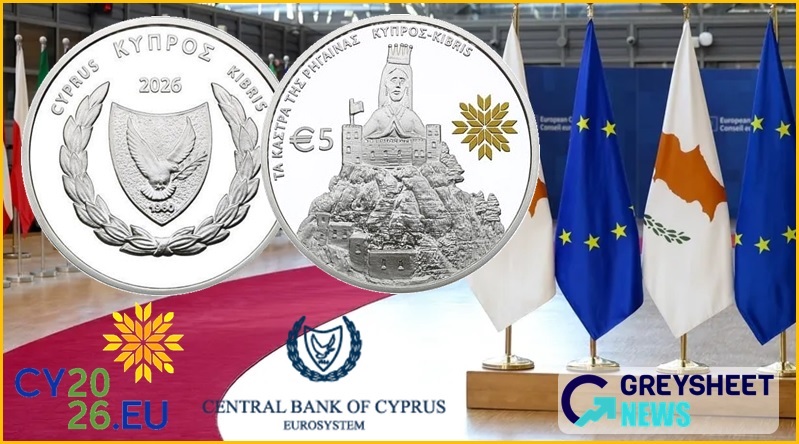
The Central Bank of Cyprus release new silver collector coins with an important EU-theme.
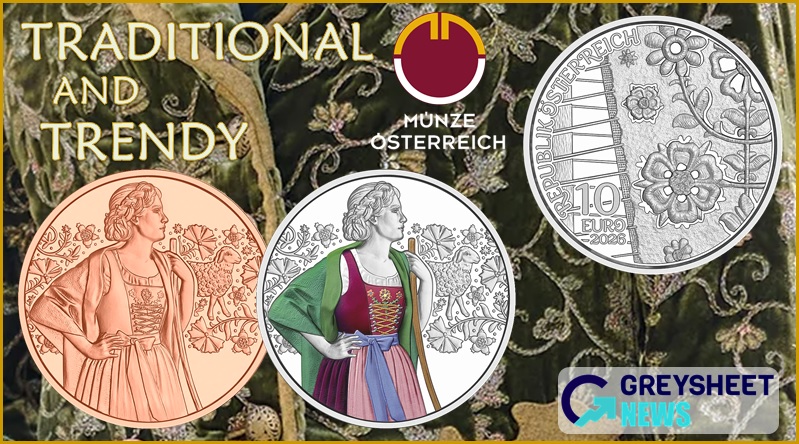
The Austrian Mint release the latest collector coins focusing on traditional Austrian attire.
Please sign in or register to leave a comment.
Your identity will be restricted to first name/last initial, or a user ID you create.
Comment
Comments