




 Whitman Expo
Greece. New Silver Proof Coins Dedicated to Ancient Astronomer Aristarchos of Samos
The Bank of Greece release new silver proof collector coins honouring a pioneer in Astronomy.
by Michael Alexander |
Published on March 13, 2026

Download the Greysheet app for access to pricing, news, events and your subscriptions.
Subscribe to RQ Red Book Quarterly for the industry's most respected pricing and to read more articles just like this.
Advertisement
As part of the Greek Culture series launched in 2012, the latest release focuses on perhaps one of the most celebrated ancient Greek astronomers and mathematicians. Aristarchus (c. 310-230 BC) was a brilliant astronomer and mathematician who made significant contributions to our understanding of the universe more than two millennia ago.
Born on the small island of Samos, he became a student of Strato of Lampsacus (335 – 269 BC) eminent philosopher who was himself the third head of the Peripatetic School in Athens. Aristarchos is credited with the invention of an improved sundial and also wrote on vision, light, and colours. His only existing work entitled On the sizes and distances of the sun and the moon, in which he has not yet challenged the earth-centred model. In a treatise that has not survived, he was the first to put forward the heliocentric theory. According to Archimedes of Syracuse (c. 287 – c. 212 BC) the Ancient Greek mathematician, physicist, engineer, astronomer, and inventor stated that Aristarchos hypothesised the fixed stars and the sun remain unmoved, and that the Earth revolves around the sun in the circumference of a circle with the sun at the centre. Accused of impiety for his revolutionary theory, he left Athens for the Greek city of Alexandria in Ptolemaic Egypt, and his work was ignored. Almost two thousand years would pass for the heliocentric theory to be revived by Nicolaus Copernicus (1473–1543) the Polish Renaissance astronomer who did mention the theory of Aristarchos in a passage that he afterwards omitted from the published version of his theory entitled On the revolutions of the heavenly orbs.
In addition to his work on the heliocentric model, Aristarchus also made contributions to mathematics and astronomy. He calculated the circumference of the Earth and the distance to the Moon. He also studied the motion of the planets and the stars. Vitruvius ( c. 80–70 BC – c. 15 BC) the Roman architect and engineer during the 1st century BC declared that Aristarchos was among those rare polymaths who were equally versed in geometry, astronomy, music and other arts.
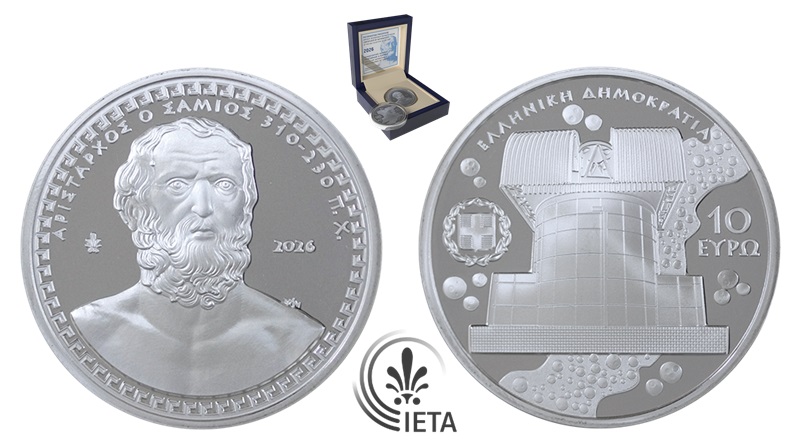
The silver proof coins are produced by the Hellenic Mint on behalf of the Bank of Greece and designed by senior engraver George Stamatopoulos. The obverse side includes an image of Aristarchos based on a marble bust and centred. The primary design is surrounded by a traditional Greek Key border placed along the rim. Within the border and above the likeness of Aristarchos is the text ΑΡΙΣΤΑΡΧΟΣ Ο ΣΑΜΙΟΣ 310 – 230 Π. Χ. (Aristarchos of Samos 310 – 230 BC) To the left of the bust is the distinctive palmette mintmark denoting the Greek Mint and to the right, the year of issue, 2026. The reverse side depicts the Aristarchos Telescope Observatory located on Mount Chelmos, Greece and named in honour of the ancient astronomer. It is the largest telescope in the country first launched in 2005. To the left of the Observatory is a small crest of the Hellenic Republic. Above the primary design along the upper rim is the text ΕΛΛΗΝΙΚΉ ΔΗΜΟΚΡΑΤΊΑ (Hellenic Republic) with the coins’ denomination 10 EYPΩ (10 Euro) shown just to the right of the Observatory.
| Denomination | Metal | Weight | Diameter | Quality | Maximum Mintage |
| 10 Euro | .925 Silver | 34.1 g. | 40 mm. | Proof | 1500 |
Available from the 17th March, the coins are encapsulated and presented in a Bank of Greece-branded custom polished hardwood case accompanied with a certificate of authenticity. For additional information, please visit the collector services webpage of the Bank of Greece.
Related Stories (powered by Greysheet News)
View all news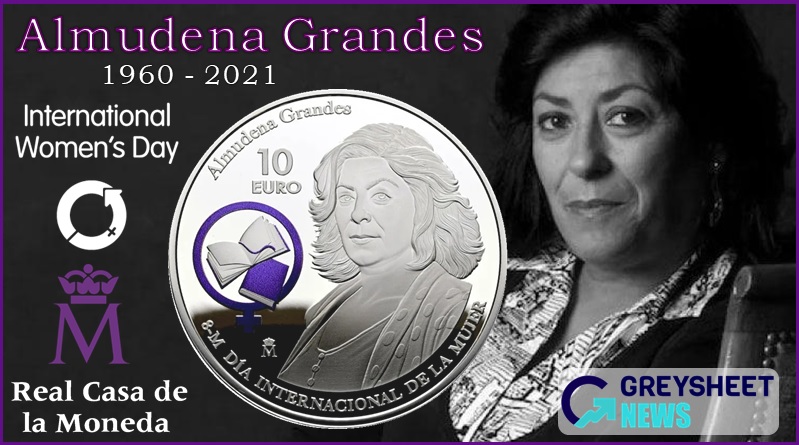
The Fábrica Nacional De Moneda Y Timbre release their sixth coin marking International Women's Day.


The Royal Canadian Mint release an impressive collection of collector coins celebrating the World Cup.
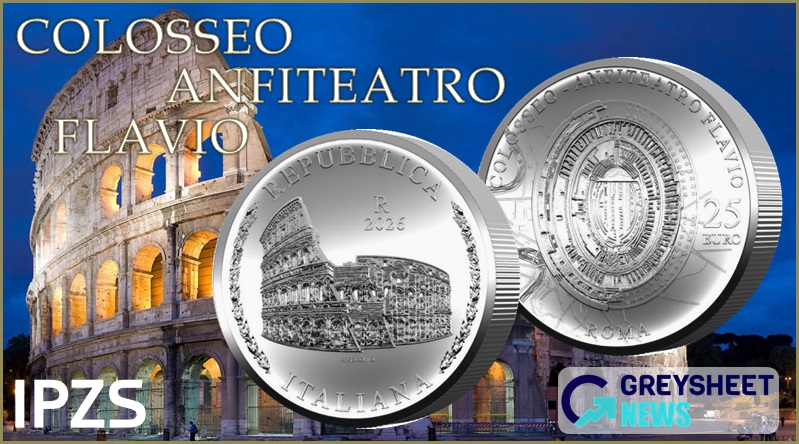
The Istituto Poligrafico -IPZS release new silver proof one-kilo commemorative coins.
Please sign in or register to leave a comment.
Your identity will be restricted to first name/last initial, or a user ID you create.
Comment
Comments