




 Whitman Expo
From Stellas to Standouts: Heritage’s Star-Studded CSNS U.S. Coins Auction Features Elite Rarities
All four gold stellas, 1933 Indian eagle and featured collections among highlights at April 29-May 2 event.
by Heritage Auctions |
Published on April 18, 2026

Download the Greysheet app for access to pricing, news, events and your subscriptions.
Subscribe to The Greysheet for the industry's most respected pricing and to read more articles just like this.
Advertisement
Stellas have long been among the most popular U.S. coins, eagerly pursued by the most serious of collectors. Struck by the U.S. mint in 1879-80, stellas are pattern coins never meant for general circulation, an experiment to create an international coin that would more closely align U.S. and European currency.
A full group of all four gold stella issues will be among the top attractions in the Presidio Collection, Part II at Heritage’s April 29-May 2 CSNS US Coins Signature® Auction, at which Heritage again is the official auctioneer.
“The Presidio is an exceptional collection, and has provided bedrock rarities throughout the Platinum Session of this event,” says Todd Imhof, Executive Vice President at Heritage Auctions. “The selection of the four stella issues is an incredible cross-section of one of the most prized groups of rarities in all of U.S. gold coinage.”
Included in this group is a magnificent 1880 Coiled Hair Stella, Judd-1660, Pollock-1860, JD-1, Low R.7, PR62 NGCthat is one of only a handful of surviving examples of the rarest of the four varieties. The 1880 Coiled Hair, which originally was struck along with a goloid dollar and metric dollar in three-coin sets, has a known population today of just 10 pieces, one of which is in the Smithsonian.
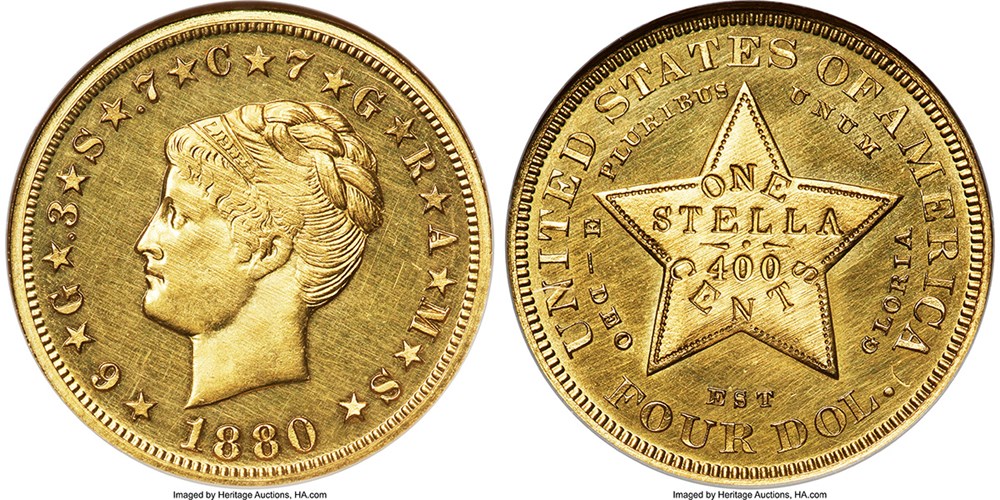
The Presidio Collection also includes an 1880 Flowing Hair Stella, Judd-1657, Pollock-1857, JD-1, R.6, PR65 NGC. CACthat is one of just 18 examples traced and tied for the finest among CAC-certified survivors. The stellas that exist today are technically patterns, but have been collected with regular U.S. issues since they were minted. The pedigree for this must-have coin from a minuscule population is amplified by its past spot in the famed Eliasberg Collection.
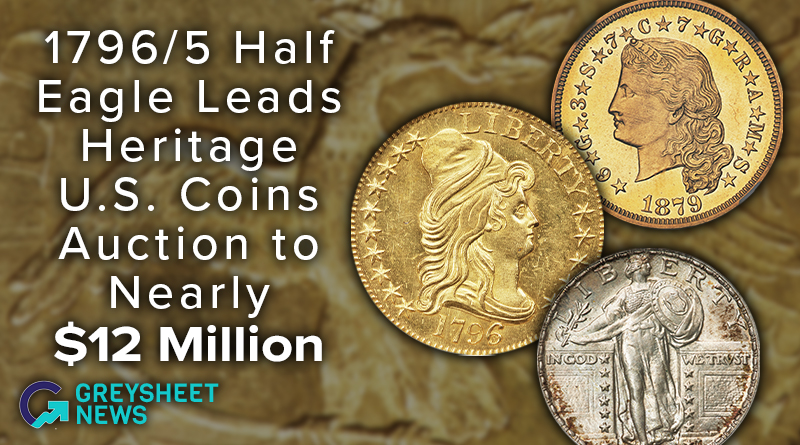
Also offered in this auction is one of just 14 examples traced of an 1879 Coiled Hair Stella, Judd-1638, Pollock-1838, JD-1, R.6, PR67 Cameo NGC that is among the rarest and most valuable issues in American numismatics. PCGS CoinFacts estimates the surviving population at 12-15 examples in all grades, which agrees closely with John Dannreuther’s estimate of 12-14. The offered example was purchased privately, and no record of prior auction appearances has been found.
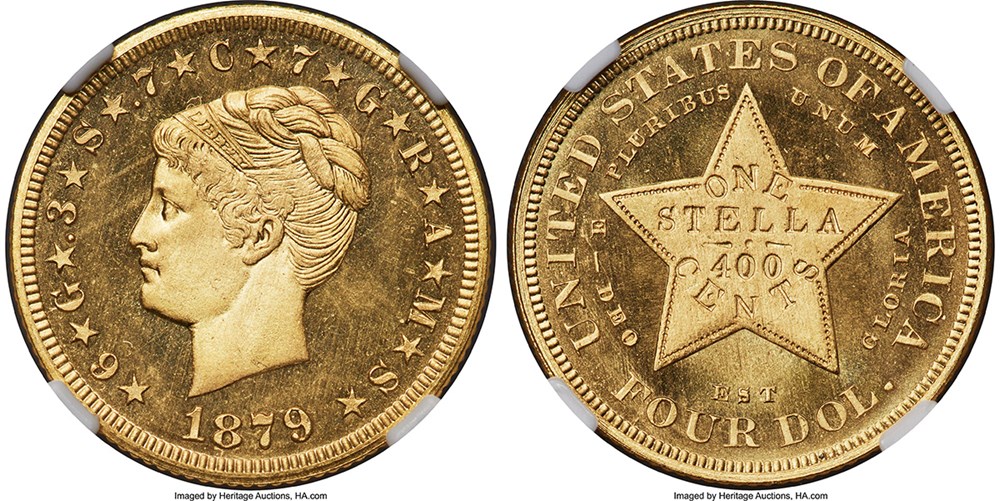
The most readily available of the stella varieties, but still an important must-have part of any collection, is the 1879 Flowing Hair Stella, Judd-1635, Pollock-1833, JD-1, R.3, PR65 Cameo NGC … but that does not change the fact that they are anything but common.
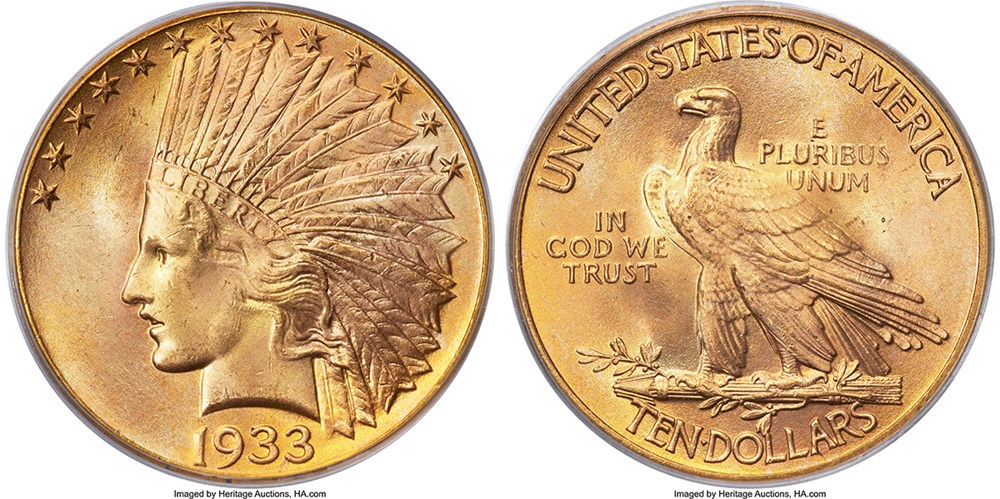
Another treasure from the Presidio Collection is a 1933 Indian Eagle, MS65 PCGS. CAC. PCGS CoinFacts estimates the surviving population at 30-40 examples in all grades, while Q. David Bowers offers a slightly larger estimate of 45-60 specimens. Heritage currently has traced only 24 examples. This example first surfaced in the collection of Louis E. Eliasberg, Sr., the only numismatist ever to complete a full collection of U.S. federal coinage by date, mintmark and major variety. It was later a highlight of several famous collections, including the fabulous Floyd Starr Collection and the remarkable collection of John Kutasi. It has not been publicly offered since 2008, making it entirely fresh to the market.
The Pizza Collection
The Presidio is one of several exceptional collections in the auction — a list that also includes the “Pizza Collection,” a 108-lot assemblage that received its pedigree from its consignor, a former pizzeria owner who collected Standing Liberty quarters and Morgan dollars due to their scarce issues and the challenge they represented.
Among the highlights in the collection is an 1893-S Morgan Dollar, MS63 PCGS. From a series-low business-strike mintage of 100,000 pieces, the 1893-S Morgan dollar is the acknowledged key to the extremely popular series, called “… the object of great desire in the Mordan dollar series” by Q. David Bowers. There was little commercial demand for silver dollars in 1893, and they generated little interest at auction or in numismatic publications in the late 19th and early 20th century. The coin offered here is a spectacular Select specimen, an exceptional example of this landmark Morgan dollar rarity. The 1893-S Morgan dollar is listed among the 100Greatest U.S. Coins. The PCGS Population includes just 10 graded in 63, with only 10 graded finer.
Another treasure from the collection is a 1927-S Quarter, MS65+ Full Head PCGS. CAC that has not been seen at Heritage in nearly two decades, and 16 years since it was offered at auction, evidence of how tightly the best specimens are held by collectors. There are just eight Full Head 1927-S quarters that have been publicly documented MS65 or finer, the finest of which is an MS66+ Full Head PCGS coin that has never appeared at auction. The example offered here ranks fourth, the only MS65 Full Head to have a Plus designation and the finer of just two Condition Census Full Head pieces with CAC endorsement.
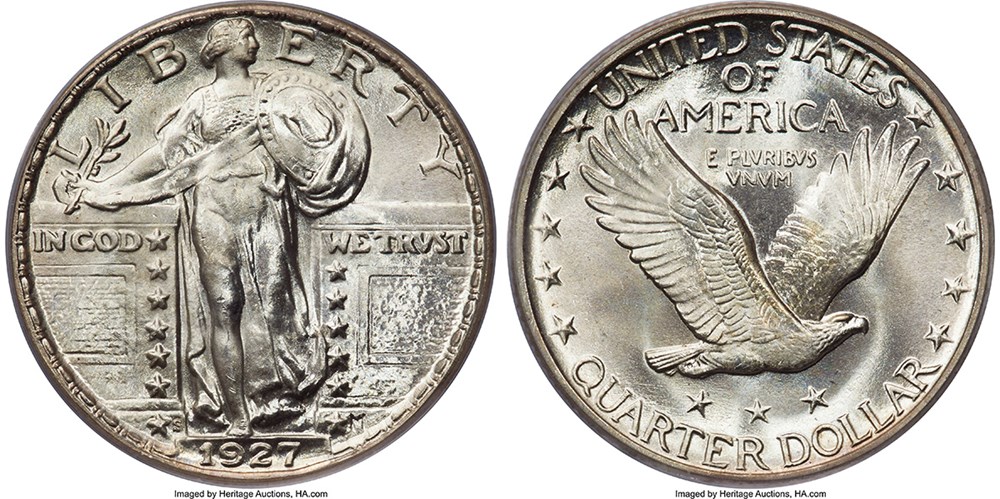
Also in play is a 1916 Standing Liberty Quarter, Judd-1989, Pollock-2050, R.8, PR61 NGC. Pattern Standing Liberty quarters are some of the rarest trial coins known, residing only in the Smithsonian Institution and the most prestigious private collections. This outstanding example was discovered in 2018, when it came to Heritage in an old-time collection, masquerading as a normal 1916. It was fitting that it was acquired in that offering by the builder of The Pizza Collection, whose Standing Liberty quarter set is one of the most impressive ever seen at Heritage. Both other privately held pattern Standing Liberty quarters (the other Judd-1989 and the Judd-1988) are tightly kept off the market. The offered coin is one of just two Judd-1989 examples.
A 1918/7-S Quarter FS-101 MS64 Full Head PCGS is an excellent example of an overdate that is, in terms of scarcity, the top key in the Standing Liberty quarter series. The example offered shares the second-highest grade with six other MS64 Full Head coins, and no records of prior auction appearances have been found. Some of the Condition Census Full Head 1918/17 quarters have traded hands several times, while others have not been seen at auction in many years. Even most of the current high-ranking PCGS Registry Sets lack a Full Head example of the overdate.
Also offered is the finest 1919-D MS67 Full Head Quarter PCGS. This Denver issue is among the scarcest dates with Full Head sharpness, and it is even rarer in high-grade Full Head. The 1919-D is among the most challenging Full Head acquisitions, with only eight confirmed in MS66 or finer Full Head. Several have made it to auction in the last decade, but the MS67 coin offered here is the finest, last appearing at auction in 2012.
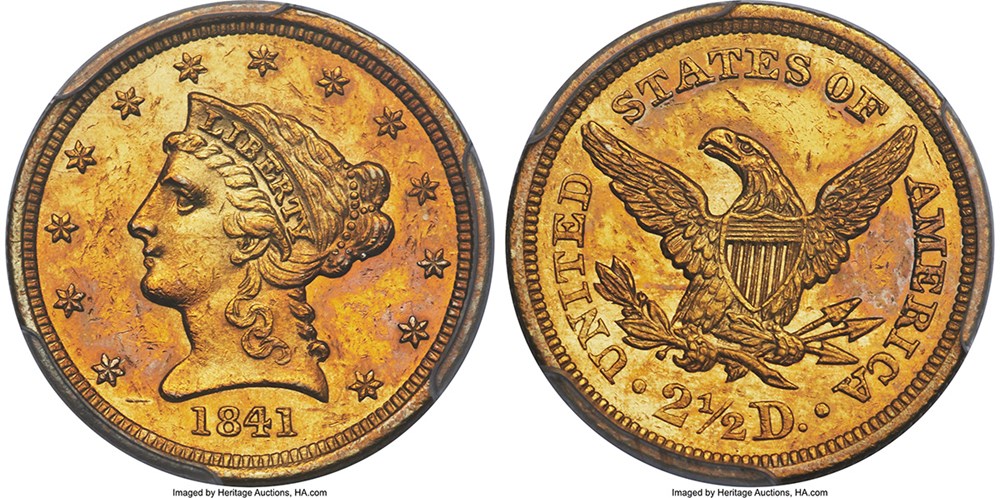
Many of the auction’s top lots are not part of a featured collection. Among them is the finest-certified business-strike 1841 Liberty Quarter Eagle MS61 PCGS. The 1841 Liberty quarter eagle is a landmark rarity in the popular U.S. gold series, of which the surviving population has been estimated by Dannreuther at 14-18 in all grades and by PCGS CoinFacts at 12-13 in business strike formats, including four proofs. Between them, PCGS and NGC have combined to certify 18 coins, a total that includes an unknown number of resubmissions and crossovers. Three examples are housed in institutional collections at the Smithsonian Institution and the Connecticut State Library.
Also offered is an exceedingly rare 1866 Liberty Half Eagle, PR66 Cameo PCGS that will be a magnificent addition to the finest collection or Registry Set. This is a rare issue in proof format, one of just 11 survivors traced of a coin of which just 30 examples were struck. PCGS CoinFacts estimates a surviving population of 15-20, while Dannreuther estimates 10-12 specimens extant … but acknowledges a few more might survive because of “uncertainty as to the previous owners of several examples.” PCGS and NGC have certified 16 between them, including an unknown number of resubmissions and crossovers. Two are in institutional collections at the Smithsonian Institution and the American Numismatic Society.
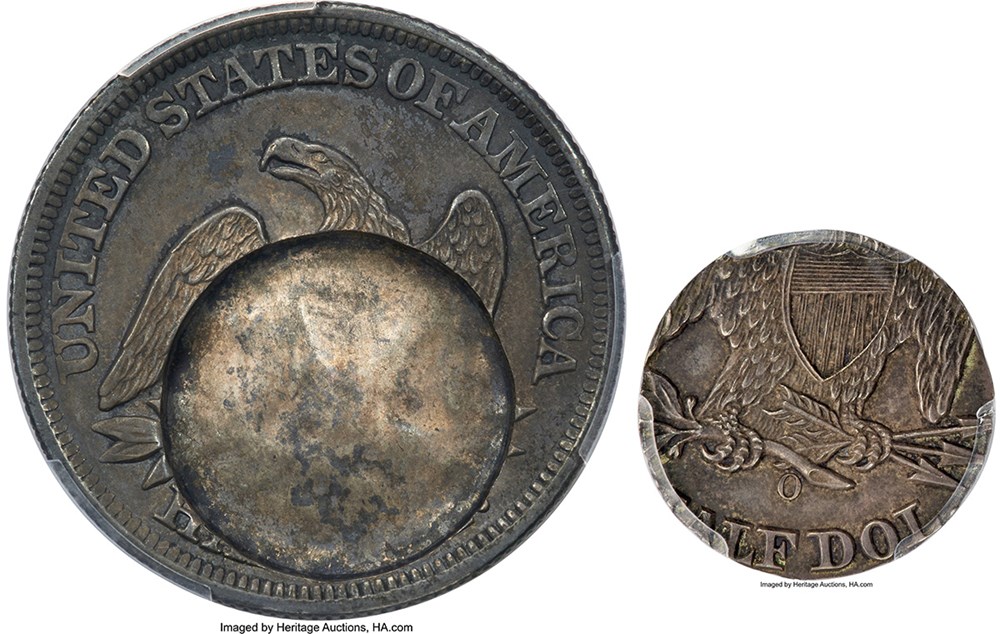
Error coins are extremely popular with some collectors, who will be drawn to an 1860-O Half Dollar — Indented by Half Dime Planchet, Mated Pair — MS63 PCGS. The so-called “55-cent piece,” from the “Weird Vertical Stripes” variety, with crude vertical lines on the eagle’s shield, is an amazing mint error involving planchets of two different denominations. A half dime planchet and a half dollar planchet were fed together between half dollar dies, with the half dime planchet situated between the half dollar planchet and the reverse die. The half dollar planchet was indented by the half dime planchet during the strike, creating a mated error pair. Each of the coins on its own would be a spectacular error find, yet the two coins have remained together since the year Abraham Lincoln was elected President.
A few coins produced during the redesign of U.S. coinage in the early 20th century, including a 1922 Modified High Relief Peace Dollar Production Trial, Judd-2020, MS65 PCGS. CAC. Subtype 2-A that will be in play in this auction, are specifically and individually referenced in contemporary Mint correspondence. In the left obverse field is its defining feature, the number “3200” written to indicate that this was the last coin struck from the modified relief 1922 dies before they failed. Just six Modified High Relief 1922 Peace dollars from these dies, two of which are in circulated condition, are currently documented to survive, including two proofs and four with a business strike finish. Of the six survivors, the coin offered in this auction is the finest of the non-proof specimens and the only one with the “3200” inscription.
Other top lots in the auction include, but are not limited to:
• An 1854 Kellogg Twenty Dollar Copper Die Trial MS64 Brown PCGS. K-1
• An 1879 Flowing Hair Stella, Judd-1635, Pollock-1833, JD-1, R.3, PR65 PCGS. CAC
• An 1854 Three Dollar Gold JD-1, Low R.7, PR62 PCGS
• A 1926-S Quarter MS66+ Full Head PCGS. CAC
Images and information about all lots in the auction can be found at HA.com/1393.

Related Stories (powered by Greysheet News)
View all news
1837 Warsaw-minted 20 Zlotych leads event at $73,200.

Early U.S. gold rarities, an 1879 Flowing Hair Stella and S.S. Central America ingots power strong results in March 26-28 event

Scarce Yorktown Continental issues, high-grade Franklin & Hall Pennsylvania Bills of Credit also among March 8 event highlights.
Please sign in or register to leave a comment.
Your identity will be restricted to first name/last initial, or a user ID you create.
Comment
Comments