

Cyprus. New Silver Proof Coins Remembering the Campaign for Self-Rule and Liberation
The Central Bank of Cyprus release their latest silver collector coins honouring a national hero.
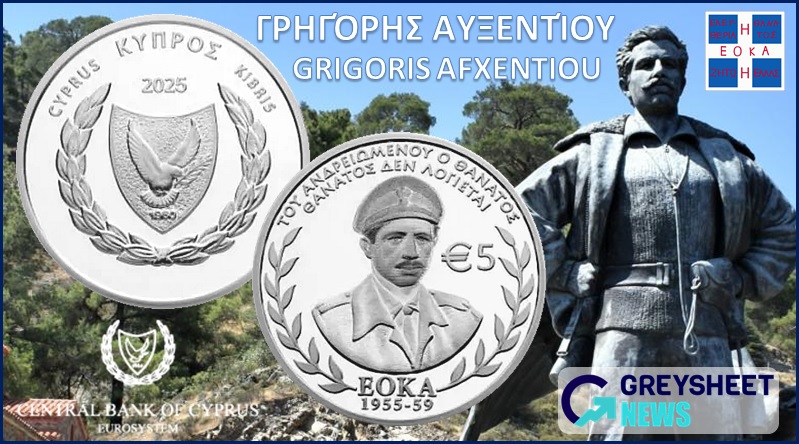
2025 marks the 70th anniversary of the establishment of the Ethniki Organosis Kyprion Agoniston - EOKA which translates as the National Organisation of Cypriot Fighters. Their aim was to fight for the end of British rule in Cyprus and for an eventual union with Greece.
The island of Cyprus is in the Eastern Mediterranean and has had a Greek demographic cultural presence dating back thousands of years, visible in its language, religion, and traditions. The island was conquered by the Ottoman Empire in 1571 but prior to this time it had never been under Turkish rule, having been governed at different times by Greek, Byzantine and Latin powers. Following the Russo-Turkish War fought between 1877 and 1878, control of Cyprus was lost by the Ottomans and transferred to British administration in June 1878.
Initially, Greek Cypriots welcomed British rule as they were aware that the British had returned the Ionian Islands to Greece in 1864 and hoped they would facilitate Cyprus’ union with Greece. They were also hopeful for British investment in Cyprus, which the Ottoman occupation left as an impoverished island. With the appointment of a new pro-Hellenic governor of Cyprus by the British in 1926, this fostered the idea among Greek Cypriot nationalists that British rule would be a stepping stone for the eventual union with Greece. Two years later was the 50th anniversary of British administration on the island which most Greek Cypriots had refused to acknowledge. Many had begun to take part in acts of civil disobedience and displayed the Greek flag in place of the British flag in public government buildings.
In 1955, the Ethniki Organosis Kyprion Agoniston - EOKA (National Organisation of Cypriot Fighters) was formed with an aim to end of British rule in Cyprus and for eventual union with Greece. At the time, Cyprus’ minority Turkish population consisted of almost 18 percent and who were against union with Greece, as was the Turkish government in Ankara. Headed by Georgios Grivas, a Greek Army officer veteran of World War I and World War II, EOKA’s second in command was Grigoris Afxentiou, also a former officer of the Greek army. Afxentiou had graduated from the reserves Officers Academy in 1950 without previous experience on battlefield tactics.
In the spring of 1955, he conducted attacks against the Cyprus Broadcasting Corporation and since the day of these attacks, he was placed at the top of the list of most wanted men by the colonial government. Initially, a reward of £250 for his arrest was posted which was soon raised to £1000 and then £5000 – a considerable amount at the time. With a bounty on his head, Afxentiou went into hiding in the Pentadactylos mountain range where he trained EOKA fighters on weapon use and guerrilla warfare. Georgios Grivas moved Afxentiou to the Troodos mountain range and to his own hideout in the small town of Spilia. Having moved again to a secret hideout near the Machairas Monastery near the village of Lazanias with four fellow guerrilla fighters in March 1957, an informant had betrayed his location to British troops who surrounded Afxentiou. The British soldiers asked Afxentiou to surrender his weapons, to which he replied "come and take them", quoting Leonidas I of Sparta. Afxentiou then opened fire with his submachine gun, killing a corporal. Realising Afxentiou would not surrender, the Royal Engineers poured petrol down the slope into the dugout and set it on fire. The British buried his body was buried by the British authorities at the Imprisoned Graves in the yard of the Central Jail of Nicosia where he remains interred to this day.
The activities of EOKA before their disbandment in 1959 resulted in the deaths of 104 British soldiers, 54 policemen including 15 Greek Cypriots, 22 Turkish Cypriots and 12 British as well as 238 civilian citizens. Cyprus was never united with Greece as had been EOKA’s objectives but rather, the island achieved full independence as a Republic within the Commonwealth of Nations which was recognised in October 1960.
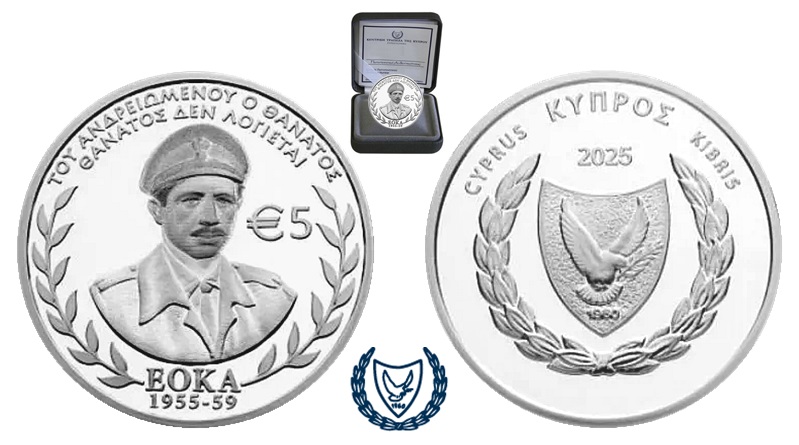
The silver proof coins were produced by the Bank of Greece’s Minting facilities in Athens and on behalf of The Central Bank of Cyprus. The obverse side features a depiction of EOKA fighter Grigoris Afxentiou, front-facing and based on a photograph. His image is surrounded by laurel branches. The text ΤΟΥ ΑΝΔΡΕΙΩΜΕΝΟΥ Ο ΘΑΝΑΤΟΣ ΘΑΝΑΤΟΣ ΔΕΝ ΛΟΓΙΕΤΑΙ (The death of a brave man is not considered death) is placed above the primary design along the upper rim. The commemorative inscription EOKA 1955-59 is placed under the image of Afxentiou and the denomination €5 is shown just to the right of the likeness of Afxentiou. The reverse side features the emblem of the Central Bank of Cyprus which is centred. Above the emblem is the text CYPRUS · ΚΥΠΡΟΣ · KIBRIS and the year 2025 is placed just under the text.
| Denomination | Metal | Weight | Diameter | Quality | Maximum Mintage |
| 5 Euro | .925 Silver | 28.2 g. | 38.6 mm. | Proof | 2000 |
Available from the 8th December, each coin is encapsulated and presented in a custom case accompanied with a certificate of authenticity. For additional information, please visit the retail webpage of the Central Bank of Cyprus.

Download the Greysheet app for access to pricing, news, events and your subscriptions.
Subscribe Now.
Subscribe to RQ Red Book Quarterly for the industry's most respected pricing and to read more articles just like this.
Visit these great CDN Sponsors
CDN Sponsors





Author: Michael Alexander
 Michael’s background in both numismatics and banknotes spans more than three decades and whose activities have varied from being a dedicated world coin collector to coin & medal design, marketing, theme concept and production. His additional interests include banknote research and in 1997, he founded the London Banknote and Monetary Research Centre to further these interests and activities. The company continues to offer monthly currency bulletins to both online and printed publications which includes information about the latest banknote news and releases from Central Banks and Monetary Authorities around the world. Michael has been a contributor to COIN NEWS magazine based in the UK since 1998 where many of his in-depth interviews, articles and bulletins have been published.
Please sign in or register to leave a comment.
Your identity will be restricted to first name/last initial, or a user ID you create.
Comment
Comments