



 Whitman Expo
Canada. New Commemorative $2 Coins Released to Remember 30 Years of the Toonie
The Royal Canadian Mint release commemorative $2 coins marking their first release in 1996.
by Michael Alexander |
Published on March 6, 2026

Download the Greysheet app for access to pricing, news, events and your subscriptions.
Subscribe to RQ Red Book Quarterly for the industry's most respected pricing and to read more articles just like this.
Advertisement
The Bank of Canada’s $2 banknote was issued as a definitive denomination since the establishment of national currency issued by their authority in 1935. However, as a measure of cost-saving, the Bank decided to discontinue the production of $2 banknotes and transition this denomination onto a circulation coin. The One dollar banknote had undergone the same successful transition in 1987. The last $2 banknotes were originally introduced into circulation from 1986 as part of the Birds of Canada series. In preparation for the introduction of the $2 coin, the $2 banknotes were officially withdrawn from circulation on the 16th February 1996, three days prior to the coin's introduction and to facilitate the widespread use. In further preparation, the Royal Canadian Mint had produced 275 million coins at their Winnipeg facility. The first $2 circulation type coins were released on the 19th February 1996 and are minted using a patented distinctive bi-metallic coin-locking mechanism. In a short time, the coin had begun to be referred to as the nickname so commonly used today – the toonie. The word used affectionately for the coin is a devised from the number ‘two’ and referencing the word ‘loonie’, a slang word for the Canadian one dollar coin – so called due to the loon bird depicted on the reverse.
The coin’s centre featured a lone polar bear created by Canadian artist Brent Townsend. Because of the motif, there had been suggestions the coin should be referred to as Nanuqs in honour of the Polar Bear standing on an ice floe depicted on the reverse. An informal national competition to name the bear resulted in the suggestion of "Churchill", a reference to the common polar bear sightings in Churchill, Manitoba but, toonie simply stuck with Canadians. The obverse side of the first coins depicted an effigy of HM Queen Elizabeth II created by Canadian artist Dora de Pedery Hunt which was introduced onto Canadian circulation coinage in 1990. Since their introduction, the $2 has become a favourite or preferred denomination for commemorative purposes with the first commemorative reverse having been released in 1999.
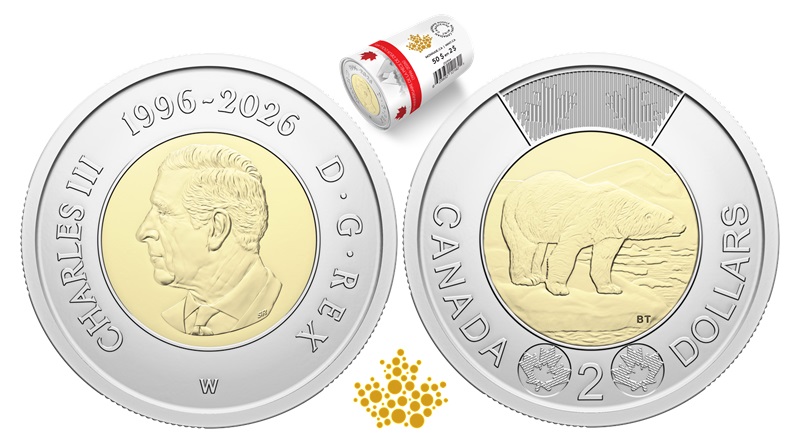
The coin has remained largely unaltered in its appearance, originally consisting of a copper alloy and a pure nickel outer ring. In 2012 the Mint revised its highest-value circulation coin by changing the composition to multi-ply plated steel. Advanced security features such as a latent-image application were also added to its surface. With the death of Queen Elizabeth II in 2022, the coin was minted with a black nickel outer ring in tribute to the passing of a beloved and respected Queen whose loss felt by millions of Canadians. Since 2023, the effigy of King Charles III created by Steven Rosati has been added to the $2 coin and all Canadian coinage.
| Denomination | Metal | Weight | Diameter | Quality | Mintage Limit |
| 2 Dollars | Bi-metallic | 6.99 g. | 28 mm. | UNC | 750,000 |
In celebration of this new milestone, the Royal Canadian Mint has issued a Collector’s Edition Non-Circulation Special Wrap Roll, limited to a mintage of 30,000 rolls containing 25 coins in each roll. For additional information, please visit the e-webshop of the Royal Canadian Mint.

Related Stories (powered by Greysheet News)
View all news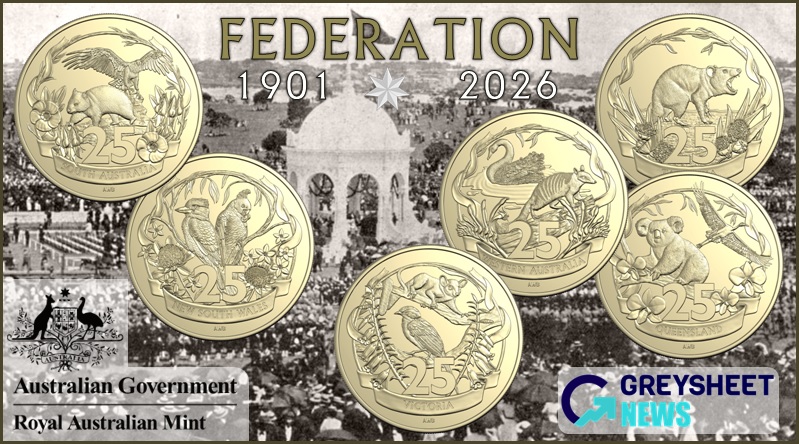
The Royal Australian Mint release new collector coins with a special denomination.


The Royal Mint release their latest coins in the on-going and popular Music Legends coin series.
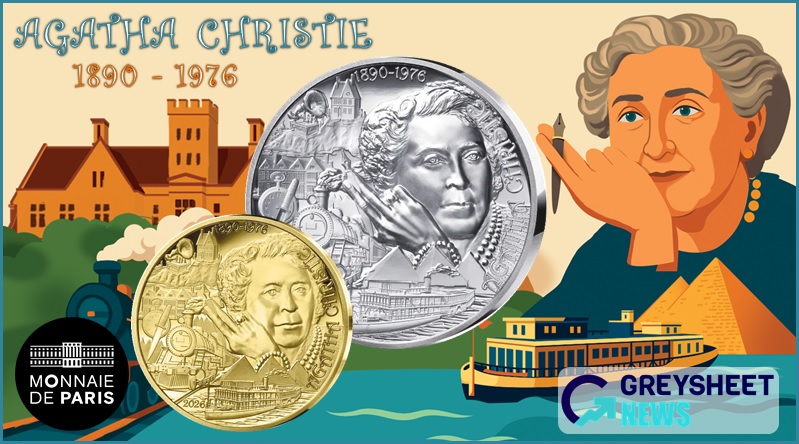
The Monnaie de Paris release new gold and silver coins highlighting beloved literary works.
Please sign in or register to leave a comment.
Your identity will be restricted to first name/last initial, or a user ID you create.
Comment
Comments