




 Whitman Expo
Australia. Latest Commemorative Coins Remembers Historic Battle and Brave Regiment
The Royal Australian Mint release coins marking a significant chapter in the country’s Military history.
by Michael Alexander |
Published on April 7, 2026

Download the Greysheet app for access to pricing, news, events and your subscriptions.
Subscribe to RQ Red Book Quarterly for the industry's most respected pricing and to read more articles just like this.
Advertisement
This year, Australia reflects on their involvement in the Korean War as the nation marks the 75th anniversary of the decisive Battle of Kapyong. This particular fight stands as one of Australia's most memorable victories, as they were one of the first to offer military assistance to the US and South Korea after the Democratic People’s Republic of Korea began its invasion into the south on July 25, 1950.
Australia’s troops and a brave Canadian contingent took part in the Battle from the 22nd to the 27th April 1951, changing the fortunes of the South supported by the UN and armed forces of the United States. The battle was a significant chapter of Australia’s involvement in the Korean War which concluded in 1953.
The South Korean capital of Seoul changed hands numerous times in the early stages of the Korean War and, in April 1951, communist North Korea’s ally China launched their spring offensive in a bid to recapture Seoul. It was at Kapyong Valley, about 60 kilometres or, 38 miles north-east of Seoul, that the 3rd Battalion, Royal Australian Regiment (3RAR) defended against persistent Chinese forces on the 23rd and 24th April. This was part of a broader United Nations effort, which included Canadian and British infantry battalions, US tanks and mortars, and the 16th Field Regiment, Royal New Zealand Artillery. Suffering heavy casualties, China was ultimately defeated and forced to withdraw and Seoul remained in the hands of the South Korean Republic’s control. Australia’s 3RAR, the Canadian and US forces were awarded the US Presidential Unit Citation for their immense bravery in the battle. In total, 59 Australians were wounded and 32 were killed while the Canadians suffered 23 wounded and 10 killed. In contrast, Chinese casualties were staggering with conservative estimates placing the number of Chinese killed and wounded at approximately 2000, a figure that translates to a casualty rate of roughly one in three. Even though the Australian and Canadian soldiers were outnumbered by up to five times against the Chinese Communist People’s Volunteer Army, the 3rd Battalion of the Royal Australian Regiment kept their position on Hill 504.
The armistice was recognised by the UN and both sides in the Korean war, and which officially ended the fighting – albeit without an actual peace treaty. The 38th parallel was also recognised as the border between the two sides and today is one of the world’s most heavily guarded and fortified frontiers. All three branches of Australia’s armed services took part in the war with 340 fatalities, 1200 wounded and 30 who were taken prisoner.
In May 2019, the Melbourne Korean War Memorial was formally unveiled in Quarry Park, serving as Victoria State's first major memorial dedicated to the more than 17,000 Australians and allied Koreans who served in the conflict. The memorial in Melbourne is Australia's fourth such site following ones built in Canberra in 2000, Sydney in 2009 and Gold Coast in 2011.
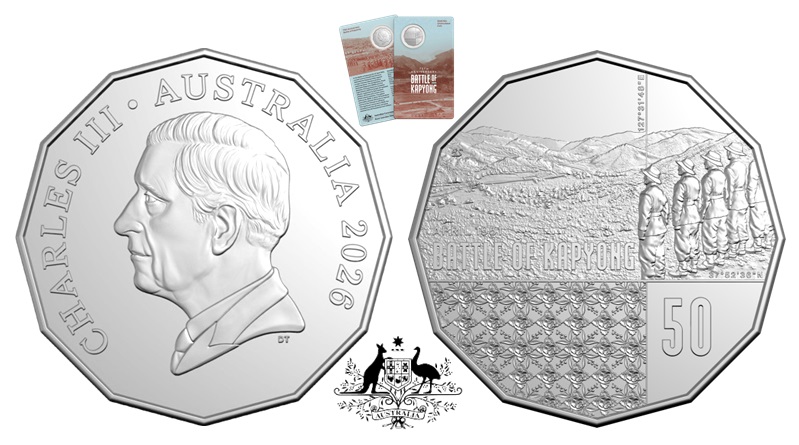
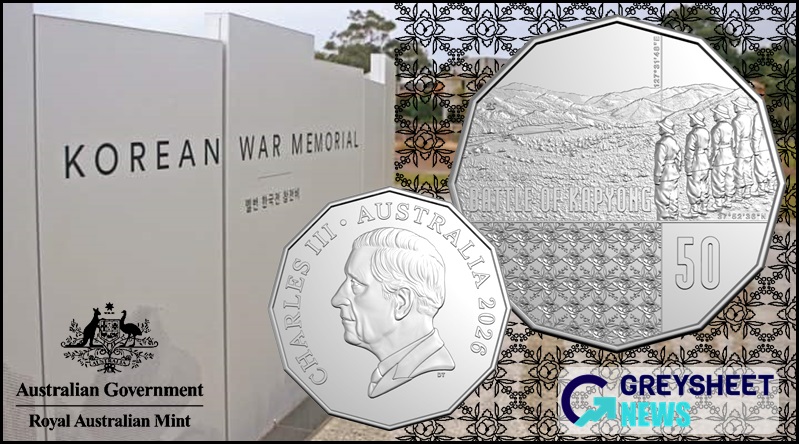
Designed by Bronwyn Scott, the reverse side depicts the Royal Australian Regiment - 3RAR soldiers towards the upper portion and shown positioned on hill 504. The 3RAR were known as ‘Old Faithful’ for their tenacious defence in Korea. Superimposed over the scene to the left is the commemorative text APRIL 1951 BATTLE OF KAPYONG. Below and to the left side is a detailed floral pattern inspired by munsal, a traditional Korean lattice frame. The pattern includes wattle and 32 poppies to commemorate each of the 32 Australian soldiers who lost their lives in the battle. To the right of the lattice pattern is the numeral 50 denoting the coins’ face value in cents. The coordinates of the battle location are included and seen in a horizontal and vertical direction. The obverse includes the Commonwealth obverse effigy of HM King Charles III designed by engraver Dan Thorne. The year 2026 included as part of the legend.
| Denomination | Metal | Weight | Diameter | Quality | Mintage limit |
| 50 Cents | Cupro-nickel | 15.5 g. | 31.5 mm. | BU | 40,000 |
Available from the 2nd April, the BU cupro-nickel coins are encased in a coin-card format which includes illustrations and informative text. For additional information, please visit the e-webshop of the Royal Australian Mint.
Related Stories (powered by Greysheet News)
View all news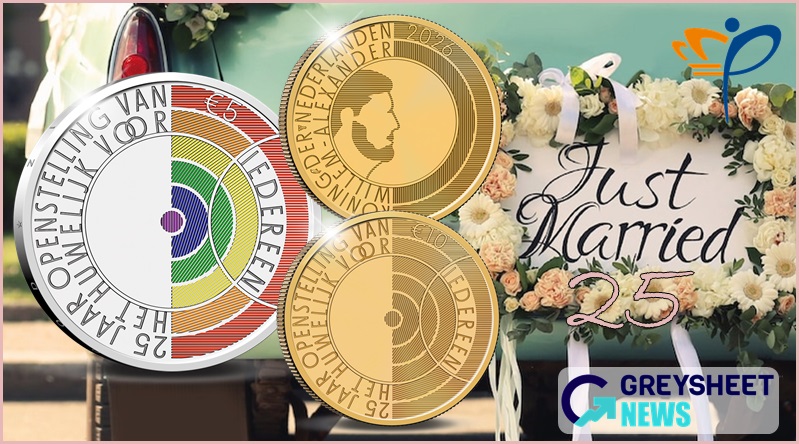
The Royal Dutch Mint release gold and silver coins honouring 25 years of marriage equality.


The Royal Canadian Mint release the latest silver proof coins honouring the Canadian Space Agency.
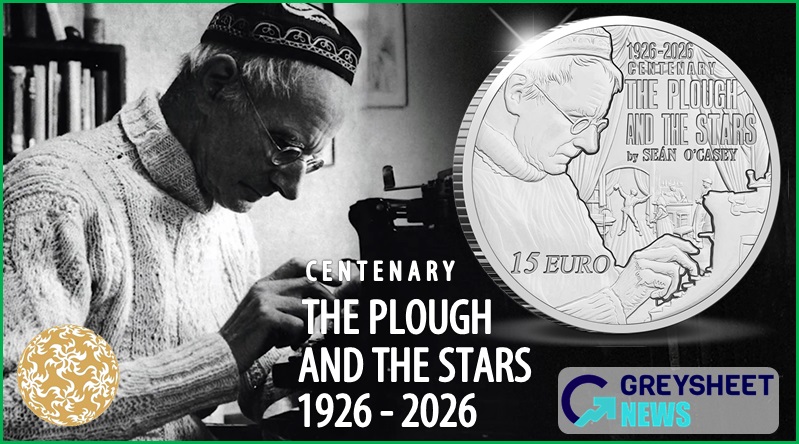
The Central Bank of Ireland release new silver proof coins marking an important literary anniversary.
Please sign in or register to leave a comment.
Your identity will be restricted to first name/last initial, or a user ID you create.
Comment
Comments