




 Whitman Expo
A Rare Coin that has No Business Being Rare
There are coins that collectors, coin dealers, and numismatic authors know to be rare. Such coins are featured in books, magazine and website articles, and at dealers’ booths at coin shows both big and small.
by CDN Publishing |
Published on March 5, 2026

Download the Greysheet app for access to pricing, news, events and your subscriptions.
Subscribe to The Greysheet for the industry's most respected pricing and to read more articles just like this.
Advertisement
By Eric Brothers, Contributor
On the other hand, there are coins that have no business being rare, based on their substantial mintages. Collectors, for the most part, are not familiar with such coins. Even dealers are not always aware of the rarity of these issues. Additionally, numismatic authors can be baffled by rare coins that have no business being rare. Among such coins is the 1870-S Seated Liberty half dollar.
1870-CC Seated Half vs. 1870-S Seated Half
In this article, we shall briefly analyze one coin that is rare: the 1870-CC Seated Liberty half dollar (mintage 54,617); and discuss in-depth one that has no business being rare: the 1870-S Seated Liberty half dollar (mintage 1,004,000). How many survivors are there of those coins? Carson City specialist Rusty Goe has determined that there are 145–165 pieces today of the 1870-CC, while Coin World puts the figure at around 200. There is no source that has estimated the survival rate of the 1870-S half dollar. And why should they—with its mintage of 1,004,000?
But here’s the rub. We discover something interesting when examining the population reports of PCGS and NGC. In total, the grading services have authenticated and graded 302 examples of the 1870-CC half dollar. However, examining the 1870-S half dollar, we see that the services have graded 296 of them. There are six more graded examples of the 1870-CC than the 1870-S. So, a coin with over 18 times the mintage has less graded pieces than an issue that Ron Guth writes (in PCGS Coinfacts), "the 1870-CC Half Dollar is one of the toughest of all the dates" of the Carson City half dollar series, and that "it remains a great rarity today."
Perhaps Goe and Coin World underestimated the number of survivors of the 1870-CC—or the issue has been the subject of multiple crack-outs and resubmissions over the years. But what about the 196 slabbed 1870-S coins? One can argue that a coin that has no business being rare would not be the subject of crack-outs and resubmissions. There are possibly more 1870-S half dollars to be found in the numismatic community. But how many? To date, no numismatic authority or publication has ventured a guess. However, sellers on eBay are currently offering raw circulated pieces.
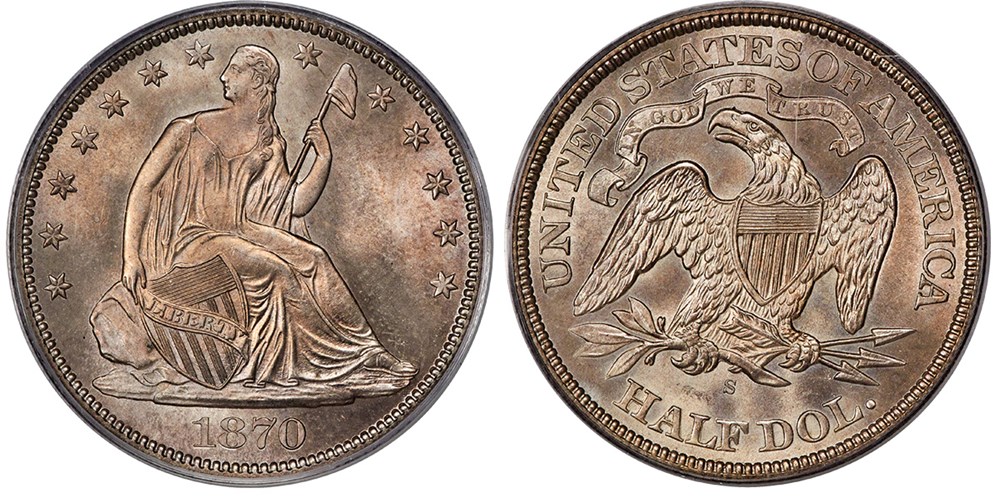
1870-S Seated Liberty Half is Rare
The bottom line is that the 1870-S Seated Liberty half dollar is a rare coin. But is it as rare as the 1870-CC? No, it is not, but it is indeed rare. The main difference in survival in the two issues can be found when analyzing mint state examples. The total mint state specimens is eight of the 1870-CC (with the finest being one MS64 at PCGS) and 36 of the 1870-S (with the finest being four MS65 at PCGS and two MS65 at NGC). However, a question must be asked: Why is the 1870-S so rare?
Guth writes (in PCGS Coinfacts), "In 1870, employees at the San Francisco Mint produced over one million Half Dollars. This was larger than the Half Dollar production at the Philadelphia and Carson City Mints combined. Nonetheless, because of the great distance between the San Francisco Mint and collectors back East, very few 1870-S Half Dollars ended up in collections."
Let that sink in for a while. Is that an explanation of why the 1870-S half dollar is rare—"because of the great distance between the San Francisco Mint and collectors back East"? Did over a million half dollars just disappear? If over one million coins disappeared, then they went somewhere. The fact that there are 36 mint state examples of the 1870-S graded mint state by PCGS and NGC tell us that there were indeed collectors in San Francisco—either in the Mint or in the city itself. However, to study the rarity of a coin issue or series, we must look beyond the coin at financial and economic factors. We cannot analyze a coin’s rarity simply by staring at it.
Seated Liberty Half Dollars in China
In a 2008 article in Numismatic News, Paul M. Green writes, "as the largest silver denomination in regular production in San Francisco,… half dollars were exported. We have proof as they were found in China and… had chopmarks from merchants there." But did that include the 1870-S issue?
In the July 2024 issue of The Numismatist, Dan Owens writes that he "examined 13 published steamship treasure cargoes (San Francisco to Japan and China) from January through December 1870 and did not find any shipments of Seated halves going to China." But were there other steamship cargo documents that Owens was unable to analyze? Did the 1906 San Francisco earthquake destroy records that would have proved otherwise?
Continuing in Numismatic News, Green tells us that half dollars "were used in international trade as was seen in a 1996 Superior sale that included half dollars found in Hong Kong. The dates involved included every San Francisco [issue] from 1860–1872 with some of the coins being chopmarked." Green concludes, "the indication is very clear that San Francisco half dollars from 1860 through the early 1870s regularly sailed west to China and that makes their mintage suspect as indications of current availability." This provides solid evidence of 1870-S half dollars being sent to the Orient.
Seated Liberty half dollars were used widely in international trade, especially those that emanated from the San Francisco Mint. That was due to the city being the gateway to Pacific trade routes—and the non-stop demand for silver coins in China and Hong Kong. Empirical evidence includes perhaps hundreds of Seated Liberty halves that carry Chinese chop marks, many of which carry the "S" mintmark of San Francisco.
Green further discusses chopmarked Seated Liberty half dollars (Numismatic News in 2011): "The clear suggestion is that long before the Trade dollar, Seated Liberty half dollars were being sent to China and that sort of export use may help to explain why half dollar mintages during the period remained higher than other silver denominations." However, these coins saw export and significant circulation elsewhere.
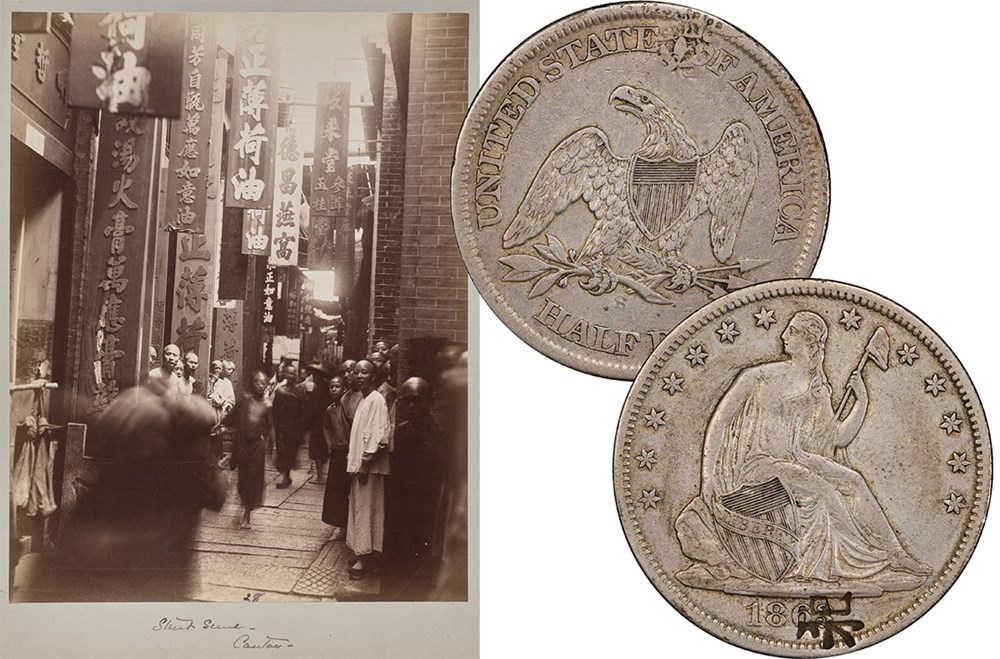
Right: 1863-S Seated half with a Chinese chopmark. S-Mint half dollars were shipped to China in trade from 1855 to 1872. Photo courtesy of Dan Huntsinger Collection.
Seated Liberty Half Dollars in Canada
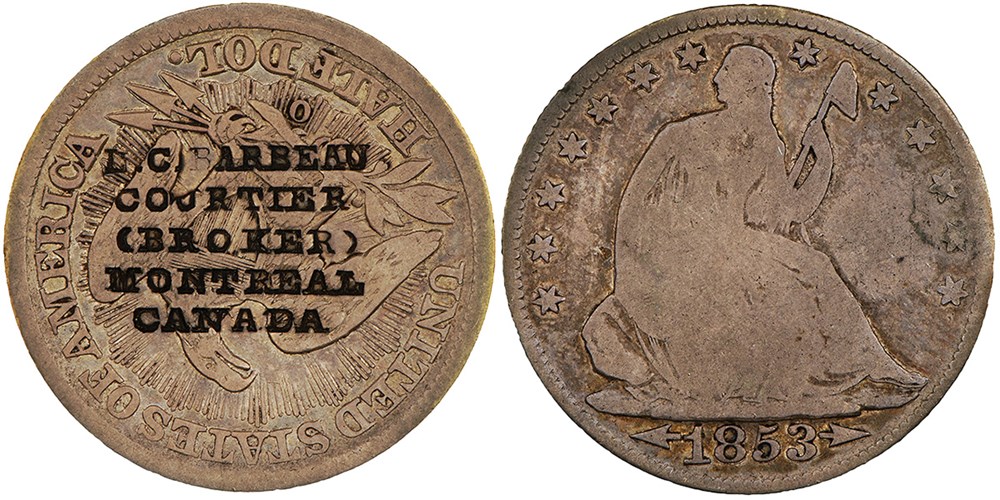
It was during the 1858–1861 Fraser River Gold Rush that British Columbia (BC), Canada, had a critical shortage of circulating coinage. This led to the widespread use of silver U.S. coins, which included Seated Liberty half dollars. Such coins were imported generally from San Francisco via American merchants and miners who traveled to BC. They became de facto legal tender through colonial ordinances and merchant agreements. Seated Liberty halves and other coins were vital for transactions in mining camps like Victoria and New Westminster. The formal Merchant Agreement signed by Victoria merchants in 1859 made U.S. half dollars (and other coins) legal tender in practice.
It was due to the shortage of British coins that U.S. coins became dominant. Evidence includes export by private trade routes, such as steam ships from California, and extensive circulation in Canada. Thus, thousands upon thousands of U.S. silver coins moved north, with half dollars being perfect for miners’ wages and supplies.
A Canadian editorial of 1859 discussed coins at the Fraser River mining camps: "With the large immigration to this country in 1858 from the United States came the custom of doing business with a decimal currency…. the circulating medium in British coin at that period was a mere nothing in comparison to the amount of American coin introduced by the immigrants." Related to this is the Currency Bill of 1860, which formalized U.S. coins as legal tender in Vancouver Island. This was in response to the Cariboo Gold Rush of 1860 to 1868. Fueled by the Cariboo mining trade with California, the U.S. half dollar became the standard for wages and supplies in towns like Barkerville.
U.S. silver coins were ubiquitous in BC up until the 1881 Uniform Currency Act. The above provides compelling circumstantial evidence that significant amounts of 1870-S Seated Liberty half dollars were shipped (or carried) from San Francisco to the mining fields and elsewhere in British Columbia. U.S. silver coins also circulated extensively in both Quebec and Ontario up until 1870, when legislation resulted in over $5 million worth of them being exported to New York and London.
A Condition Rarity
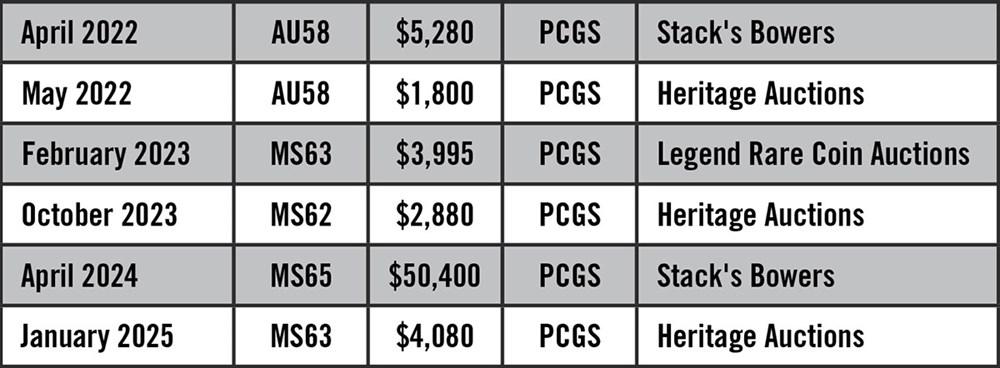
Evidence provided suggests that the 1870-S Seated Liberty half dollar is a rare coin, due to its export to China and Canada. However, collectors of means who purchase condition rarities are familiar—with this rare coin that has no business being rare. For example, in January 2023 a piece graded PCGS MS65 (with a gold CAC sticker) sold for $90,000 via Heritage Auctions. Here are a few other recent auction appearances of the 1870-S half dollar:
A Sleeper Coin?
Is the 1870-S half a "sleeper"? There is a wide price spread between AU58 and MS65. There is even a wide spread within the AU58 grade. However, there is a relatively small spread between AU58 and MS63. Circulated examples of the 1870-S below AU58 are much more reasonably priced. Perhaps it would be a good coin to include in your collection—before the word gets out!
- Sources:
- "1870-CC 50C [Seated Liberty]" PCGS Coinfacts https://www.pcgs.com/coinfacts/coin/1870-cc-50c/6328
- "1870-S 50C [Seated Liberty]" PCGS Coinfacts https://www.pcgs.com/coinfacts/coin/1870-s-50c/6329
- "Seated Liberty Half Dollars 1870-CC." NGC Coin Explorer. https://www.ngccoin.com/coin-explorer/united-states/half-dollars/seated-liberty-half-dollars-1839-1891/16328/1870-cc-50c-ms/
- "Seated Liberty Half Dollars 1870-S." NGC Coin Explorer. https://www.ngccoin.com/coin-explorer/united-states/half-dollars/seated-liberty-half-dollars-1839-1891/16329/1870-s-50c-ms/
- Paul M. Green. "Old West Flavors S-mint Seated half dollars." Numismatic News. October 6, 2008.
- Paul M. Green. "Few Chase after Seated half dollars." Numismatic News. June 13, 2011.
- Dan Owens. "Treasure on the High Seas." The Numismatist. July 2024.
- James Powell. A History of the Canadian Dollar. Bank of Canada. 2005.
- Steve Roach. "Market Analysis: Two Carson City Seated half dollars." Coin World. September 19, 2024. https://www.coinworld.com/news/auctions/market-analysis-two-carson-city-seated-half-dollars

Related Stories (powered by Greysheet News)
View all news
On the morning of December 12, 2025, amidst a sea of red on global financial exchanges, one ticker screen flickers with a defiant green: silver, $64.09 per ounce.

According to Representative Campbell P. White, in his congressional report of 1832, the exportation of half dollars carried on steadily after 1804 and was extensive from 1811–1821.

The launch marks the fulfillment of several years of research, listening to collectors and dealers, and developing a first class product with first class professionals.
Please sign in or register to leave a comment.
Your identity will be restricted to first name/last initial, or a user ID you create.
Comment
Comments