

United Kingdom. Gold and Silver Proof Coins Released In Tribute to Master Engraver Jean Baptiste Merlen
The Royal Mint release the latest gold and silver proof coins in an exceptional collector’s series.
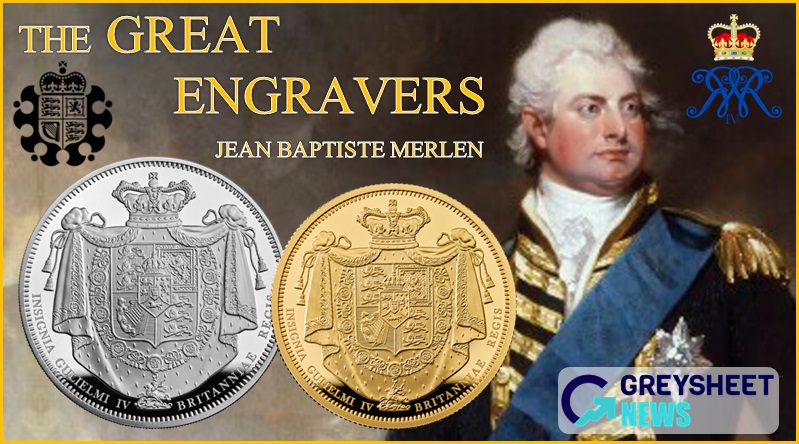
Launched in 2019, the Great Engravers Collection continues with a commemoration of Jean Baptiste Merlen’s reverse design for the 1831 crown. One of the rarest and most iconic designs in British numismatics, this modern interpretation has been re-mastered with the benefit of unique historical insight. It is also the first time Jean Baptiste Merlen’s work has featured in the Great Engravers Collection and commemorates an iconic design that is a masterpiece of engraving skill.
Jean Baptiste Merlen (1769–1850) began his career at the Paris Mint but left France soon after the Battle of Waterloo. In 1820, William Wellesley Pole recruited him to work with The Royal Mint and assist Benedetto Pistrucci in preparing the coinage for the new king, George IV. Best known for his reverse designs, including those for the 1820 half-crown and the Maundy Money designs from 1822, Merlen was a skilful engraver and although he retired in 1844, his shield motif remained on the reverse side of the gold Sovereign until 1887. Celebrated for both its beauty and rarity, the 1831 crown holds a distinguished place in British numismatics. The William IV shield design features the Royal Mantle, with the Armorial Ensigns of the United Kingdom. The shield consists of the three lions of England, the rampant lion of Scotland and the harp of Ireland. As King William IV was the fifth sovereign of the House of Hanover to sit on the British throne, a small crown surmounted version of the Hanoverian Arms appears in the centre of the British shield. Surrounding the shield is the collar of the Order of the Garter. Shown under the crest, the text ANNO is seen to the lower left and the year 1831 is placed to the lower right.
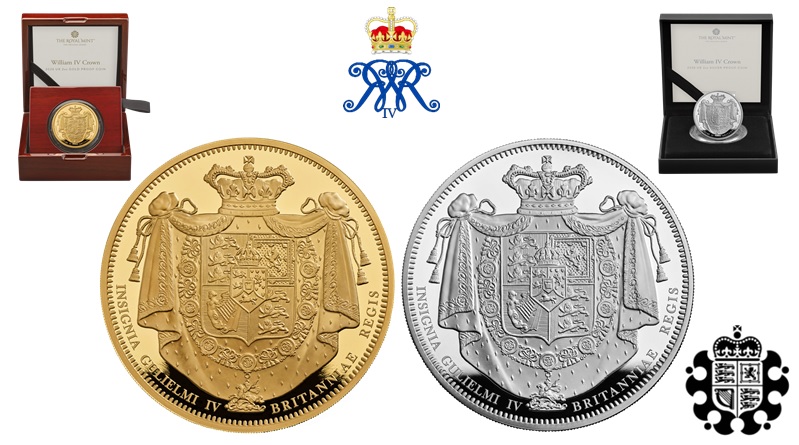
Faithfully recreated using modern minting techniques, Jean Baptiste Merlen’s crest of King William IV is featured on the reverse and centred. Below the primary design is the commemorative inscription INSIGNIA GULIELMI IV BRITANNIAE REGIS. The obverse side includes the effigy of HM King Charles III created by sculptor Martin Jennings. The denomination from 5 to 5000 POUNDS and year of issue of 2026 also appears on the obverse as part of the legend surrounding the King’s likeness.
| Denomination | Metal | Weight | Diameter | Quality | Maximum Mintage |
| 5 Pounds | .999 Silver | 62.2 g. | 40 mm. | Proof | 3110 |
| 10 Pounds | .999 Silver | 156.3 g. | 65 mm. | Proof | 360 |
| 10 Pounds | .999 Silver | 312.2 g. | 65 mm. | Proof | 100 |
| 200 Pounds | .999 Gold | 62.4 g. | 40 mm. | Proof | 175 |
| 200 Pounds | .999 Gold | 62.4 g. | 40 mm. | Proof | 60 matte proof |
| 500 Pounds | .999 Gold | 156.3 g. | 50 mm. | Proof | 35 |
| 1000 Pounds | .999 Gold | 1005 g. | 100 mm. | Proof | 7 |
| 5000 Pounds | .999 Gold | 5015 g. | 175 mm. | Proof | 1 |
Available from the 9th February, each coin is encapsulated and presented in a custom case, the silver options are housed in black polished cases and are also accompanied by a numbered certificate of authenticity. The gold coin sets are presented in hardwood high-gloss cases with numbered certificates of authenticity. A special two-coin set including a traditional proof and matte proof strike is also available in very limited quantities. For additional information, please visit the e-webshop of the Royal Mint.

Download the Greysheet app for access to pricing, news, events and your subscriptions.
Subscribe Now.
Subscribe to RQ Red Book Quarterly for the industry's most respected pricing and to read more articles just like this.
Visit these great CDN Sponsors
CDN Sponsors






Author: Michael Alexander
 Michael’s background in both numismatics and banknotes spans more than three decades and whose activities have varied from being a dedicated world coin collector to coin & medal design, marketing, theme concept and production. His additional interests include banknote research and in 1997, he founded the London Banknote and Monetary Research Centre to further these interests and activities. The company continues to offer monthly currency bulletins to both online and printed publications which includes information about the latest banknote news and releases from Central Banks and Monetary Authorities around the world. Michael has been a contributor to COIN NEWS magazine based in the UK since 1998 where many of his in-depth interviews, articles and bulletins have been published.


Please sign in or register to leave a comment.
Your identity will be restricted to first name/last initial, or a user ID you create.
Comment
Comments