

Romania. New Proof Gold Coins Highlight Discovery of Votive Tablets of Germisara
The National Bank of Romania release their latest gold collector coin as part of a popular series.
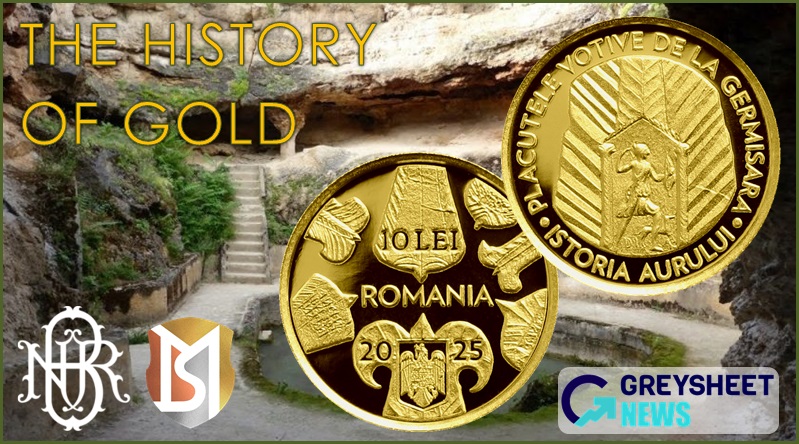
Entitled The history of Gold in Romania and first launched in 2003 with this denomination, the coins focus on various artefacts and artisan pieces which highlight Romanian culture and identity. The latest coins feature the artistry of The Votive Plates from Germisara, artefacts found in an ancient Roman spa. Germisara are thermal springs retreat located in Transylvania, the Germisara Castrum dates between 1 BC and 250 AD and was a developed community centre for the Romans with both a military and civilian role, indicated by the presence of important civic buildings like tribunals.
The important archaeological items were in fact accidentally discovered in 1987 during the construction of additional spa facilities in Geoagiu Băi. Shortly after construction began, workers discovered on the bottom of a natural pool in the Dâmbul Romanilor thermal complex the gold tablets, seven in number along with about 600 coins, a marble statue, four altars or bases of limestone statues and numerous other objects.
Crafted from thin plates of 22 karat gold, the plaques were dedicated to the thermal waters and goddesses who were associated with cures. The location served as a place of worship where people offered coins and other items to the gods in hopes of healing. A statue of the goddess Diana and various votive altars were also found in the surrounding sacred area. The discovery also highlighted the blend of both indigenous Dacian and later Roman religious traditions at the site, where the natural springs were considered sacred long before the Romans arrived and developed the area into a full Roman health resort. The historic finds are on display in the Magna Curia Palace which houses the Museum of Dacian and Roman Civilisation located in the city of Deva.
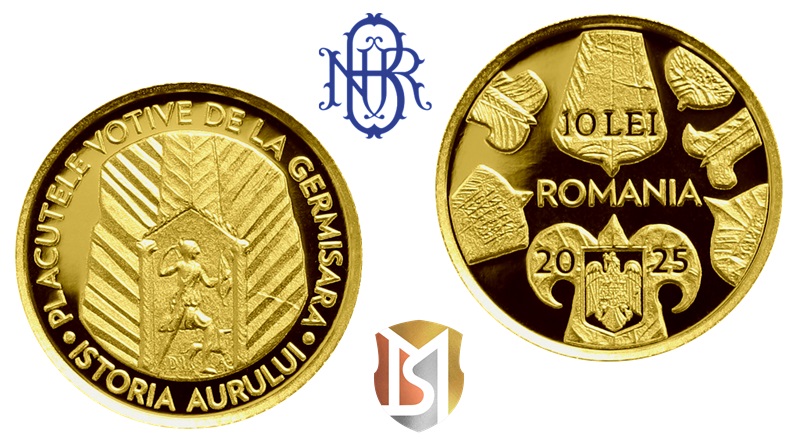
The gold proof coins are produced by the Monetăria Statului, Romanian State Mint at their facilities in Bucharest on behalf of the National Bank. The obverse side features detail from the largest votive tablet found which depicts the Goddess Diana on the hunt centred. Along the rim and above the primary design is the inscription PLACUTELE VOTIVE DE LA GERMISARA (Votive Plaques from Germisara). Below and along the lower rim is the text ISTORIA AURULUI (History of Gold). The reverse side highlights illustrations of portions of the votive tablets including detail of their handles from each of the seven tablets arranged within a circle. Centred is the text ROMANIA with the coins’ denomination 10 LEI placed above and the year 20 and 25 placed below with the national crest separating the numerals.
| Denomination | Metal | Weight | Diameter | Quality | Maximum Mintage |
| 10 Lei | .999 Gold | 1.22 g. | 13.9 mm. | Proof | 1000 |
Available from the 29th December, A certificate of authenticity containing the signatures of the NBR governor and the central cashier is included with the coins, which are available directly through the Bucharest, Cluj, Iasi, and Timişoara regional branches of the National Bank of Romania. For additional information, please visit their numismatics webpage.

Download the Greysheet app for access to pricing, news, events and your subscriptions.
Subscribe Now.
Subscribe to RQ Red Book Quarterly for the industry's most respected pricing and to read more articles just like this.
Visit these great CDN Sponsors
CDN Sponsors






Author: Michael Alexander
 Michael’s background in both numismatics and banknotes spans more than three decades and whose activities have varied from being a dedicated world coin collector to coin & medal design, marketing, theme concept and production. His additional interests include banknote research and in 1997, he founded the London Banknote and Monetary Research Centre to further these interests and activities. The company continues to offer monthly currency bulletins to both online and printed publications which includes information about the latest banknote news and releases from Central Banks and Monetary Authorities around the world. Michael has been a contributor to COIN NEWS magazine based in the UK since 1998 where many of his in-depth interviews, articles and bulletins have been published.

Please sign in or register to leave a comment.
Your identity will be restricted to first name/last initial, or a user ID you create.
Comment
Comments