

Poland. Latest Silver Collector Coins in Treasures of Medal-Making Art Features Eminent Economist
The National Bank of Poland release the second coins as part of the art of medallic excellence series.
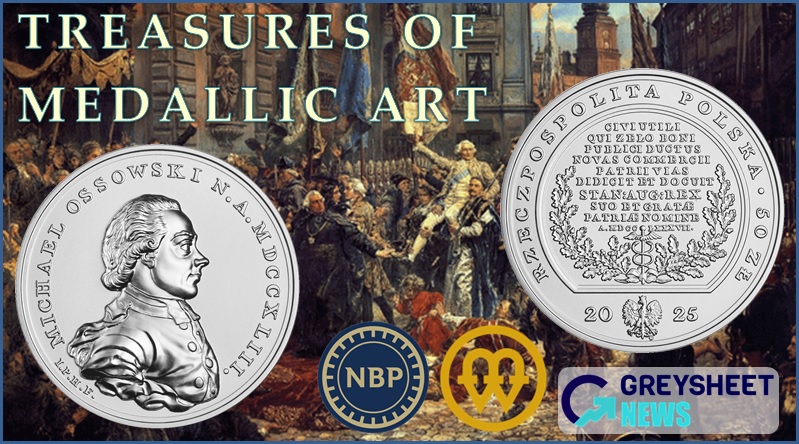
Launched in 2025, the silver coin series replicate historic medals from the collection of medals housed in the Royal Castle in Warsaw showcasing rich historical designs with high relief. The series also highlights the artistic and historical value of medallic art, a field where medals commemorate figures and events, and where commemorative coins are inspired from. The first coin released in January of this year featured the medal honouring statesman Stanisław Małachowski.
The second coin in the series is dedicated to Michał Ossowski (1743–1797), a Polish politician and economist who is credited with making a significant contribution to the country’s economic development. He studied physics and theology, among other subjects and was ordained as a priest in 1773. Thanks to his excellent education, he became a teacher and over time, a close friend and associate of Antoni Protazy Potocki – the later Voivode or, Governor of Kiev, banker and entrepreneur. Ossowski undertook numerous economic initiatives and called for economic reforms, striving to improve the fate and living standards of the common people. As a skilled financier, he promoted various fiscal innovations, including the issuance of paper money. He acted as the presiding authority at the appointment of Potocki in a newly established bank in Warsaw and also set up merchant’s offices to develop Polish trade.
For his services to banking, industry and the development of the Black Sea trade, Father Michał Ossowski was awarded a medal by King Stanisław August in 1787, minted in the Warsaw mint by the royal medallist Jan Filip Holzhaeusser. In accordance with custom, the king personally presented Ossowski with a gold medal, while a limited number of silver and bronze copies were also minted.
The coins are produced by the Mennica Polska – Mint of Poland at their facilities in Warsaw and on behalf of the National Bank. Designed by Robert Kotowicz, both obverse and reverse sides are based on the original medal created by Jan Filip Holzhaeusser and minted in ultra-high relief.
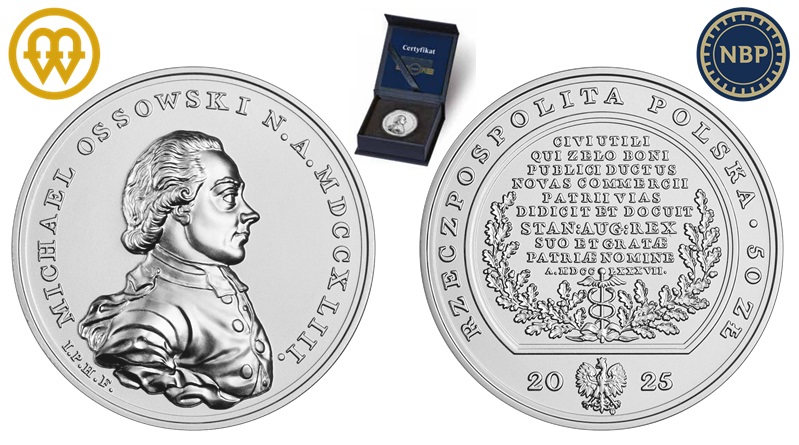
The obverse of the coin features a reproduction of the bust of Ossowski in right profile along with an inscription in Latin MICHAEL OSSOWSKI N. A. MDCCXLIII (Michał Ossowski, born in 1743) including the medallist’s initials I. P. H. F. placed along the lower left rim. The reverse side of the coin features the commemorative text of the medal in Latin CIVI UTILI QUI ZELO BONI PUBLICI DUCTUS NOVAS COMMERCII PATRII VIAS DIDICIT ET DOCUIT STAN: AUG: REX SUO ET GRATAE PATRIAE NOMINE A. MDCCLXXXVII (To a useful citizen who, guided by his zeal for the public good, discovered and pointed out new trade routes for his homeland – Stanisław August the King, in his own name and on behalf of the grateful homeland, in the year 1787). Above the primary design and along the rim are the inscriptions RZECZPOSPOLITA POLSKA (Republic of Poland) and the denomination 50 ZŁ. Just under the commemorative inscription is the image of Poland’s crowned Eagle, established as the state emblem and below the Eagle on the right is the Mintmark MW. To the left and right of the Eagle are the two digits of the year of issue, 20 and 25.
| Denomination | Metal | Weight | Diameter | Quality | Mintage Limit |
| 50 Zlotych | .999 Silver | 62.2 g. | 45 mm. | UHR Specimen | 5000 |
Available from the 9th December, the silver ultra-high relief specimen finish coins are encapsulated and presented in a heavy-gauge lined card case, accompanied with a certificate of authenticity. For additional information on these and other coins issued from the National Bank of Poland, please visit their e-webshop.

Download the Greysheet app for access to pricing, news, events and your subscriptions.
Subscribe Now.
Subscribe to RQ Red Book Quarterly for the industry's most respected pricing and to read more articles just like this.
Visit these great CDN Sponsors
CDN Sponsors






Author: Michael Alexander
 Michael’s background in both numismatics and banknotes spans more than three decades and whose activities have varied from being a dedicated world coin collector to coin & medal design, marketing, theme concept and production. His additional interests include banknote research and in 1997, he founded the London Banknote and Monetary Research Centre to further these interests and activities. The company continues to offer monthly currency bulletins to both online and printed publications which includes information about the latest banknote news and releases from Central Banks and Monetary Authorities around the world. Michael has been a contributor to COIN NEWS magazine based in the UK since 1998 where many of his in-depth interviews, articles and bulletins have been published.
Please sign in or register to leave a comment.
Your identity will be restricted to first name/last initial, or a user ID you create.
Comment
Comments