

Moldova. New Silver Proof Coins Honour Memory of Respected Queen Consort
The National Bank of Moldova release commemorative coins remembering Queen Marie of Romania.
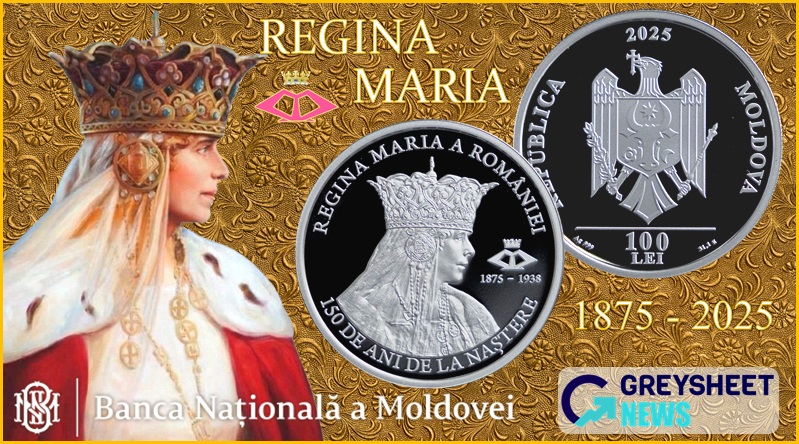
The commemorative coins are issued on the occasion of the 150th anniversary of her birth of Romania's Queen Marie. She was once Queen Consort of the unified Kingdom of Romania that included territory of present-day Moldova . During her Husband King Ferdinand’s reign the continent saw the incorporation of Transylvania, Bessarabia (eastern Moldova), and other territories that included the historical region of Moldavia, present-day Moldova forming Greater Romania. The new Queen was passionately dedicated to achieving the national ideal of the Great Union.
With the outbreak of World War I and the death of the country’s first King Carol I in 1914, Marie urged her husband and the late King’s successor King Ferdinand to ally himself with the Triple Entente and declare war on Germany. Born in 1875 as a Princess of Edinburgh, a granddaughter of Queen Victoria, a niece of King Edward VII and a first cousin of King George V, Marie was instrumental in advocating for Romania to join the Allies in World War I. King Ferdinand did declare war on the Central powers in 1916 but, during the early stages of fighting, the national capital Bucharest was occupied by Imperial Germany and Austria.
With the defeat of the Central powers and the downfall of Imperial Russia, Queen Marie was called upon by Romania’s Prime Minister as she was best poised to negotiate with Great Britain and France due to her political and dynastic connections. She helped solidify through diplomacy significant parts of historic Moldavia from the collapsed Russian Empire and Transylvania from the former Austro-Hungarian Empire, doubling the territory of Romania which resulted in the country becoming the fifth largest in Europe.
In February 1918, Moldavia declared independence from the now defunct Russian Empire and integrated into Romania later that year following a vote of its assembly. The decision was disputed by Soviet Russia and in 1940, due to the Molotov–Ribbentrop Pact, Romania was compelled to cede Bessarabia and Northern Bukovina back to the Soviet Union. As a consequence, this captured territory became part of the USSR as the Moldavian Soviet Socialist Republic which lasted until August 1991 when the legislature again declared their independence.
As such, she was Queen of Greater Romania and was credited for her exemplary diplomatic skills in the wake of such a devastating continental war. At the end of the Great War, and with a final peace, King Ferdinand believed it was finally time to celebrate his and the Queen’s accession. In October 1922 and during an age old ceremony, Ferdinand placed the Romanian crown on his own head and moments later, he placed the Queen’s crown on her head.
Marie became a beloved and respected figure who was unofficially known as the Grandmother of Europe due to the dynastic marriages of her children, but is also remembered as the last Queen consort of Romania. Her son King Carol II reigned from 1930 until 1940 but divorced his wife Princess Helen of Greece in 1928. Her Grandson King Michael reigned twice from 1927 until 1930 and again from 1940 until he abdicated in 1947 before marrying Princess Anne of Bourbon Parma in 1948. Although Princess Anne was titled as Queen of Romania, the couple never ruled.
Marie retired from public life after the accession of her son Carol II and died in 1938. She was interred in the Cathedral of Curtea de Argeș a Romanian Orthodox cathedral and the traditional burial site of Romania’s royal family. After the communist take-over in 1947, her diplomatic and charitable efforts were discredited in an effort to excoriate the monarchy in it’s entirely. However, after the Romanian Revolution of 1989 and the collapse of the Soviet Union in 1991, Marie's popularity recovered and was presented to the people of Romania and Moldova as a model of patriotism. She is also remembered for her work as a nurse during the First World war, and for her extensive writing, including her critically acclaimed autobiography.
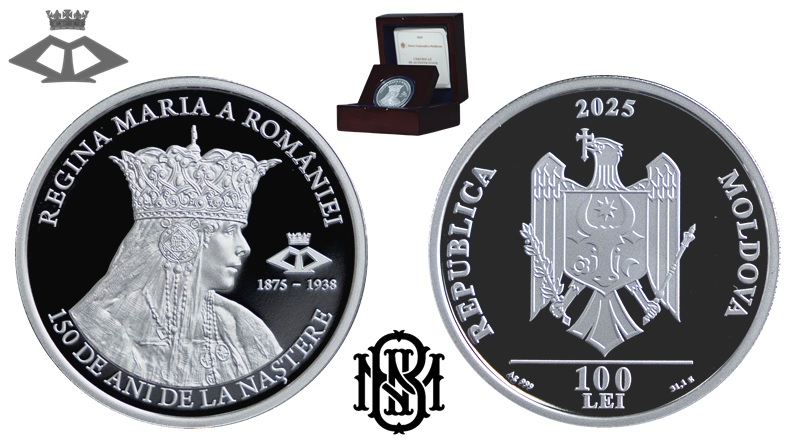
The silver proof coins are produced by the Monetăria Statului, Romanian State Mint at their facilities in Bucharest on behalf of the National Bank of Moldova. The obverse side depicts Queen Marie wearing a custom gold crown made especially for the occasion of the coronation of the Royal couple in 1922 and from gold mined in Transylvania. The medieval style is inspired from a fresco of the Curtea de Argeş Monastery and with side pendants specific to Byzantine imperial diadems. Above the portrait and along the upper rim is the inscription REGINA MARIA A ROMÂNIEI. Below, and along the lower rim is the additional text 150 DE ANI DE LA NAȘTERE (150 years of birth) To the right of the Queen’s likeness is her crowned M monogram. The reverse side features the official Moldovan crest centred with the text REPUBLICA MOLDOVA placed along the rim on either side of the crest. The denomination 100 LEI is shown just below along the lower rim and the year of issue, 2025 is shown above.
| Denomination | Metal | Weight | Diameter | Quality | Mintage Limit |
| 100 Lei | .999 Silver | 31.1 g. | 37 mm. | Proof | 750 |
Available from the 1st December, the coins are encapsulated and presented in a polished hardwood custom case accompanied with a certificate of authenticity. For additional information, please visit the procurement page of the National Bank’s commemorative coins website.

Download the Greysheet app for access to pricing, news, events and your subscriptions.
Subscribe Now.
Subscribe to RQ Red Book Quarterly for the industry's most respected pricing and to read more articles just like this.
Visit these great CDN Sponsors
CDN Sponsors





Author: Michael Alexander
 Michael’s background in both numismatics and banknotes spans more than three decades and whose activities have varied from being a dedicated world coin collector to coin & medal design, marketing, theme concept and production. His additional interests include banknote research and in 1997, he founded the London Banknote and Monetary Research Centre to further these interests and activities. The company continues to offer monthly currency bulletins to both online and printed publications which includes information about the latest banknote news and releases from Central Banks and Monetary Authorities around the world. Michael has been a contributor to COIN NEWS magazine based in the UK since 1998 where many of his in-depth interviews, articles and bulletins have been published.
Please sign in or register to leave a comment.
Your identity will be restricted to first name/last initial, or a user ID you create.
Comment
Comments