

Greece. New Silver Proof Coin Features Ingenious Ancient Astrological Instrument
The Bank of Greece release their fourth coin in the popular collector series highlighting ancient Greek technology.
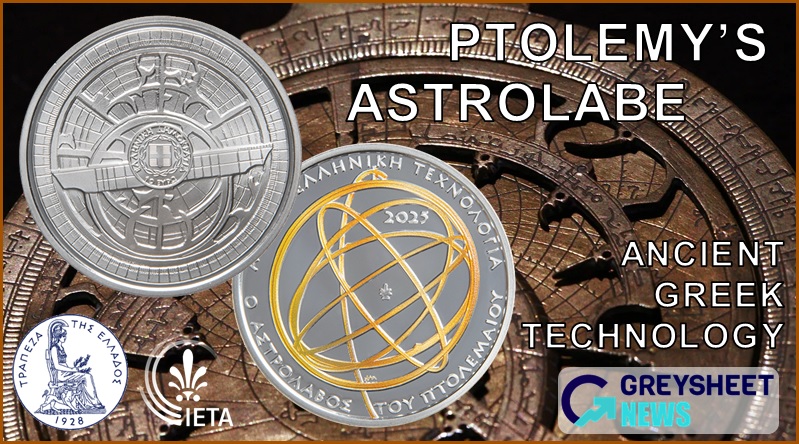
As part of the series launched in 2022, the focus for 2025 is that of the fascinating scientific instrument known as the Astrolabe. It is an ancient apparatus which was attributed to the Greek Astronomer Ptolemy (Claudius Ptolemaeus, c. 100 – 170 AD) who lived in Alexandria, Egypt during the 2nd century AD and was also an acclaimed geographer and mathematician in his day.
His astrolabe instrument was ostensibly used to measure the position of celestial bodies and to solve various astronomical questions. His work, particularly the publications Almagest and Geography had a profound and lasting influence on astronomy, cartography, and geography for centuries. His apparatus is essentially a two-dimensional model of the celestial sphere, designed to be used to measure the altitudes and latitudes of celestial bodies, aiding in navigation and astronomy. The astrolabe consists of a plate with a rotating framework that represents the stars and the ecliptic, allowing users to determine the position of celestial bodies and perform calculations. The two-Dimensional Model of the astrolabe projects the spherical sky onto a flat surface, providing a simplified representation for observation and calculations.
The rete or, rotating framework represents the stars and the ecliptic, while the tympan, a plate for a specific latitude provides the reference for the local horizon and celestial coordinates. By aligning the rete with the position of a celestial body in the sky, the user is able to determine its altitude and azimuth - the direction of a celestial object, allowing for calculations of its coordinates. The astrolabe was used to solve a variety of astronomical problems, such as determining the time of day, finding the location of a star at a particular time, and predicting the movement of the sun and moon. The astrolabe was widely used in ancient and medieval times for astronomy, navigation, and timekeeping and more than 2000 years later. Despite there being no such astrolabe models which survived from his day, Ptolemy described the instrument quite precisely in detail as part of his Syntaxis mathematica or Megiste, known in the West as Almagest. As such, workable models were able to be accurately re-created and continue to be a valuable tool for understanding the history of science and the principles of astronomy.
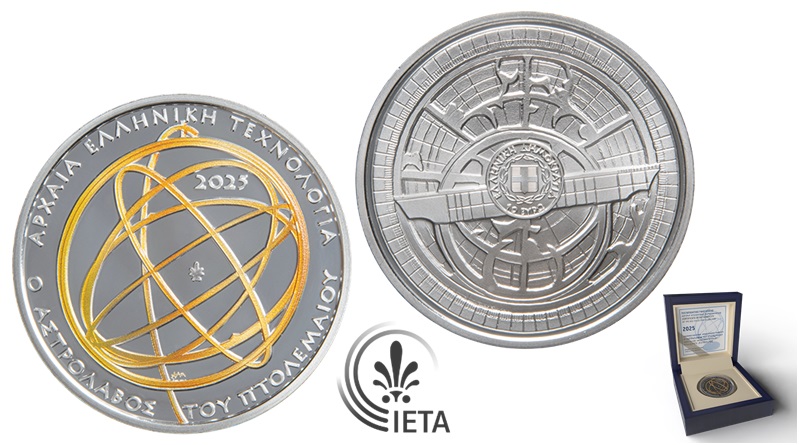
Designed by George Stamatopoulos, chief engraver, the obverse side features a depiction of Ptolemy’s astrolabe which is based on a reconstruction of the instrument by the Kotsanas Museum of Ancient Greek Technology located in Athens. Above the spherical model of the rete which is centred is the inscription placed above the primary design along the upper rim ΑΡΧΑΙΑ ΕΛΛΗΝΙΚΗ ΤΕΧΝΟΛΟΓΙΑ (Ancient Greek Technology) and the additional text Ο ΑΣΤΡΟΛΑΒΟΣ ΤΟΥ ΠΤΟΛΕΜΑΙΟΥ (Ptolemy’s Astrolabe) placed along the lower rim. The year of issue, 2025 is seen just within the sphere to the upper right and the distinctive mintmark of the Greek Mint, a stylised palmette is shown almost in the centre of the coin. The reverse design replicates the plates and guides of the part of the astrolabe known as the tympan. Centred is a small crest of the Hellenic Republic and includes the text ΕΛΛΗΝΙΚΗ ΔΗΜΟΚΡΑΤΙΑ (Hellenic Republic) as well as the denomination of 10 ΕΥΡΩ which encircles the crest.
| Denomination | Metal | Weight | Diameter | Quality | Mintage Limit |
| 10 Euro | .925 Silver | 34.1 g. | 40 mm. | Proof & Plating | 2000 |
Available from the 29th April, each proof quality coin is presented in a custom Bank of Greece-branded case accompanied with a certificate of authenticity. To purchase the coins, collectors residing in Greece can visit the Bank of Greece’s headquarters in Athens. Those outside Greece are asked to enquire to the following mailing address, d25nomismaticorders@glk.gr

Download the Greysheet app for access to pricing, news, events and your subscriptions.
Subscribe Now.
Subscribe to RQ Red Book Quarterly for the industry's most respected pricing and to read more articles just like this.
Visit these great CDN Sponsors
CDN Sponsors






Author: Michael Alexander
 Michael’s background in both numismatics and banknotes spans more than three decades and whose activities have varied from being a dedicated world coin collector to coin & medal design, marketing, theme concept and production. His additional interests include banknote research and in 1997, he founded the London Banknote and Monetary Research Centre to further these interests and activities. The company continues to offer monthly currency bulletins to both online and printed publications which includes information about the latest banknote news and releases from Central Banks and Monetary Authorities around the world. Michael has been a contributor to COIN NEWS magazine based in the UK since 1998 where many of his in-depth interviews, articles and bulletins have been published.

Please sign in or register to leave a comment.
Your identity will be restricted to first name/last initial, or a user ID you create.
Comment
Comments