

Germany. Latest €2 Commemorative Coins Honour Eminent Statesman
The German Federal Republic’s Ministry of Finance release their first €2 commemorative coin for 2026.
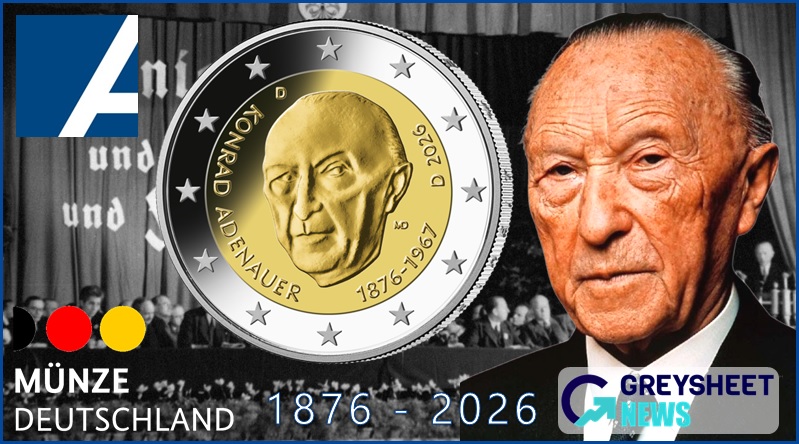
The €2 commemorative coins are issued to mark the 150th anniversary of birth of Konrad Adenauer and which is part of the series entitled Unity, Justice and Freedom. Konrad Adenauer's life reflects four important, modern eras of German history, from Empire to Post-war peace.
Adenauer was born on the 5th January 1876 in Cologne, both parents Konrad and Helene had backgrounds in the civil service. After his formative years in the German Empire, he rose to political prominence during the Weimar Republic, in place from the end of the First World War until the rise of the Third Reich. Adenauer was already known for his opposition to the National socialist party of Adolph Hitler and in 1932, as president of the Prussian Council of State, he opposed the dissolution of the Prussian state parliament. In February 1933 and in protest, Adenauer refused to welcome Adolf Hitler at the airport when he arrived in Cologne and banned the hanging of swastikas on buildings belonging to the city administration as well as ordering the removal of Nazi banners displayed on the bridge. His actions provoked the fury of the Nazi party to such an extent, he was dismissed from his position as Mayor of Cologne in March 1934, though his administration was officially voted out of office due to illegal election manipulations by the central government. Adenauer was also tried for corruption later that same year, but no evidence was found and the case was dismissed.
During the years of the Third Reich, Adenauer and his family changed their locations numerous times, taking refuge with friends and supporters. Accepting a financial compensation for his home in Cologne which had been confiscated by the government, he moved to Rhöndorf, a district of the town of Bad Honnef in the German state of North Rhine-Westphalia and built a home there. Adenauer maintained contacts with activists of various groups of the resistance movement against Nazism and in August 1944, he was arrested together with his wife, spending three months in detention in Cologne. One month later, he managed to escape, but was recaptured shortly thereafter and, as a single prisoner, was imprisoned in the Gestapo prison in Brauweiler near Cologne. In November 1944, he left the Gestapo prison but was not permitted to stay in Cologne. The end of the war found him and his wife, who had already been released and seriously ill, in their home in Rhöndorf which came under artillery fire and was severely damaged.
With the capitulation and surrender of the Nazi’s to the Allies after the suicide of Hitler, Germany was in complete disarray and facing total destruction, politically and economically. In May 1945, the 69-year-old Adenauer was appointed mayor of Cologne by the American military government as he was ranked first on their so-called ‘White List’ of acceptable Germans to approach. In September 1945, Adenauer became a founder and member of the board of the Christian Democratic Party - CDP in the Rhineland and which was founded by former activists of the Centre Party. With the British occupation of Cologne, he was dismissed from the office of mayor in October. In March 1946 Adenauer became chairman of the CDU in the British occupation zone and in 1947 he was appointed chairman of the CDU in all three western allied occupation zones.
In 1948, a post-war Parliamentary Council was established with the aim of creating a new constitution for Germany as a Federal Republic as well as agreeing on a date for national elections. Germany’s first post-war constitution was adopted on the 8 May 1949 by the council and new elections in Germany, the first since 1933 took place on the 14th August 1949 to the Bundestag. Adenauer himself was elected as what became known as West Germany’s first chancellor on the 15th September 1949 by the new parliament and winning the majority by just one vote. The German sector occupied by the Soviet Union was not able to participate in the elections as the Kremlin were already installing a government separate to the three sectors occupied by the western allies.
In the post-war period, Adenauer believed that the greatest threat to Germany was the USSR and communism. He considered closer cooperation with Western European countries and an alliance with the USA to be an effective form of defense against the influence of the USSR. Unlike the Social Party of Democrats, the opposition party of the time, Adenauer believed that German reunification was impossible as long as the USSR remained a superpower. As Chancellor until 1963, he significantly shaped the young nation by co-authoring the Basic Law which serves as the country’s Constitution, implementing the social market economy, firmly integrating Germany into the West, promoting reconciliation with France and the new nation of Israel and advanced European integration. During Adenauer’s tenure, West Germany joined NATO in 1955 and signed the Treaty of Rome in 1957 which went on to establish the European Economic Community. Adenauer died on the 19 April 1967 in his family home at Rhöndorf. His requiem mass in Cologne Cathedral was attended by a large number of international guests which represented over one hundred countries and organisations and was interred at the Waldfriedhof - forest cemetery at Rhöndorf.
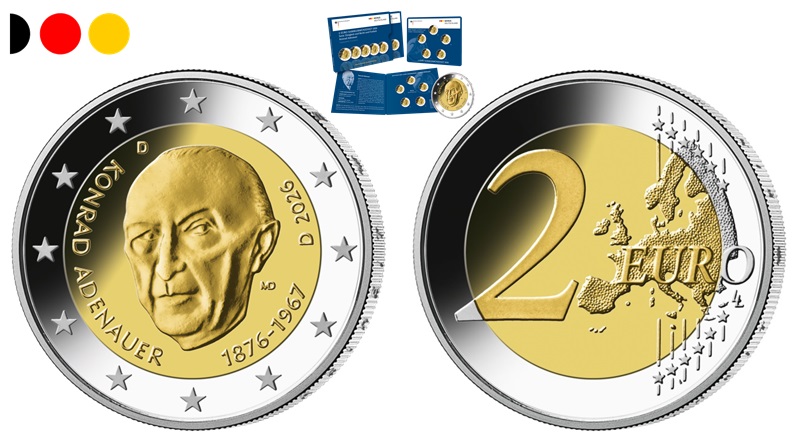
Designed by artist and sculptor Marianne Dietz, the obverse or national side depicts a three-quarter front-facing portrait of Konrad Adenauer. Surrounding the portrait is commemorative text KONRAD ADENAUER along with his years of birth and death, 1876-1967 and year of issue, 2026 along with the letter D denoting the country of issue. Above and to the left is the mintmark letter indicating the mint is as follows - Berlin (A), Munich (D), Stuttgart (F), Karlsruhe (G), Hamburg (J ). The primary design is surrounded by twelve five-pointed stars signifying the original members of the European Union. The reverse side is that of the standard Euro-zone design for all circulating 2 Euro coins, the numeral 2 superimposed over a map depicting Europe created by artist Luc Luycx. As with all standard €2 German coins, the edge of the commemorative issue bears the inscription: EINIGKEIT UND RECHT UND FREIHEIT (Unity and Justice and Freedom)
| Denomination | Metal | Weight | Diameter | Quality | Mintage Limit |
| 2 Euro | Bi-metallic | 8.5 g. | 25.7 mm. | UNC | 29,845,000 |
| 2 Euro | Bi-metallic | 8.5 g. | 25.7 mm. | BU | 13,000 sets |
| 2 Euro | Bi-metallic | 8.5 g. | 25.7 mm. | Proof | 18,000 sets |
Available from the 8th January, each Brilliant Uncirculated and Proof quality set includes five coins, one from each state mint and is presented in a folder-type format, the proof version also includes a protective slipcase. For additional information, please visit the e-webshop of Munze Deutschland – official distributors.

Download the Greysheet app for access to pricing, news, events and your subscriptions.
Subscribe Now.
Subscribe to RQ Red Book Quarterly for the industry's most respected pricing and to read more articles just like this.
Visit these great CDN Sponsors
CDN Sponsors




Author: Michael Alexander
 Michael’s background in both numismatics and banknotes spans more than three decades and whose activities have varied from being a dedicated world coin collector to coin & medal design, marketing, theme concept and production. His additional interests include banknote research and in 1997, he founded the London Banknote and Monetary Research Centre to further these interests and activities. The company continues to offer monthly currency bulletins to both online and printed publications which includes information about the latest banknote news and releases from Central Banks and Monetary Authorities around the world. Michael has been a contributor to COIN NEWS magazine based in the UK since 1998 where many of his in-depth interviews, articles and bulletins have been published.
Please sign in or register to leave a comment.
Your identity will be restricted to first name/last initial, or a user ID you create.
Comment
Comments