

France. New Gold and Silver Proof Coins Mark Exceptional Supersonic Aviation Anniversary
The Monnaie de Paris release new gold and silver coins featuring the wonder and ingenuity of Concorde.
This year, the world of aviation celebrates and remembers the 50th anniversary of the Concorde’s first commercial flight. A true technological gem and an engineering marvel, Concorde was a revolutionary Anglo-French supersonic airliner. Capable of flying passengers at over twice the speed of sound - Mach 2 or, around 1,354 mph and flying at an altitude of 60,000 feet, passengers on board could actually see views of the Earth's curvature. The revolutionary and advanced design featured an iconic delta wing, narrow fuselage, turbojet-powered engines and a droop nose to improve visibility during take-off and landing. With total of 20 Concorde’s built, 10 each in Britain and 10 in France, the Concorde was a symbol of modernity and continuously the holder of speed records for commercial flight.
The famous supersonic aircraft took their first flight commercially on the 21st January 21 1976 with two simultaneous flights departing from the partner countries that developed it - France and Great Britain. One of the aircraft that took off from Paris flew to Rio de Janeiro via Dakar, Senegal while the other Concorde airplane departed from London and flew to Bahrain. Scheduled Concorde flights entered service in 1976 with British Airways and Air France, flying popular transatlantic routes. Concorde drastically cut Paris to New York City flight times to around 3 and a half hours, routinely seating 100 passengers, but could accommodate up to 128 in a narrow cabin which offered luxury at supersonic speeds. Concorde's crew members usually included six cabin attendants and an aircrew of three comprising two pilots and one flight engineer. Initially, with Concorde’s launch, the cost of a one-way ticket was priced around $1000 but rose significantly over time. Towards the last decade of their service, a typical one-way ticket from New York to London could cost between $10,000 and $12,000.
Concorde faced environmental issues such as ‘sonic booms’ during landing which limited overland flights and restricted routes. The service also faced additional economic challenges such as high fuel consumption which required one ton of jet fuel per seat for a transatlantic flight and expensive maintenance made it a costly venture. Despite the cost of a ticket, and some periods of profitability, the Concorde service was not a long-term commercial success and talks of retiring the fleet were mentioned at governmental levels near the late 1990’s. Unexpectedly, a fatal crash occurred on the 25th July 2000 when Air France Flight 4590 crashed shortly after take-off with all 109 passengers and crew as well as four bystanders on the ground killed. This was the only fatal incident involving Concorde but commercial service was suspended until November 2001. Air France flew its last commercial flight on the 30th May 2003 and British Airways retired their Concorde fleet on the 24th October the same year, ending supersonic passenger flight, 27 years after commercial operations had begun. Today, eighteen of the 20 aircraft built are preserved and are on display in Europe and North America.
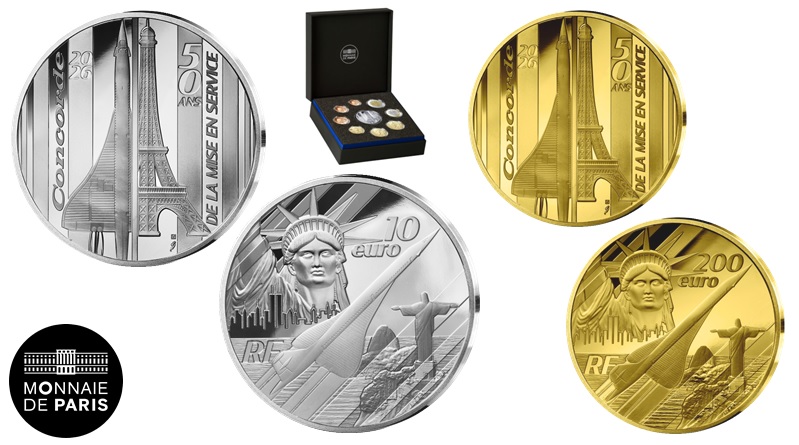
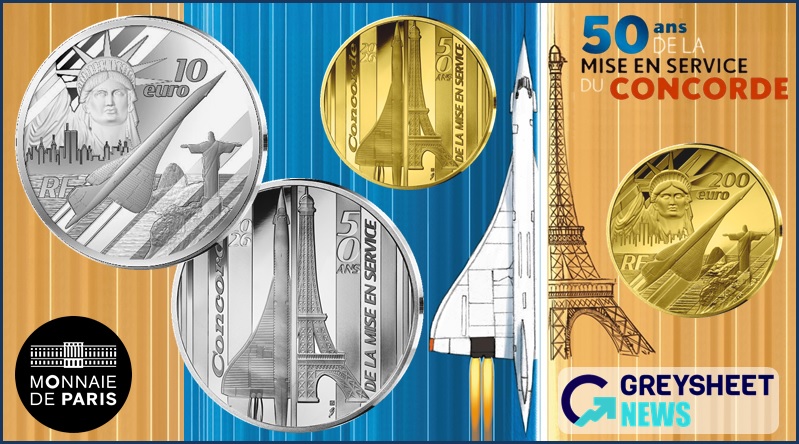
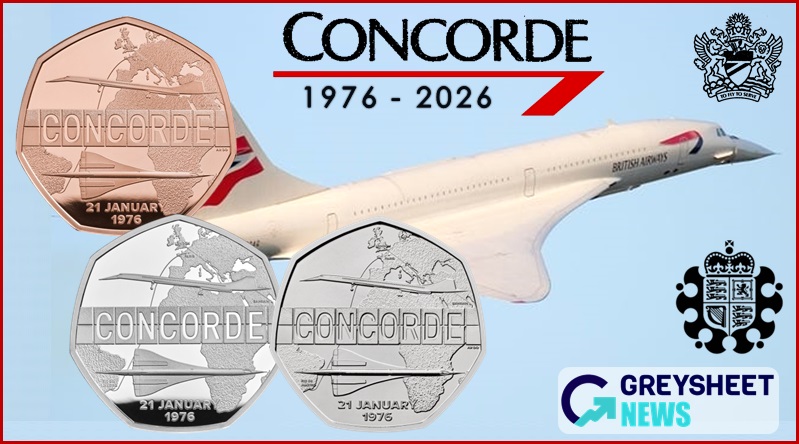
The collection is created in collaboration with comic book artist Romain Hugault, who immortalises the Concorde amid its most iconic destinations - New York and Rio. On the obverse, a composition features a representation of the Concorde seen from above and centred. In place of its right delta wing is a representation of the Eiffel Tower. Its shape, resembling that of the supersonic aircraft, blends perfectly with the shape of Concorde. The fusion of these elements recalls both the nationality of France’s fleet of Concorde and its first take-off location. On either side of the central subject are vertical lines evoking the aircraft's blazing speed. The text CONCORDE and DE LA MISE EN SERVICE DU CONCORDE is shown in a vertical direction. To the upper left of the Concorde depiction is the year 2026 and shown on the right, the anniversary text 50 ANS. The reverse side of the collector range of coins highlights the most prestigious destinations served by Air France's Concorde, that of New York and Rio. The design features the Concorde flying at full speed over Rio Bay, recognisable by the Corcovado seen from behind and Sugarloaf Mountain. Above the aircraft, New York is represented by the face of the Statue of Liberty dominating the iconic Manhattan skyline of the late 20th century, in which the twin towers of the World Trade Centre can be seen. The face value 200 or 50 EURO (gold) 10 EURO (silver) shown in stylised lettering is shown to the upper right of Liberty’s image and the letters RF are positioned to the lowerleft,completing the design.
The reverse side on the face value coin range include the current standard motif of the geometrical design of shapes arranged in different positions creating a series of borders which encircle the text REPUBLIQUE FRANCAISE and a laurel wreath of sprigs of olive and oak branches. The denomination of EURO 1000 (gold) 10 or 20 (silver) is arranged in the centre.
| Denomination | Metal | Weight | Diameter | Quality | Mintage Limit |
| 10 Euro | .333 Silver | 13 gr. | 31 mm. | UNC | 15,000 |
| 20 Euro | .999 Silver | 22.2 g. | 37 mm. | Proof | 4000 |
| 50 Euro | .999 Gold | 7.78 g. | 22.2 mm. | Proof | 500 |
| 200 Euro | .999 Gold | 31.1 g. | 37 mm. | Proof | 200 |
| 1000 Euro | .999 Gold | 6.5 g. | 23 mm. | UNC | 2026 |
Available from the 20th January, each coin in the collector range is encapsulated and presented in a custom case accompanied with a certificate of authenticity. The range of face value coins are presented in a colourful folder (€10) or, encapsulated and presented in a custom case (€1000). For additional information, please visit the e-webshop of the Monnaie de Paris.

Download the Greysheet app for access to pricing, news, events and your subscriptions.
Subscribe Now.
Subscribe to RQ Red Book Quarterly for the industry's most respected pricing and to read more articles just like this.
Visit these great CDN Sponsors
CDN Sponsors






Author: Michael Alexander
 Michael’s background in both numismatics and banknotes spans more than three decades and whose activities have varied from being a dedicated world coin collector to coin & medal design, marketing, theme concept and production. His additional interests include banknote research and in 1997, he founded the London Banknote and Monetary Research Centre to further these interests and activities. The company continues to offer monthly currency bulletins to both online and printed publications which includes information about the latest banknote news and releases from Central Banks and Monetary Authorities around the world. Michael has been a contributor to COIN NEWS magazine based in the UK since 1998 where many of his in-depth interviews, articles and bulletins have been published.

Please sign in or register to leave a comment.
Your identity will be restricted to first name/last initial, or a user ID you create.
Comment
Comments