

France. New €2 BU and Reverse Proof Coins Celebrate 80 Years of The Little Prince Literary Character
The Monnaie de Paris release their first €2 commemorative coins remembering a beloved publication.
First published in the United States in 1943 and then in France three years later, The Little Prince is author Antoine de Saint-Exupéry's (1900 – 1944) best-known work. The stories of the Little Prince were created in 1942 by the French poet and aviator who made his first flight in 1912 and which began his passion for aviation. He studied architecture until he joined the French Air Force service in 1921 while living in Strasbourg. A 1923 plane accident in Le Bourget demobilised him, and it was at this time that his writing career began. In 1931, he published his second book, Vol de nuit published in 1931 and from 1932 on, he focused on writing and journalism, occasionally reporting on major events, while also remaining a test and air-raid pilot. After the invasion of the Third Reich in 1940, an armistice was signed on the 22nd June 1940 and during this time, he left France bound for New York with the aim of enlisting or convincing the Americans to enter the fighting. It was at this time that de Saint Exupéry wrote Le Petit Prince while living in New York City.
The simple tale tells the story of a child, the little prince, a youngster from another galaxy who travels the universe gaining wisdom. The Little Prince draws sometimes unflattering portraits of grown-ups as being hopelessly narrow-minded. In contrast, children come to wisdom through open-mindedness and a willingness to explore the world around them and within themselves. The story is written in the style of a narrator who introduces himself as a man who learned when he was a child that adults lack imagination and understanding. Now a pilot, he has crash-landed in a desert and there he encounters a small boy who he refers to as the little prince. The author learns that the boy comes from a very small planet, which the narrator believes to be asteroid B-612. Over the course of the next few days, the little prince tells the narrator about his life. On his asteroid-planet, which is no bigger than a house and, after several adventures and dilemmas, the story resumes six years later.
The narrator surmises that the Little Prince returned to his planet, and ends his story by imploring the reader to contact him if they ever spot the little prince. In April 1943, Saint Exupéry returned to duty in aviation and was stationed in Tunisia. In the spring of 1944, he joined a unit in charge of photographic reconnaissance in preparation for the Allied landings in the south of France. Sadly, Saint Exupéry did not see the liberation of his country, having died after crashing his plane at sea on the July 31st 1944, but his plane was not found until 2000.
His story was first published in English and French in the US by Reynal & Hitchcock in April 1943, and posthumously in France following the country’s liberation as Saint-Exupéry's works had been banned by the Vichy Regime. Published in 1945 and released the following year, the works have since been translated into more than 300 languages and dialects, selling an estimated 140 million copies worldwide, which has made this story one of the best-selling and most translated books ever published. All of the novella's simple but elegant watercolour illustrations, which were integral to the story, were also painted by Saint-Exupéry.
In tribute to the works of Antoine de Saint-Exupéry, the Little Prince and its author were highlighted on France’s last legacy franc-denominated bank note series. The 50-franc note issued in 1997 featured a portrait of Saint-Exupéry on the obverse, along with a rendition of the Little Prince. The story has been made into a feature length anime-film that was released in 2015 and has served as the inspiration for a “Petit Prince” theme park of 23 hectares located in Alsace.
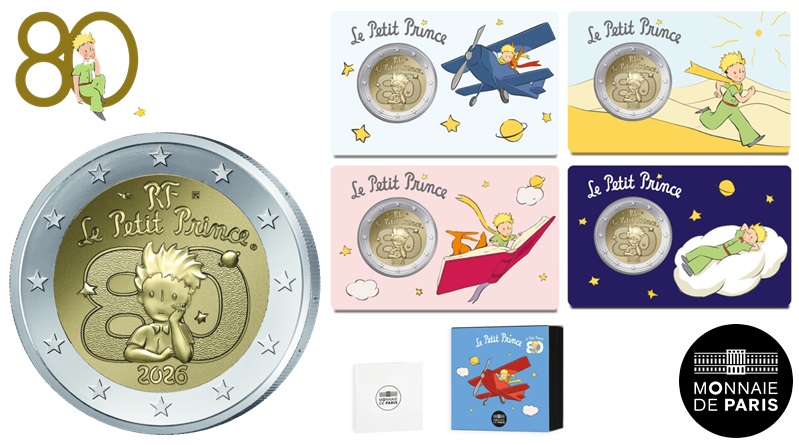
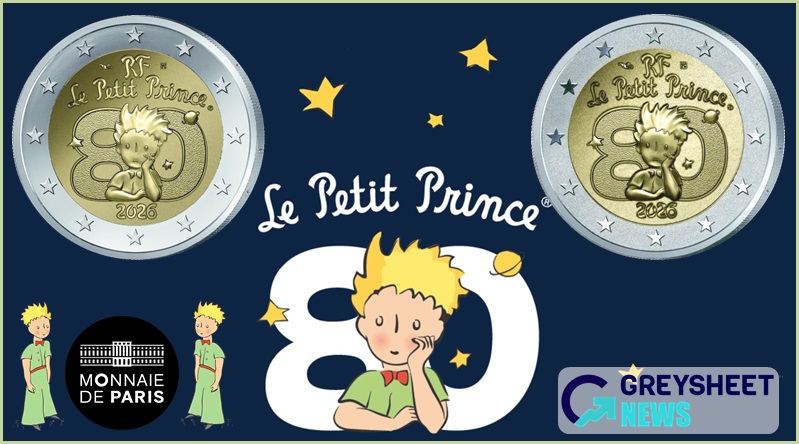
The obverse or, national side of the commemorative coin includes a depiction of the official logo of the 80th anniversary of the release of The Little Prince in France. The design includes an image of the Little Prince deep in thought. Behind him is the large numeral 80 referring to the anniversary. Above him is the inscription Le Petit Prince (The Little Prince) shown in the stylised form familiar in the artwork of the publication. The initials RF representing République Française (French Republic) and two hallmarks are seen above the commemorative text. Below the Little Prince is the year 2026 indicating the year of release. The reverse side is that of the standard Euro-zone design for all circulating 2 Euro coins created by artist Luc Luycx. The numeral ‘2’ is superimposed over a map depicting Europe.
| Denomination | Metal | Weight | Diameter | Quality | Mintage Limit |
| 2 Euro X 4 | Bi-metallic | 8.5 g. | 25.7 mm. | BU | 75,000 each |
| 2 Euro | Bi-metallic | 8.5 g. | 25.7 mm. | Proof | 15,000 |
| 2 Euro | Bi-metallic | 8.5 g. | 25.7 mm. | Reverse Proof | 5000 |
Available from the 29th January, the BU €2 coins are presented in a sealed coin-card format in four varieties of design. All four cards tell the story of a dreamy Little Prince, traveller and adventurer. He is shown 1) Running through the desert, 2) Travelling aboard an aeroplane, 3) Flying as a passenger on an open book and 4) Gazing at the starry night sky while sitting on a cloud. The proof coins are encapsulated and presented in a custom Mint-branded case accompanied with a certificate of authenticity. For additional information, please visit the e-webshop of the Monnaie de Paris.

Download the Greysheet app for access to pricing, news, events and your subscriptions.
Subscribe Now.
Subscribe to RQ Red Book Quarterly for the industry's most respected pricing and to read more articles just like this.
Visit these great CDN Sponsors
CDN Sponsors






Author: Michael Alexander
 Michael’s background in both numismatics and banknotes spans more than three decades and whose activities have varied from being a dedicated world coin collector to coin & medal design, marketing, theme concept and production. His additional interests include banknote research and in 1997, he founded the London Banknote and Monetary Research Centre to further these interests and activities. The company continues to offer monthly currency bulletins to both online and printed publications which includes information about the latest banknote news and releases from Central Banks and Monetary Authorities around the world. Michael has been a contributor to COIN NEWS magazine based in the UK since 1998 where many of his in-depth interviews, articles and bulletins have been published.
Please sign in or register to leave a comment.
Your identity will be restricted to first name/last initial, or a user ID you create.
Comment
Comments