

Cook Islands. Mega-size Silver and Gold Proof Coins Mark 60 years of Self-Government Status
The Government and Treasury of the Cook Islands release new coins celebrating a national event.
The Cook Islands were first settled around 1000 AD by Polynesian peoples who are thought to have migrated from Tahiti, located 1154 kilometres or, 717 miles northeast of the main island of Rarotonga. The first name given by Europeans to the group of present-day Cook Islands was Gente Hermosa, or, ‘beautiful people’ by Spanish explorers to Rakahanga in 1606. Each of the Cook Islands 15 islands have individual names in indigenous languages, and the islands' official name in the Cook Islands Māori language is Kūki 'Āirani, a transliteration of the English name.
The islands as a whole are named after the English captain and explorer James Cook who visited during the 1770’s. However he referred to the group as Hervey Island which he named after Augustus Hervey, 3rd Earl of Bristol which the southern island group became known as. It was the Baltic Explorer Admiral Adam Johann von Krusenstern who first referred to the southern islands as the Cook Islands in his Atlas de l'Ocean Pacifique published in the 1820’s. Ceded to Great Britain in 1888 to avoid being conquered by French troops as they had done with Tahiti, the islanders' leaders presented a petition asking that the islands should be annexed as British territory. In October 1900, a British Proclamation was issued, stating that the secessions were accepted and the islands declared parts of Her Britannic Majesty's dominions.
The entire territory - including the northern island group was not known as the Cook Islands until after its annexation by New Zealand in the early part of the 20th century. Having become a self-governing dominion within the British Commonwealth since 1907, New Zealand’s passage of the Cook Islands Act 1915, specifically defined the Cook Islands' area and included all presently included islands. The territory is comprised of 15 islands totalling approximately 236.7 square kilometers or, 91.3 square miles in land mass.
In 1965, the New Zealand Government offered four options to the Cook Islands in a referendum. The islanders were given the choice of full independence, self-government, full union with New Zealand or integration into a new Polynesian confederation. The inhabitants of the Cook Islands opted for self-government within an alliance with New Zealand. This status has been in place from the 4th August 1965, when a constitution was promulgated. Since this time, the first Monday in August is celebrated each year as Constitution Day. Cook Islanders also have the option of New Zealand citizenship, plus the status of being a Cook Islands national.
Today, almost 11,000 Cook Islanders call the capital city of Rarotonga their home which equates to nearly 72 percent of the total population of the Cook Islands who lives there. Rarotongans are proud of their intact mountain rainforest as well as their endless white sandy beaches and clear turquoise waters. It is for this reason that tourists from all over the world come to visit the Cook Islands and why it has become a favourite destination for ‘off the beaten path’ travel.
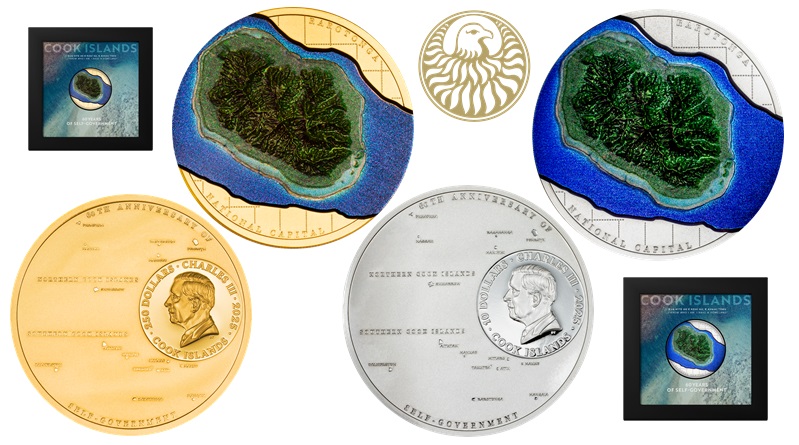
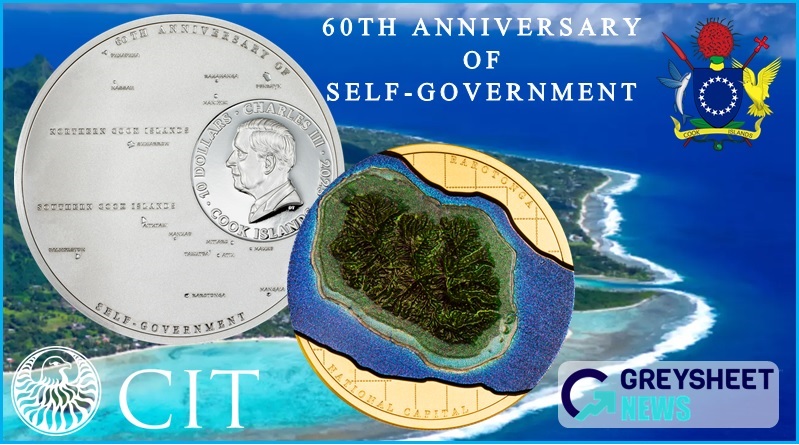
The coins are commissioned by Coin Invest Trust – CIT of Vaduz, Liechtenstein and produced by the B. H. Mayer’s Kunstprägeanstalt at their facilities in Munich on behalf of the Treasury of the Cook Islands. Utilising smartminting® Ultra High Relief technology and the addition of vivid colour, the reverse side which is shared on all three options features Rarotonga, the main island of the 15 Cook Islands. Shown as a naturalistic panoramic map, it is surrounded by the turquoise waters of the lagoon in the vastness of the blue Pacific and embedded in the surface with a stylised grid pattern. Along the right rim is the text RAROTONGA and placed along the lower left rim is the additional text NATIONAL CAPITAL. The obverse side depicts a map of the northern and southern Cook Islands. Above the primary design along the upper rim is the text 60TH ANNIVERSARY OF and along the lower rim below the design is the additional text SELF-GOVERNMENT. On the right half in a separated round field replicating the obverse side of Cook Islands coinage, is an effigy of HM King Charles III created by engraver Dan Thorne and is surrounded with the denomination and legend CHARLES III 2025 and COOK ISLANDS placed below the King’s likeness.
| Denomination | Metal | Weight | Diameter | Quality | Mintage limit |
| 10 Dollars | .9999 Silver | 62.2 g. | 45 mm. | Proof & Colour | 600 |
| 100 Dollars | .9999 Silver | 1000 g. | 100 mm. | Proof & Colour | 60 |
| 250 Dollars | .9999 Gold | 31.1 g. | 33 mm. | Proof & Colour | 60 |
Available from the 7th October, each large-size silver and gold proof coin is presented in a custom window-effect box for ease of viewing or display and is accompanied with a numbered certificate of authenticity. For additional information, please visit the e-webshop of CIT, Liechtenstein – official distributors.

Download the Greysheet app for access to pricing, news, events and your subscriptions.
Subscribe Now.
Subscribe to RQ Red Book Quarterly for the industry's most respected pricing and to read more articles just like this.
Visit these great CDN Sponsors
CDN Sponsors





Author: Michael Alexander
 Michael’s background in both numismatics and banknotes spans more than three decades and whose activities have varied from being a dedicated world coin collector to coin & medal design, marketing, theme concept and production. His additional interests include banknote research and in 1997, he founded the London Banknote and Monetary Research Centre to further these interests and activities. The company continues to offer monthly currency bulletins to both online and printed publications which includes information about the latest banknote news and releases from Central Banks and Monetary Authorities around the world. Michael has been a contributor to COIN NEWS magazine based in the UK since 1998 where many of his in-depth interviews, articles and bulletins have been published.
Please sign in or register to leave a comment.
Your identity will be restricted to first name/last initial, or a user ID you create.
Comment
Comments