

Australia. New Gold and Silver Proof Coins Mark Decimal Changeover Anniversary
The Royal Australian Mint release new coins in celebration of the changeover to Dollars and Cents.
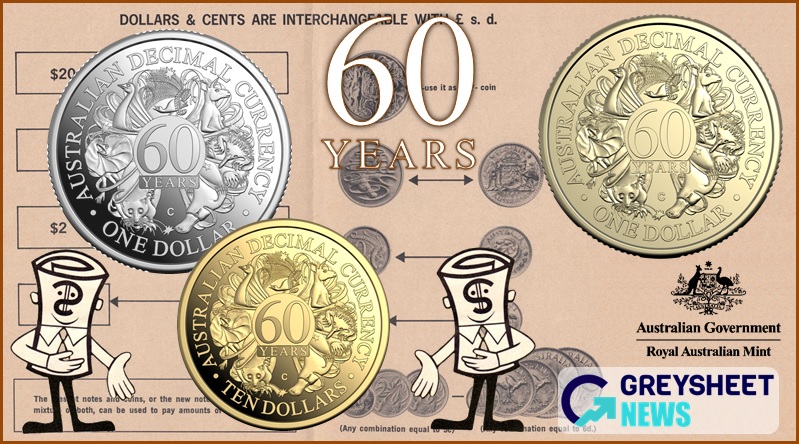
As Australia celebrates 60 years of decimal currency, it continues the story that began in 1966 of innovation, artistry and a shared national moment that still brings Australians together through their shared coinage. Prior to Australia’s changeover in 1966, the currency utilised a monetary system based on British pounds shillings and pence, a legacy in place before sovereign Commonwealth status in 1901. One pound was equal to 20 shillings, one shilling was equal to 12 pence, and as such one pound was equal to 240 pence. For many Australians, the changeover to decimal currency in 1966 was more than a new way to count, it was a symbol of progress and optimism, as well as striking a piece of national identity.
Leading up to the changeover from pounds, shillings and pence to dollars and cents, there was significant high level political discussion regarding the appropriate name for the new currency. Prime Minister Menzies, a staunch monarchist proposed that the basic unit should be called the Royal, but this suggestion was met with considerable protest. A competition inquiry launched by the Treasury sought the public’s input about the new currency with an ‘Australian flavour’ which attracted about 1000 suggestions. The public submitted suggestions such as the Austral, Oz, Boomer, Roo, Kanga, Emu, Koala, Digger, Zac, Kwid and even Dinkum, a slang word meaning something to be genuine or the truth. Ultimately, the government of the day decided on the use of the Dollar divided into 100 cents as Australia’s new currency which was still somewhat controversial at the time, as it seemed to tie Australia’s economic and perhaps political to the fortunes of the United States of America. In preparation for enough coinage to satisfy the changeover, four Mints were recruited to full production beginning in 1964. Four facilities took part in the new coins production which included the Royal Mint in London and its two branches in Melbourne and Sydney. As part of greater independence from the home country, a new purpose-built and state of the art Mint was opened and inaugurated in time for C-Day. The new Royal Australian Mint in Canberra was officially opened by the Duke of Edinburgh on behalf of the Queen and in time for the big day, more than one billion coins of all six denominations were stockpiled in good time.
When it came to the new currency’s designs, it was decided that the coins should depict Australian wildlife while the notes should reflect historical personalities and contributions to the wider world. The successful reverse coin designs chosen were the work of Stuart Devlin, described as the artisan with the Midas touch. He was an artist who transformed everyday coins into something extraordinary, earning him the title of Goldsmith and Jeweller to the Queen. The new decimal currency also coincided with the Treasury’s decision to remove silver content from all of the circulation coins with the exception of the new 50 cent coin. Minted from 13 grams of 80 percent silver, the one-year-only coin was soon withdrawn from circulation as its metal content was worth more than its face value. It was replaced with a twelve-sided cupro-nickel version in 1969 which are still in use. The obverse side of all the coins depicted the Arnold Machin effigy of Queen Elizabeth II which was part of the changeover, replacing the Gillick likeness of the Queen introduced in 1953.
In preparation for the changeover in the preceding three months, armed police had escorted dozens of security vans across the country to adequately stock the nation’s banks with the new currency. C-Day, the 14th February was met with a minimum of inconvenience as banks and Post Offices had closed four days earlier to convert their machinery and processes. When banks opened on Valentine’s Day, they were able to immediately begin issuing new dollars and cents an enthusiastic public awaiting their use or simply to just see their new money up close. Newspapers reported that even the Decimal Currency Board was surprised by how smoothly things went. Australia’s decimalisation process was monitored by other countries such as New Zealand and Britain, who went on to switch to decimal currency in 1967 and 1971 respectively. Over time, the currency evolved and changes were introduced such as $1 banknotes being replaced in May 1984 by a $1 coin and the $2 banknotes replaced by a smaller coin in June 1988. Ten Dollar commemorative banknotes were issued on the occasion of the bicentenary anniversary of the arrival of the First Fleet of British convict ships at Sydney in 1788, the world’s first polymer banknotes.
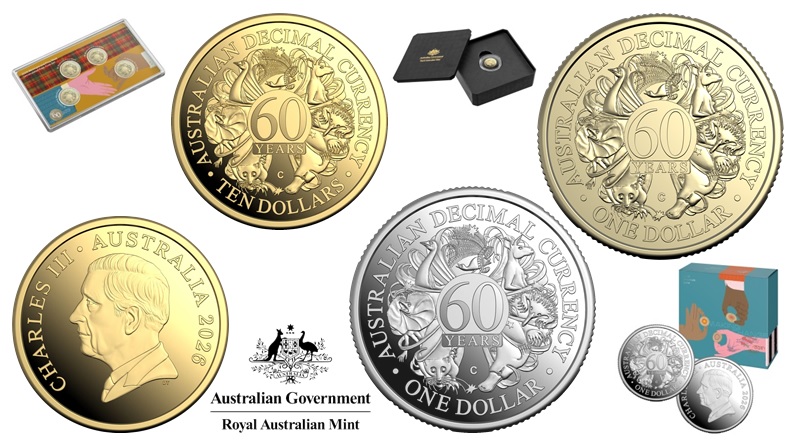
The commemorative design brings together the beloved animals from Stuart Devlin’s original 1966 coin designs – and still found on some current coinage. Designed by lead coin artisan Adam Ball, his collage of the original wildlife depicted on the six denominations first issued in 1966 is the basis for the compilation.
Included is the sugar glider possum depicted on the one cent coin, frilled-neck lizard seen on the two cent coin, the echidna seen on the five cent coin, the lyrebird seen on the ten cent coin, a platypus included on the twenty cent coin and the emu along with the kangaroo and Southern Cross crest found on the fifty cent coin. Centred is the numeral 60 and text YEARS. The primary design is surrounded with the text AUSTRALIAN DECIMAL CURRENCY placed along the rim and the denomination TEN DOLLARS (gold) or ONE DOLLAR (base metal and silver) is shown below. All of these depictions are united in one focal design as part of a nostalgic tribute to the changeover that defined the Australian nation. The obverse side features the effigy of HM King Charles III designed by Daniel Thorne along with the year of issue, 2026 as part of the legend surrounding the royal portrait.
| Denomination | Metal | Weight | Diameter | Quality | Maximum Mintage |
| 1 Dollar | Alum-Br | 9 g. | 25 mm. | BU | Unlimited |
| 1 Dollar | 99.9 Silver | 11.6 g. | 25 mm. | Proof | 5000 |
| 1000 Tenge | 99.99 Gold | 3.1 g. | 17.5 mm. | Proof | 2026 |
The BU coin set comprises four one dollar coins bearing the C (Canberra) mintmark and B, S & M privymarks. The set is presented in an acrylic pack, housed in an illustrated outer sleeve. The gold and silver proof coins are encapsulated and presented in a two-piece custom case accompanied with a certificate of authenticity. For more information on this range of coins, please visit the e-webshop of the Royal Australian Mint.

Download the Greysheet app for access to pricing, news, events and your subscriptions.
Subscribe Now.
Subscribe to RQ Red Book Quarterly for the industry's most respected pricing and to read more articles just like this.
Visit these great CDN Sponsors
CDN Sponsors






Author: Michael Alexander
 Michael’s background in both numismatics and banknotes spans more than three decades and whose activities have varied from being a dedicated world coin collector to coin & medal design, marketing, theme concept and production. His additional interests include banknote research and in 1997, he founded the London Banknote and Monetary Research Centre to further these interests and activities. The company continues to offer monthly currency bulletins to both online and printed publications which includes information about the latest banknote news and releases from Central Banks and Monetary Authorities around the world. Michael has been a contributor to COIN NEWS magazine based in the UK since 1998 where many of his in-depth interviews, articles and bulletins have been published.

Please sign in or register to leave a comment.
Your identity will be restricted to first name/last initial, or a user ID you create.
Comment
Comments