

A Much Maligned, but Innovative Design
Bela Lyon Pratt’s only foray into the world of designing coinage was innovative, well-received, and largely successful.
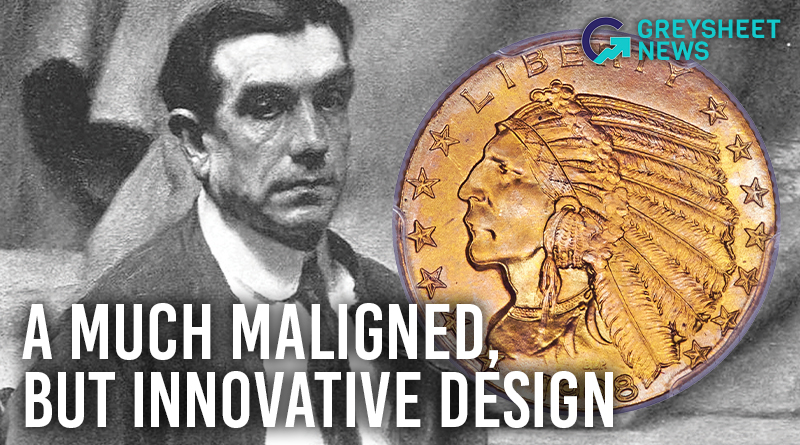
Bela Lyon Pratt was born in 1867 in Norwich, Connecticut. His mother, Sarah Whittlesey Pratt, was a doting mother, and her son sought her approval on many of his artistic endeavors throughout his life. The American Numismatic Society holds a great deal of correspondence between mother and son in the papers of Bela Lyon Pratt. His father, George Pratt, was a Yale-educated lawyer and prominent in his community.
At the age of 16, Pratt attended the Yale University School of Fine Arts, where he excelled. Upon graduation from Yale, he attended the Art Students League of New York, where a number of his instructors were important in teaching him how to create what his mind could imagine. None of his instructors was as important to him as Augustus Saint-Gaudens, who recognized his talent and became Pratt’s mentor. Pratt worked directly for Saint-Gaudens in his private studio, where the instructions continued.
As a young man, he also sought to travel and experience the world, so Pratt traveled to Paris, where he trained with a number of renowned French sculptors at the Ecole des Bueax-Arts (School of Fine Arts).
By 1892 Pratt had returned to the United States, at Saint-Gaudens' urging, in order to create two large sculptural groups for the World’s Columbian Exposition in Chicago. He later produced sculptures and fountains for the 1901 Pan-American Exposition, in Buffalo, NY. It was at that Exposition where a calamity led to important opportunities for Pratt’s career.
It was at the Temple of Music at the Pan-American Expo, where President William McKinley was assassinated. That single event led to Vice President Teddy Roosevelt assuming the presidency and to one of his great goals—the renaissance of American coinage.
Roosevelt greatly admired the simplistic but elegant styles of early Greek and Roman coins. Roosevelt longed for America’s coinage to truly exemplify the young nation that was rising in status in the world and becoming a world power. In an important and often-quoted letter to the Secretary of the Treasury, Roosevelt called America’s current coinage designs to be of “hideous atrociousness.”
Roosevelt asked his personal friend, Augustus Saint-Gaudens, if he would create some designs for the current coinage that would reflect favorably on America’s ability to create coins that were dramatic, artistic, and beautiful.
As Saint-Gaudens was in poor health, he immediately began to create designs for the Double Eagle ($20), and soon after, the Eagle ($10). But health-wise, Saint-Gaudens was running out of time. He looked to others to help him as the Quarter Eagle ($2.50) and Half Eagle ($5) also needed redesigning.
Due to the fact that the relief continually needed to be lowered on the Double Eagle and that the inscription “E PLURIBUS UNUM,” needed to be added to the edge of that coin, among other minor difficulties, the two smaller denomination coins were not actually considered until 1907. The Double Eagle and the Eagle were both struck and released during that year.
Originally, the two smaller denominations of coins were intended to utilize the design of the Saint-Gaudens Double Eagle, but Chief Engraver of the Mint, Charles E. Barber, who did not welcome outside coin designers, complained that the inscriptions would be too small to decipher on planchets as small as those for the Quarter Eagle and Half Eagle. The Mint worked in vain, but progress on these two coins was painfully slow.
Dr. William Sturgis Bigelow was a close friend of President Roosevelt. He was one of the most pre-eminent experts on Japanese art and culture. On returning home to Boston after a long trip to Japan, Senator Henry Cabot Lodge, another friend of Bigelow’s and of Pratt’s, told Bigelow about the magnificent Saint-Gaudens coinage but also about the problems with the smaller denominations.
Bigelow wrote to Roosevelt, in January of 1908, and stated that he was “working with a Boston sculptor on an idea that would permit coins to be struck in high relief but also be easily stackable for commerce. Roosevelt expressed his interest to Bigelow, who asked Pratt to go to work immediately on those two coins.
Pratt studied Saint-Gaudens’ Double Eagle and the Eagle coin designs and was undoubtedly influenced by them. But unlike Saint-Gaudens’ Eagle obverse, Pratt did not attempt to depict Miss Liberty wearing a headdress.
Instead, Pratt used a photograph of an unidentified male Native American as his inspiration for the obverse side of the coin. Pratt made several models of his design and sent one to Bigelow to present to Roosevelt. At a lunch meeting in April of 1908, Bigelow presented the design to Roosevelt, who was enthusiastically supportive of Pratt’s design. That was all of the incentive that was required, and Pratt went about finishing his designs on both smaller coins.
Not only was Pratt’s decision to use a photograph of a Native American man instead of an allegorical representation of Miss Liberty wearing a Native headdress imaginative, but the method of Pratt’s actual design, using an incuse design rather than a high relief design protected by an even higher rim, was innovative and borderline extraordinary. No American coins had ever been struck using an incuse design.
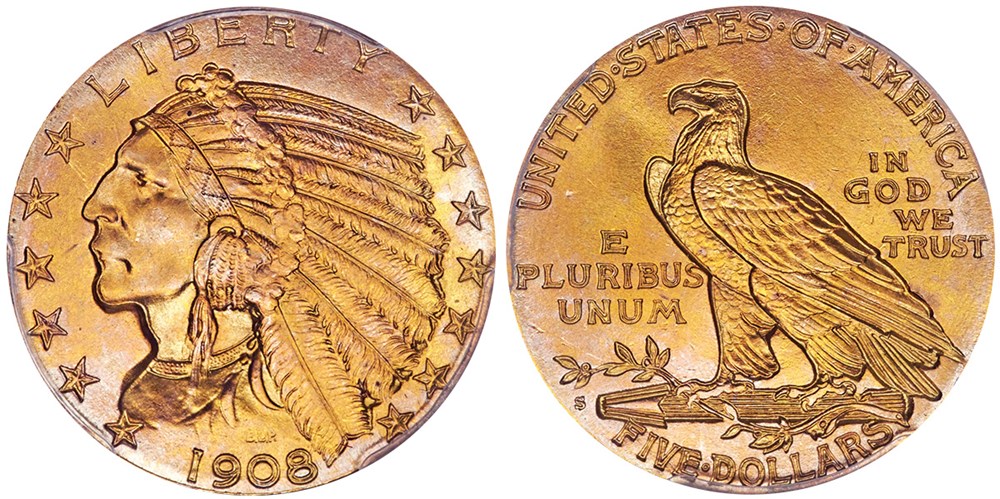
On an incuse design, the design is ‘sunk into’ the coin and is lower than the fields. Prior to these two coins, all coins had a relief design where the subject matter was higher than the connecting fields. The designs were, in theory and in practice, protected by a slightly higher edge rim.
The U.S. Mint typically did not like dramatic changes such as this, and many complaints about working with this design and the unlikelihood of it striking well were numerous from staff at the Philadelphia Mint.
By November of 1908, both of these denominations of coins were being struck and eventually released to the American public. But comments on both sides were plentiful and pointed.
In the November of 1908 issue of the American Numismatic Association’s publication, The Numismatist, Howland Wood authored an article discussing the issue, and it was titled as “THE BIGELOW-PRATT GOLD PIECES—NEW $2.50 AND $5.00.” Wood’s article explained that the image of a real Native American, rather than a classical female head representing “Liberty,” was used. Wood also explained, without negative comment, how an incuse design differs from the traditional design.
But just three months later, in the February 1909 issue of the same periodical, there was a scathing critique of these same coins by Philadelphia dealer S. H. Chapman. His article was penned in a letter to President Roosevelt, which attempted to discredit all aspects of the design. “The design portrays an Indian who is emaciated,” was a complaint as Chapman also claimed that the coins could be “easily counterfeited,” and would become “a great receptacle for dirt and a conveyor of disease,” and the coins wouldn’t stack but “would fall when carried on a bank tray.” He advised the President to halt production and immediately recall these coins. Fortunately, Roosevelt did not follow Chapman’s advice.
For the betterment of the American public at the time, and for all future coin collectors, Chapman’s comments were largely ignored, and Bela Lyon Pratt’s only foray into the world of designing coinage was innovative, well-received, and largely successful.
Images courtesy of Heritage Auctions, HA.com and Picryl, Picryl.com.

Download the Greysheet app for access to pricing, news, events and your subscriptions.
Subscribe Now.
Subscribe to RQ Red Book Quarterly for the industry's most respected pricing and to read more articles just like this.
Visit these great CDN Sponsors
CDN Sponsors




Author: Michael Garofalo
 Mike Garofalo has been a coin dealer for over 40 years and recently retired as Director of Numismatics from APMEX. He has been both a wholesale dealer and a retailer. A prolific writer, he enjoys bringing to light previously unknown numismatic facts. He can be reached at Mike@NumismaticAuthor.com
Please sign in or register to leave a comment.
Your identity will be restricted to first name/last initial, or a user ID you create.
Comment
Comments